
Scaling the Shadows: How Social Ties and Clustering Shape Wireless Secrecy
Secrecy Capacity Scaling of Large-Scale Networks With Social Relationships
This paper investigates the secrecy capacity scaling laws of large-scale wireless networks by incorporating social relationships via a rank-based model. It provides asymptotic bounds for both homogeneous (PPP-based) and inhomogeneous (multiclustering) node distributions, considering noncolluding and colluding eavesdropper scenarios.
TL;DR
Researchers have finally bridged the gap between social behavior and network security at scale. By combining a rank-based social model with self-interference cancellation, this paper derives the fundamental secrecy capacity limits of large-scale wireless networks. The verdict? Social closeness boosts throughput, but spatial "clustering" is a double-edged sword that can cripple security in low-density zones.
Background: The Social-Security Nexus
In the classic Gupta-Kumar paradigm, nodes are dots in a void. But in reality, we are communal; we talk to our "neighbors" much more than strangers across the map. Furthermore, wireless signals are inherently "leaky," making them prime targets for eavesdroppers. While physical-layer security (PLS) has been studied for small groups, understanding how it scales as nodes approach infinity—while accounting for human-like social patterns—remains a frontier.
The Problem: Why Traditional Models Fail
Prior works often assumed nodes were spread like peanut butter—uniform and predictable. This paper identifies two major flaws in that approach:
- Social Blindness: Real S-D (Source-Destination) pairs aren't random; they follow a "rank-based" preference for proximity.
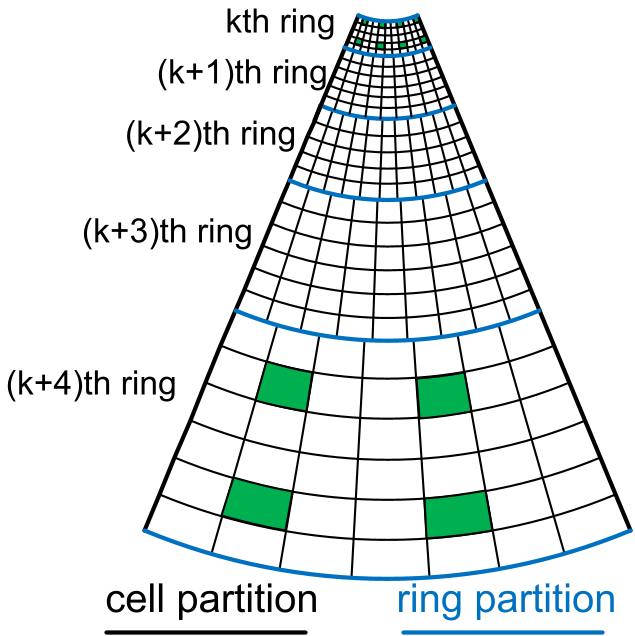
- Inhomogeneity: Networks aren't always flat. Clustering (modeled via a Cox process) creates "urban" hotspots and "rural" dead zones, drastically changing how interference and secrecy propagate.
Methodology: Jamming the Eavesdropper
The authors propose a sophisticated defense mechanism: Self-Interference Cancellation (SIC).
1. The Three-Antenna Defense
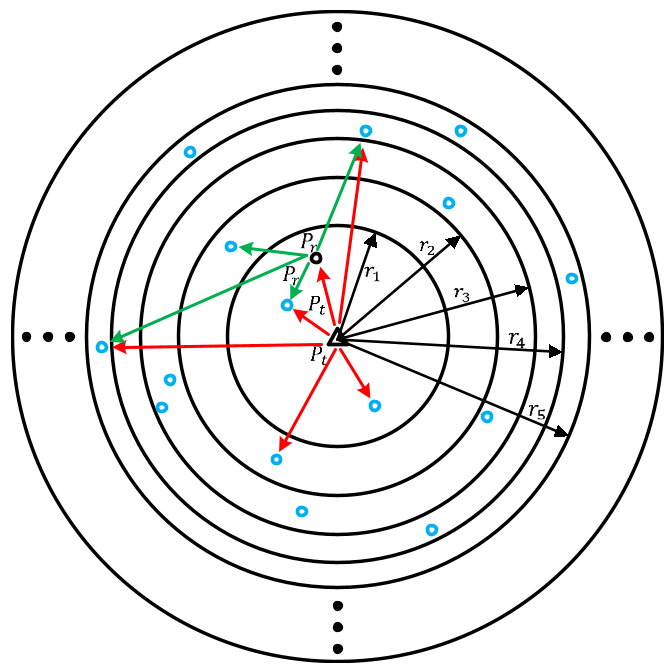
Unlike a standard node, each receiver in this model uses a three-antenna array. While one antenna listens to the sender, the other two emit a coordinated "jamming signal." This signal is carefully phased to cancel out at the receiver itself but acts as devastating noise for any nearby eavesdropper trying to intercept the packet.
2. The Rank-Based Social Model
The probability of node talking to node is governed by . As increases, the network becomes more localized. The authors analyze how this social intensity interacts with the geographic "crowding" of the network.
Critical Insights from Inhomogeneous Networks
One of the paper's most profound findings relates to multiclustered topology. When nodes are clustered (the inhomogeneous case), the network's capacity is no longer just limited by noise, but by the "traffic burden" placed on sparse regions.
- The Noncolluding Case: Eavesdroppers act alone. Here, secrecy capacity is surprisingly resilient.
- The Colluding Case: Eavesdroppers cooperate to decode messages. Capacity now becomes a tug-of-war between the density of the eavesdroppers () and the social clustering of legitimate nodes.
Experiments & Results: The Scaling Laws
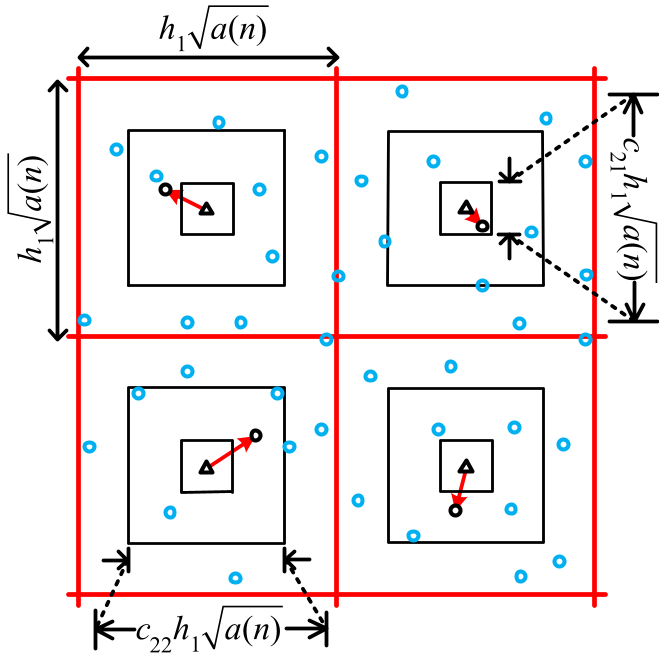
The study establishes that in homogeneous networks, the proposed multihop relay scheme is order-optimal.
- Secure Throughput: For noncolluding eavesdroppers, the per-node rate scales at .
- Impact of Social Parameter (): As social ties strengthen (higher ), the average communication distance decreases, which significantly offsets the throughput degradation typically seen in large-scale networks.
Critical Analysis & Conclusion
Takeaway
The research proves that social relationships are a powerful "natural" optimizer for network capacity. By preferring local destinations, nodes reduce the interference floor of the entire network. However, the study also warns that spatial clustering is the primary enemy of secrecy scaling, as it creates vulnerable "necks" in the network that eavesdroppers can exploit.
Limitations
The model assumes eavesdroppers are "static and silent" (passive). In a dynamic environment with active malicious jammers or nodes with superior mobility, the scaling laws might shift from being limited by infrastructure to being limited by temporal dynamics—a promising area for future research.
Future Outlook
As we move toward 6G and massive IoT, these scaling laws provide a mathematical roadmap. Incorporating social-aware routing with physical-layer jamming isn't just an academic exercise—it's likely the only way to keep our hyper-connected future secure.