
Secret Interest Groups: Empowering Private Sub-Communities on Public Social Networks
Secret interest groups (SIGs) in social networks with an implementation on Facebook
The paper introduces a framework for Secret Interest Groups (SIGs) in Online Social Networks (OSNs), enabling private group formation around sensitive topics. It utilizes a novel combination of Threshold DSS Signatures, Secret Handshakes, and Oblivious Signature-Based Envelopes (OSBE) to allow decentralized authentication and secure content sharing without relying on the OSN provider.
TL;DR
The paper "Secret Interest Groups (SIGs) in Social Networks" presents a pioneering framework for creating hidden, self-managed communities within platforms like Facebook. By leveraging Threshold Cryptography and Secret Handshakes, it allows users to authenticate each other and share encrypted content without the social network provider ever knowing the group exists or who belongs to it.
Background Positioning: This work sits at the intersection of Cryptography and Social Computing, representing one of the first practical applications of Secret Handshakes to solve real-world privacy concerns in the early era of dominant Social Media.
Problem & Motivation: The "Clueless Friend Request"
Have you ever received a friend request from someone claiming to be an old classmate, but you had no way to verify them? In 2010, as Online Social Networks (OSNs) exploded, two major issues emerged:
- Identity Theft: Anyone could clone a profile and trick others.
- Lack of Privacy for Sensitive Topics: Users interested in religious, political, or sexual interests faced a "Catch-22"—they wanted to meet like-minded people but were terrified of public exposure.
Existing solutions required a "Trusted Third Party," which was either expensive or non-existent. The authors' Insight was to move the "Trust" away from the platform and into the hands of the users through decentralized, ad-hoc group management.
Methodology: The Cryptographic Backbone
The SIG framework is split into two domains: OSN External (management) and OSN Internal (interaction).
1. Decentralized Management (Offline)
To avoid a "Single Point of Failure," the framework uses Shamir’s Secret Sharing. A group is managed by multiple "Managers." To admit a new member or appoint a new manager, a threshold of managers must cooperate. No single manager can forge a membership token alone.
2. The Secret Handshake (Online)
How do two strangers on Facebook "prove" they are in the same secret club without a third party seeing the proof? The authors use Oblivious Signature-Based Envelopes (OSBE).
- The Logic: If Alice has a signature from the SIG managers, she can "wrap" a secret key in an envelope. Bob can only open that envelope if he also possesses a valid signature from the same SIG.
- Atomicity: Either both learn they are members, or neither learns anything.
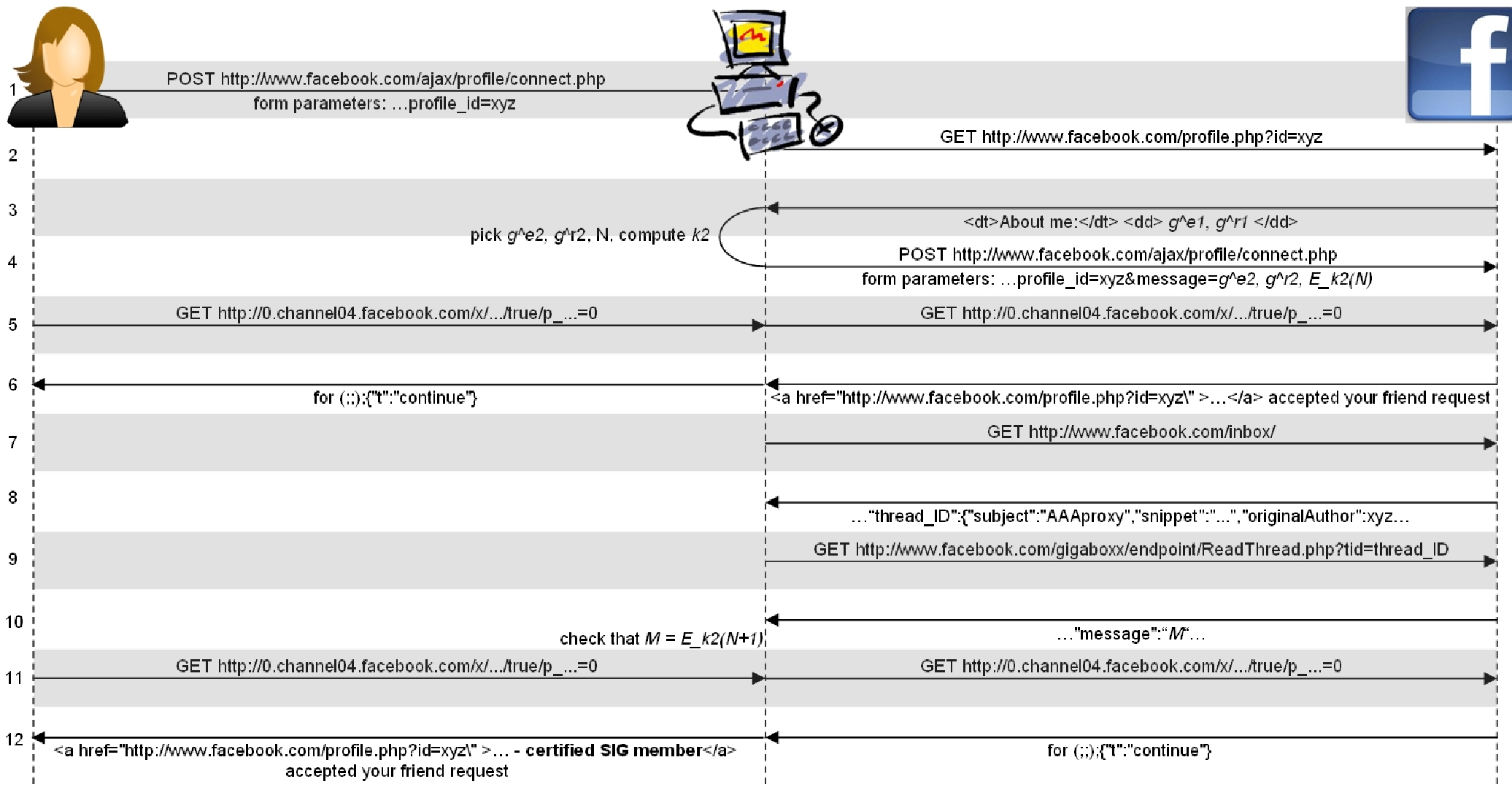 The image above illustrates the Proxy mechanism used to intercept Facebook requests and inject cryptographic handshakes.
Implementation: Hacking Facebook for Privacy
The authors implemented this using a Java HTTP Proxy. Since Facebook isn't designed for interactive cryptographic protocols (you can't always send a "ping" and get an immediate "pong"), they got creative:
- Covert Storage: They used the "About Me" section of a profile to store the initial handshake parameters (Base64 encoded).
- Automated Interaction: The proxy intercepts friend requests, appends cryptographic nonces, and even handles Facebook's CAPTCHAs by passing them back to the user for a one-time solve.
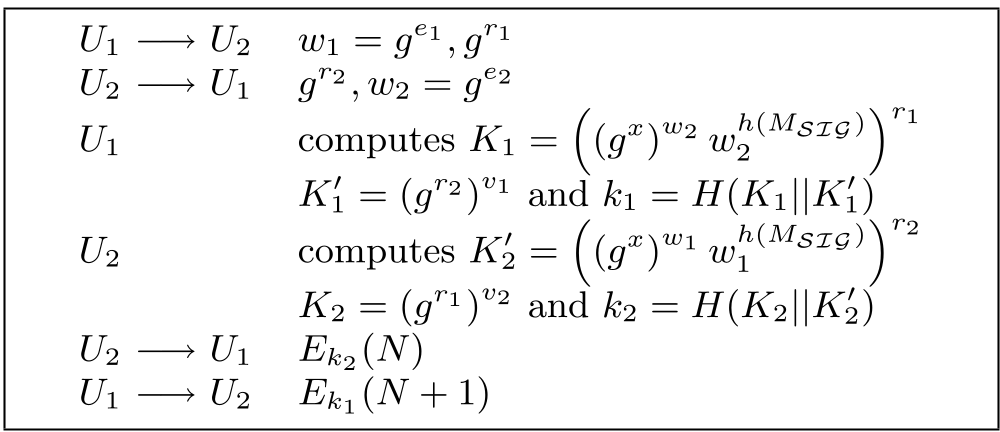 Table: The multi-step protocol for mutual authentication between User 1 (U1) and User 2 (U2).
Critical Analysis & Conclusion
Impact
The true value of this work is its Decentralized Trust Model. It proved that users don't need to trust Mark Zuckerberg to have a private conversation; they only need to trust the threshold logic of their own sub-community managers.
Limitations
- The Tracing Problem: While the SIG membership is secret (Unlinkability), the Facebook ID is still visible. If an OSN provider notices specific users frequently using the proxy's patterns, they might flag them.
- Complexity: Running a local Java proxy was a high barrier to entry for the average 2010 user.
Future Outlook
Today, this line of research has evolved into Zero-Knowledge Proofs (ZKP) and Privacy-Preserving Social Protocols like Farcaster or Lens. However, this 2010 paper remains a foundational blueprint for how to build "The Resistance" inside a centralized digital empire.