
Secure CCSS: Neutralizing Majority Malicious Attacks in Crowdsourced Spectrum Sensing
Secure Crowdsourcing-based Cooperative Spectrum Sensing
The paper introduces a secure crowdsourcing-based cooperative spectrum sensing (CCSS) framework designed to identify spectrum holes while resisting malicious data injection. The core method combines instantaneous trustworthiness metrics with long-term reputation scores using a Prioritized Weighted Sequential Probability Ratio Test (PWSPRT), achieving robust detection even when malicious users form the majority.
TL;DR
Cooperative Spectrum Sensing (CSS) is vital for Cognitive Radio, but it is easily subverted by malicious users reporting fake data. This paper proposes a defense mechanism that uses a few trusted anchor nodes and signal propagation physics to verify mobile reports. By combining instantaneous trust with long-term reputation, the system remains secure even if 90% of the participants are attackers.
Background: The Trust Crisis in Crowdsensing
Crowdsourcing spectrum sensing to mobile users (smartphones, tablets) offers massive geographic coverage at low cost. However, the open nature of CCSS creates a massive surface for Sensing Data Falsification attacks.
Current SOTA defenses suffer from two fatal flaws:
- The Majority Problem: If malicious users dominate, they can "poison" the average result or even the reputation system itself.
- Sudden Behavior Shifts: Long-term reputation scores cannot react quickly enough if a previously "good" node suddenly turns malicious.
Methodology: Physics-Aware Trust & Layered Fusion
The authors' insight is brilliant: while you can't trust the people, you can trust the laws of physics.
1. Instantaneous Trustworthiness (The "Now")
The system uses a small set of Anchor Detectors (trusted nodes). Based on the distance to the Primary User (PU) and the path loss model, the power levels at any two honest points should be highly correlated. The authors define a random variable that compares a mobile user's report to an anchor's report. If deviates significantly from a Gaussian distribution , the report is instantly flagged.
2. Fine-grained Reputation (The "Past")
The system uses a Dirichlet-Multinomial model to track performance across levels. This isn't just a binary "good/bad" score; it maps how much a user's data contributed to a correct or incorrect final decision over time.
3. PWSPRT Fusion
The final decision isn't a simple average. The Prioritized Weighted Sequential Probability Ratio Test (PWSPRT):
- Prioritizes: Processes reports with high instantaneous trust first.
- Weights: Multiplies the impact of each report by the user's reputation score.
- Terminates: Stops as soon as a statistical confidence threshold (A or B) is hit.
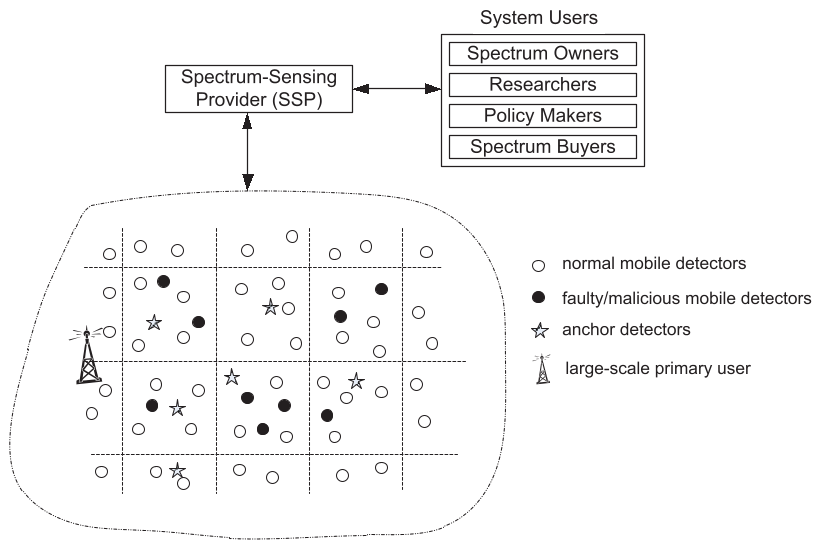 The CCSS Architecture showing Mobile Detectors and Anchor Detectors.
Experimental Validation
The authors simulated an IEEE 802.22 environment (DTV signals). The results are striking.
Defeating the Majority
In a scenario with 100 users, when the number of malicious users () exceeds 50, traditional methods (CPB, KKB) fail completely. Their miss-detection rates spike to nearly 100% because the "outlier detection" starts filtering out the honest users.
The proposed scheme stays stable. Because honest users' reports are consistent with the anchor nodes, they are processed first and with higher weight, allowing the SSP to reach a correct decision before the malicious reports are even considered.
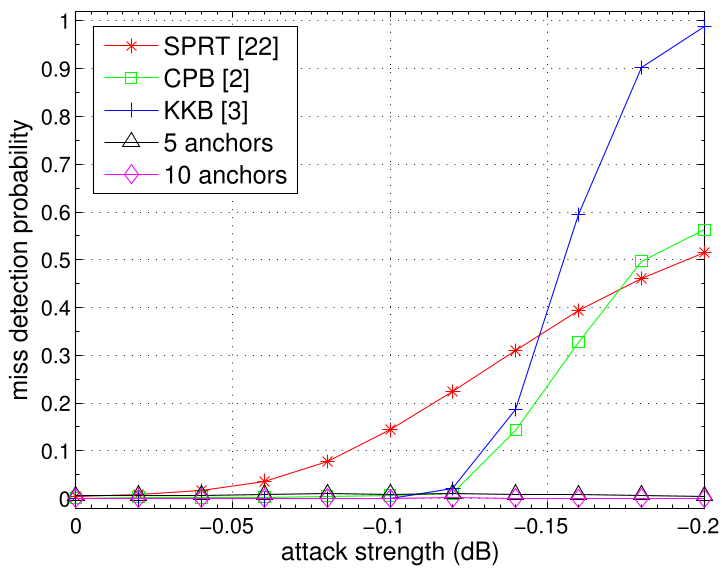 False Alarm Probability vs. Number of Malicious Detectors: The proposed scheme (solid lines) remains low even as attackers increase.
Critical Insight: Why Does This Work?
The secret sauce is the sequential processing. In a standard "Batch" fusion, malicious data is mixed into the average and destroys it. In PWSPRT, the system tries to reach a conclusion using only the "most trusted" data first. If the small group of honest users (verified by anchors) provides enough evidence, the system stops before the "majority" malicious data can even enter the calculation.
Conclusion & Future Outlook
This paper shifts the paradigm of secure crowdsensing from "social trust" (reputation) to "physical trust" (signal correlation). While the reliance on anchor nodes adds some deployment cost, it provides a hard security bound.
Limitations: The model currently assumes fixed, large-scale Primary Users (like TV towers). Applying this to mobile, low-power PUs (like wireless mics) remains a challenging future frontier.
Final Takeaway: In the era of adversarial AI and data poisoning, "truth" should be anchored in physical immutable laws rather than just statistical consensus.