
Secure Friend Discovery: Balancing Privacy and Verifiability in Mobile Social Networks
Secure friend discovery in mobile social networks
2011-04-01
Summary
Problem
Method
Results
Takeaways
Abstract
The paper proposes a secure protocol for distributed friend discovery in Mobile Social Networks (MSNs). It introduces a multi-stage approach for proximity estimation using "social coordinates" (Katz measure embeddings) and a novel secure dot product protocol that is both privacy-preserving and verifiable.
## Executive Summary
**TL;DR**: This paper introduces a robust framework for discovering friends in physical vicinity without exposing sensitive location data or private social profiles to strangers or central servers. By representing social relationships as "coordinates" and utilizing a novel **verifiable secure dot product** protocol, the authors enable mobile devices to calculate social distance privately and securely.
**Background**: Positioned between decentralized social networking and secure multi-party computation (SMPC), this work addresses the "cheating" problem in peer-to-peer discovery where users might lie about their status to trick others into a connection. It moves beyond simple "honest-but-curious" models to handle malicious adversaries.
## The Core Challenge: The Privacy-Verifiability Paradox
In a Mobile Social Network (MSN), you want to know if the person standing next to you at an airport has common friends. However, you don't want to broadcast your entire friend list.
**Prior works** had two fatal flaws:
1. **Fingerprinting**: Social coordinates are surprisingly unique. The authors' analysis across Digg, Flickr, and Myspace shows that with even moderate precision, 35%-80% of users can be uniquely identified just by their coordinates.
2. **The Liar's Advantage**: Standard private dot product protocols (like those based solely on obfuscation) allow a user to claim they are "close" to you by manipulating the result, potentially leading to social engineering attacks.
## Methodology: A Three-Tiered Defense
The authors propose a logic flow that filters out strangers efficiently while protecting the identities of potential matches.
### 1. Identity Anonymization (Virtual IDs)
To prevent long-term tracking, the system uses "Virtual IDs"—short-term public/private key pairs signed by a trusted server—allowing users to remain authenticated without revealing their permanent identity.
### 2. Proximity Pre-filtering
Before engaging in heavy math, the phones perform a "Pre-filtering" step. This tells the users ONLY if they are "close enough" (above a threshold) without revealing the actual distance. This is done via scalar multiplication of vectors to hide the raw values.
### 3. Verifiable Private Dot Product (The "Deep Math")
If the pre-filtering returns "YES," the devices invoke a protocol based on **Paillier Homomorphic Encryption**.
- **The Insight**: The authors use the self-blinding and additive properties of homomorphic encryption to allow Bob to compute the dot product on Alice's encrypted data.
- **The Innovation**: They add a "verification" step where the random numbers used for blinding are themselves verified through a second, lighter computation. This ensures Bob cannot return a fake high-proximity score.
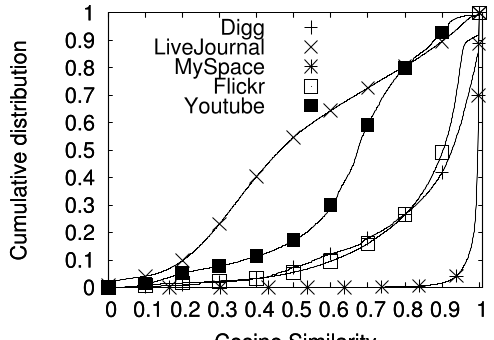
*Fig: The interaction flow between the trusted server and mobile users for virtual IDs and proximity computation.*
## Experiments and Results
The authors tested their system on "vintage" hardware (HP iPAQ and Motorola Droid) and a PC. The results prove that privacy doesn't have to be slow.
- **Latency**: While the full Verifiable Protocol (Protocol 1) took minutes on the iPAQ due to inefficient C# libraries, the optimized Protocol 2 ran in **523ms** on the Android Droid.
- **Battery**: A single discovery operation consumes a negligible amount of energy (around 286 mJ), meaning a phone could perform thousands of these checks on a single charge.
- **Accuracy**: Using the Katz measure, they showed that social coordinates can accurately predict friendship links across five major social platforms.
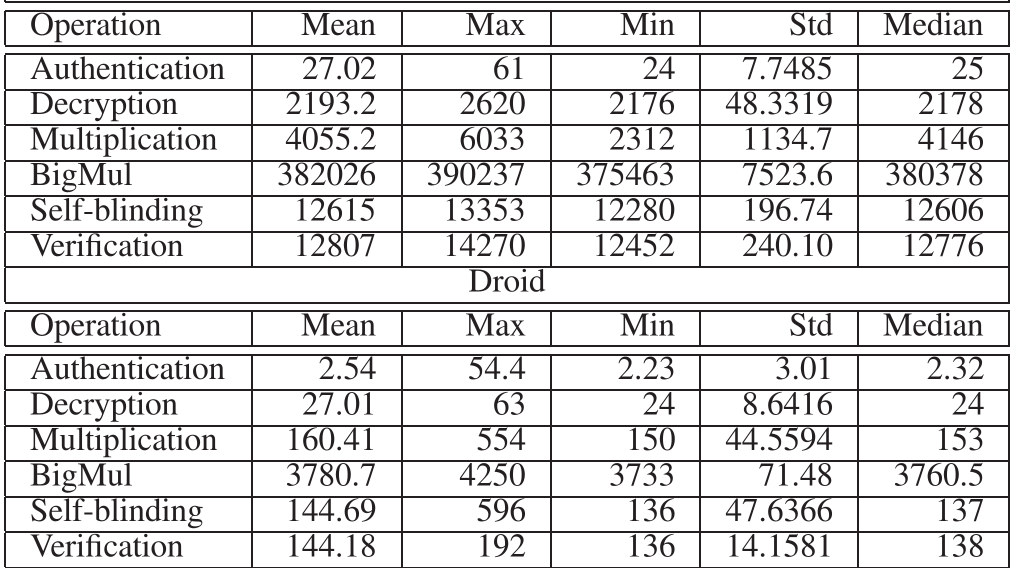
*Table: Breakdown of computation times showing the efficiency of Protocol 2 vs Protocol 1 on mobile platforms.*
## Critical Analysis & Conclusion
**Takeaway**: This paper is a seminal look at how we can bring social graphs into the physical world safely. The "Verifiable Dot Product" is a fundamental primitive that has since influenced many fields in privacy-preserving data mining.
**Limitations**: The system still requires a "trusted server" for initial bootstrapping (issuing Virtual IDs). In a truly adversarial world, the server itself could be a target. Additionally, while the math handles "liars" during computation, it cannot prevent a user from obtaining a valid but "fake" social coordinate from the server if they have successfully gamed the initial social network graph.
**Future Perspective**: As we move toward the Metaverse and hyper-local AR social networks, the techniques pioneered here—filtering by threshold before computing exact values—remain the "Gold Standard" for balancing mobile performance with extreme privacy.