
Secure PSN: Bridging Trust and Encryption via Multi-Dimensional Attribute-Based Control
Secure pervasive social networking based on multi-dimensional trust levels
The paper introduces a secure communication scheme for Pervasive Social Networking (PSN) over MANETs, utilizing Multi-Dimensional Trust Levels (Local and General). By integrating Distributed Attribute-Based Encryption (DABE), the method provides flexible access control and achieves superior performance compared to traditional cloud-based ABE schemes.
TL;DR
In the world of Mobile Ad Hoc Networks (MANETs), where servers are a luxury and strangers are common, securing Pervasive Social Networking (PSN) is notoriously difficult. This paper presents a breakthrough by combining Attribute-Based Encryption (ABE) with Multi-Dimensional Trust (Local and General). This allows for fine-grained access control that works even when the internet is down, with fixed-time decryption overhead.
The "Centralization Paradox" in Pervasive Socializing
Pervasive Social Networking happens when people physically close to each other form instant social groups (e.g., in a disaster zone, at a festival, or on a train) without relying on traditional cellular infrastructure.
Current solutions face two major roadblocks:
- Centralized Weakness: If you rely on a server for keys, the system breaks the moment you lose signal.
- Distributed Chaos: If you manage keys locally between every pair of nodes, the "Key Management" overhead explodes as people move in and out of range or change their pseudonyms.
The authors identify a missed opportunity: Trust is an attribute. By treating a node's trust level as a cryptographic attribute, they eliminate the need for complex identity tracking.
Methodology: The Two-Dimensional Trust Model
The core innovation lies in separating trust into two dimensions, which are then used as the "attributes" for ABE:
- General Trust (GT): Calculated by a Trusted Server (TS) based on long-term historical behavior.
- Local Trust (LT): Evaluated by individual PSN nodes based on immediate, local interactions.
1. The Architecture
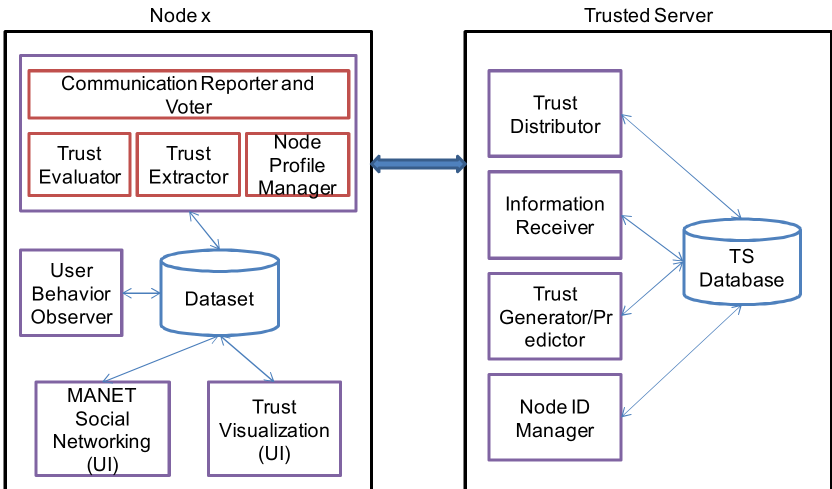
The system utilizes a hybrid framework where nodes observe behavior, and a server (whenever available) refines those observations into global reputations.
2. Encryption Logic (The ABE Layer)
Unlike standard encryption where you encrypt for a specific person, here you encrypt for a trust level.
- Scenario A (Server Active): You encrypt a message requiring a GT level of 4. Only nodes vetted by the server can read it.
- Scenario B (Server Offline): You encrypt a message requiring an LT level of 3 (from your own perspective). Only nodes you trust can read it.
- Scenario C (Hybrid): You require both (e.g.,
GT >= 3 AND LT >= 4).
The math behind this uses Bilinear Pairings, ensuring that even if an attacker colludes with others, they cannot combine their "lower-level" keys to spoof a "higher-level" trust attribute.
Experiments & Performance
The researchers compared their scheme against heavyweights like HASBE (Hierarchical ABE) and Yu's scheme (Cloud-based ABE).
Key Technical Advantage:
The complexity of most ABE schemes depends on the number of attributes. By simplifying the attribute space to just numerical trust levels, this scheme achieves O(1) Decryption. This means no matter how many people are in the social network, the time it takes to unlock a message remains constant.
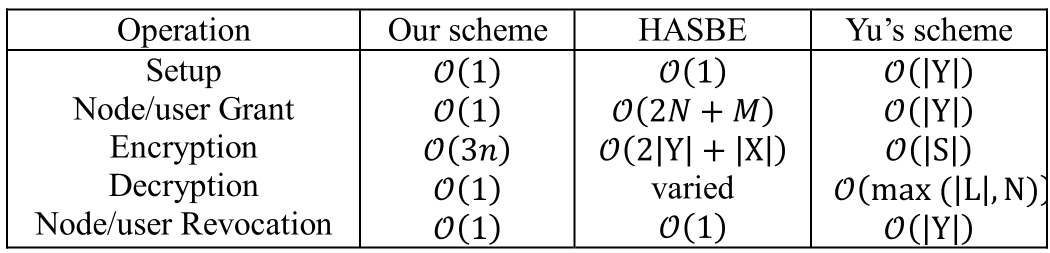
- Scalability: Encryption cost grows only with the complexity of the policy (how many 'AND/OR' conditions you have), not the number of users.
- Provable Security: The authors proved that their scheme is secure against "Indistinguishability under Chosen Plaintext Attacks" (IND-CPA).
Critical Insight & Future Outlook
This paper is a significant step toward Autonomous Security. In many modern decentralization talks, we focus on "Who you are" (Identity). This paper argues we should focus on "How you behave" (Trust).
Limitations: While the O(1) decryption is impressive, the generation of "Local Trust" keys still requires a one-to-one interaction if the server is offline. Future work could explore using Zero-Knowledge Proofs to allow a node to prove its LT status to a group without individual key issuance.
Conclusion: If we want social networks that are as resilient as the people who use them, we need systems that don't die when the signal bars disappear. By making trust "cryptographic," this work bridges the gap between social sociology and hard mathematics.