
Security in the Fog: Defending Medical Big Data with Decoys and Pairing-Based Cryptography
A Security Model for Preserving the Privacy of Medical Big Data in a Healthcare Cloud Using a Fog Computing Facility With Pairing-Based Cryptography
The paper introduces a comprehensive security model for Medical Big Data (MBD) in healthcare clouds, utilizing a "fog computing" layer to deploy a Decoy MBD (DMBD) system. The core method combines Pairing-Based Cryptography (PBC) for a tri-party authenticated key agreement and the Blowfish algorithm for data encryption, achieving a more secure and computationally efficient environment compared to traditional RSA-based cloud models.
TL;DR
As telemedicine moves toward Cloud-based architectures, the risk of massive Medical Big Data (MBD) theft grows exponentially. This paper proposes a paradigm shift: instead of trying to "catch" an attacker, the system presents a Decoy MBD (DMBD) gallery by default. Using Fog Computing to serve these decoys and Pairing-Based Cryptography for secure key exchange, the authors create a high-performance "illusion" that protects sensitive patient data while outperforming traditional RSA-based security models by over 20x in computational speed.
The "Detection" Fallacy: Why Current Cloud Security Fails
Most cloud security systems are reactive. They monitor user behavior and only deploy "honeyfiles" or decoys once a high-probability threat is detected. However, in the realm of MBD—X-rays, MRIs, and CT scans—once a breach occurs, the damage to patient privacy is irreversible. Furthermore, traditional encryption like RSA is computationally expensive for mobile healthcare devices due to massive key sizes (e.g., 3072-bit keys for 128-bit security).
Methodology: The Illusion Technique
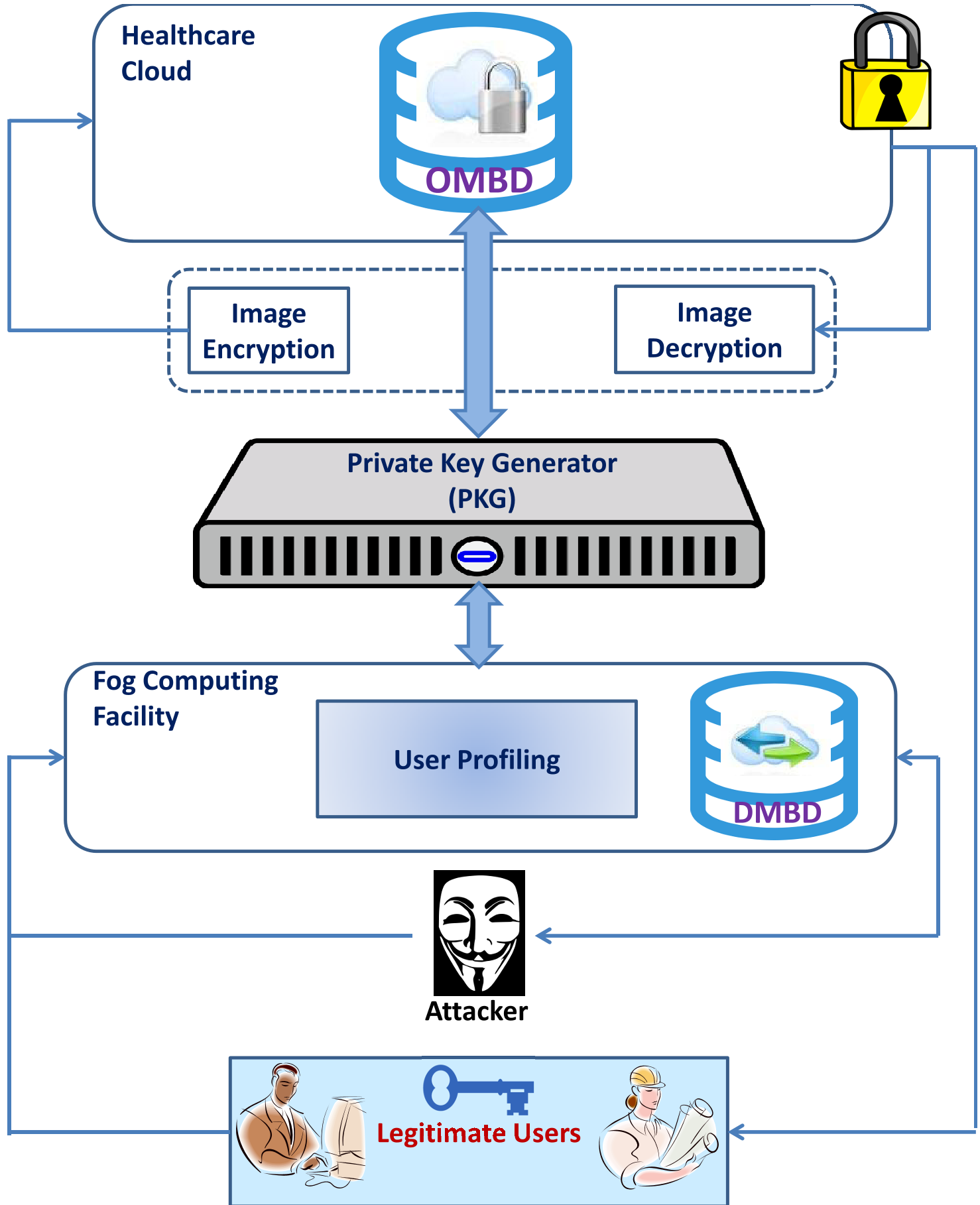
The authors suggest a "Decoy-by-Default" architecture. By utilizing the Fog Computing layer—which sits closer to the end-user than the central Cloud—the system can serve decoy data near-instantaneously.
1. The Fog-Cloud Synergy
- Fog Layer: Hosts the DMBD (Decoy) and performs User Profiling. It acts as a "buffer" or a distraction.
- Cloud Layer: Hosts the OMBD (Original MBD), which remains hidden and encrypted.
2. Tri-Party Authenticated Key Agreement
To ensure that the User, the Fog node (DMBD), and the Cloud node (OMBD) can communicate without being intercepted, the paper develops a protocol based on Bilinear Pairing.
The physical intuition here is using a map such that . This allows three parties to reach a shared secret session key in just one round of communication, regardless of the insecure nature of the internet connection.
3. Automated Decoy Generation
The system maintains "Believability." When a doctor uploads an X-ray to the cloud, the Fog layer automatically selects a corresponding "decoy" X-ray from a different category to populate the DMBD. This ensures the decoy gallery mirrors the original's growth, making it indistinguishable to an attacker.
Experimental Results & Performance
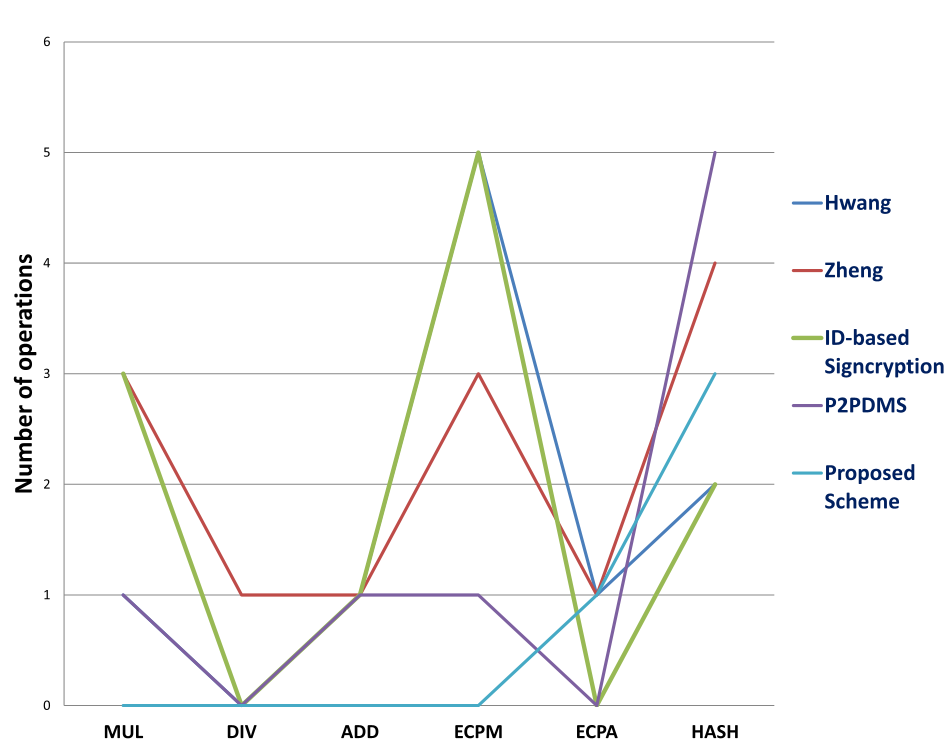
The researchers compared their PBC-based approach against the industry-standard RSA and other signature schemes.
- Efficiency: At a standard 80-bit security level, the private key operation for RSA takes 10.99s, while the proposed ECC/PBC approach reaches the same security in only 0.81s.
- Storage: ECC key sizes (160 bits) are significantly smaller than RSA (1024 bits), which is critical for medical IoT devices with limited memory.
- Algorithmic Superiority: The proposed scheme requires zero modular divisions (DIV), which are typically the most "expensive" operations in cryptographic hardware.
Critical Insight: Why This Matters for the Future
The brilliance of this work lies in its Inductive Bias toward the attacker. By assuming every access is potentially malicious and presenting the "Fog" first, the system side-steps the difficult problem of "zero-day" behavior detection.
Limitations
While the decoy strategy is robust, the paper assumes the "Security Challenge" (Question/SMS) is unhackable. If an attacker bypasses the challenge via SIM-swapping or social engineering, they gain access to the OMBD. Future iterations might benefit from integrating biometric "Multi-modal" authentication directly into the Fog layer.
Conclusion
This security model provides a template for the next generation of "zero-trust" healthcare infrastructures. By leveraging the low latency of Fog computing and the mathematical elegance of Pairing-Based Cryptography, we can finally protect Medical Big Data without sacrificing the speed required for life-saving telemedicine.