
Beyond the Central Node: A Deep Dive into Distributed OSN Security
Security and Privacy of Distributed Online Social Networks
2015-06-01
Summary
Problem
Method
Results
Takeaways
Abstract
This paper provides a comprehensive taxonomic survey of security and privacy solutions for both Centralized (COSNs) and Distributed Online Social Networks (DOSNs). It categorizes state-of-the-art approaches into three critical pillars: data privacy, data integrity, and secure social search, highlighting how decentralization shifts risks from a single global provider to multiple local replica nodes.
## TL;DR
While Distributed Online Social Networks (DOSNs) were born to escape the "Big Brother" gaze of platforms like Facebook, they face a paradoxical challenge: to ensure data is always online, they must replicate it across untrusted peers. This paper navigates the complex cryptographic landscape of data privacy, integrity, and social discovery, providing a roadmap for building truly sovereign digital social spaces.
## The Paradox of Decentralization
The core motivation for DOSNs is **user autonomy**. In a centralized system, the provider is the "God View" entity—it can sell your data, browse your private photos, or keep deleted records indefinitely.
However, the authors point out a critical irony: **Decentralization doesn't eliminate service providers; it fragments them.** Because your friends aren't always online, your data must be cached by other nodes. These replica nodes become "micro-providers." If you don't trust Mark Zuckerberg, why would you trust a random peer in a P2P network with your unencrypted shards?
## 1. Data Privacy: Choosing the Right Lock
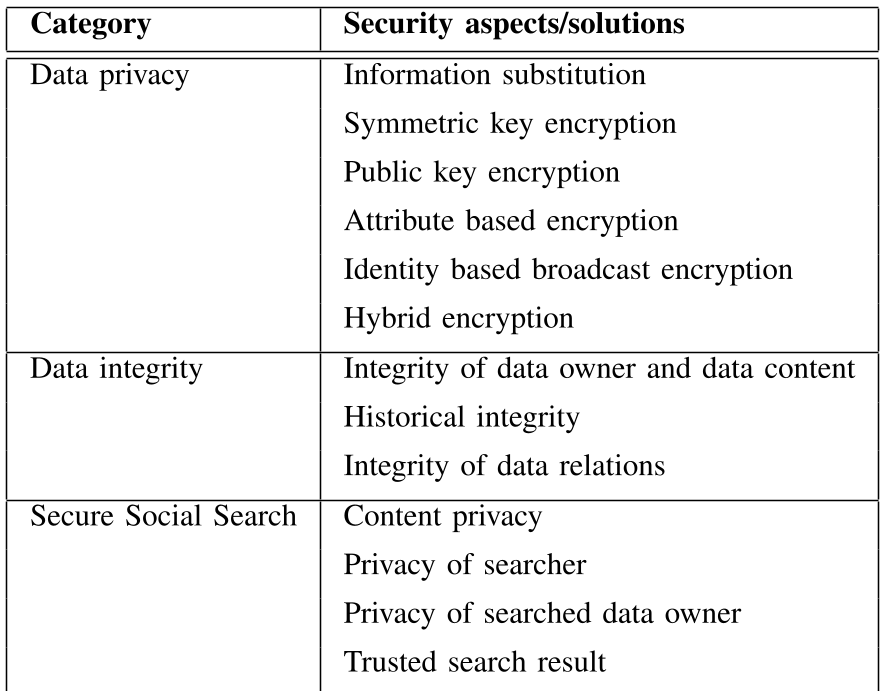
The paper categorizes privacy mechanisms by their cryptographic "flavor":
* **Attribute-Based Encryption (ABE)**: This is the "Inductive Bias" for social circles. Instead of encrypting for a specific person, you encrypt for a profile (e.g., "Friend" AND "Colleague").
* **Identity-Based Broadcast Encryption (IBBE)**: More flexible than ABE for individual revocation, allowing users to use strings like emails as public keys.
* **Hybrid Encryption**: The industry standard for performance—using fast symmetric keys for the data and protecting those keys with robust asymmetric schemes (as seen in *Persona* and *Cachet*).
## 2. Methodology: Ensuring Integrity in a Chaotic Web
Integrity in OSNs isn't just about "is the file corrupted?" The authors break it down into four dimensions:
1. **Owner Integrity**: Distributing keys via "out-of-band" physical meetings to prevent impersonation.
2. **Content Integrity**: Standard digital signatures.
3. **Historical Integrity**: Using **Hash Chaining**. Each post contains the hash of the previous one, creating a verifiable timeline. This prevents a malicious replica node from "hiding" specific updates from your past.
4. **Relational Integrity**: Linking posts to comments via specific signing keys, ensuring a comment cannot be detached from its original context.
## 3. The Challenge of Secure Social Search
How do you find a friend without telling the whole network who you are looking for?
* **Blind Signatures**: Used in *Hummingbird* (a private Twitter clone) to allow users to subscribe to hashtags without the server knowing their interests.
* **Zero-Knowledge Proofs (ZKP)**: Allowing a searcher to prove they have the right to access a profile without revealing their identity or IP address.
## Critical Analysis & Future Outlook
The paper concludes with three "Unsolved Frontiers" that are still highly relevant today:
* **Implicit Information Leakage**: Even if your name is hidden, your phone number or metadata can reveal your identity.
* **The Re-sharing Problem**: Cryptography can prevent a provider from seeing data, but it can't stop a "trusted" friend from taking a screenshot and leaking it.
* **Privacy-Preserving Advertising**: Solving the business model conflict—how can a platform survive if it can't "see" its users to serve them ads?
**Final Takeaway**: The shift from COSNs to DOSNs is a move from "Trust by Contract" to "Trust by Computation." This paper proves that while the architecture changes, the fundamental need for strong cryptographic proofs remains the only constant.