
OSN Relation Privacy: Why Anonymizing Your Name Is No Longer Enough
Security & Privacy in Social Networks
Summary
Problem
Method
Results
Takeaways
This paper provides a systematic taxonomy and analysis of relation privacy preservation in Online Social Networks (OSNs). It categorizes existing methods into identity-based continuums—ranging from complete anonymization to full disclosure—and introduces the ℓ-diversity model as a robust mechanism for partially exposed identity scenarios.
## TL;DR
Providing privacy for Online Social Networks (OSNs) is a paradox: users want privacy, but researchers need relationship data. This paper explores why simple anonymization fails against "structural attacks" and proposes a spectrum of defense mechanisms—from **k-Isomorphism** to the **ℓ-diversity** model—that protect not just who you are, but who you know.
## The Motivation: The "Degree" of Your Vulnerability
Most users believe that if their name is replaced by a random ID (e.g., "User_101"), their privacy is secure. This paper debunked that myth. In a graph, your **topology is your fingerprint**. If an attacker knows Alice has exactly two friends, and only one node in the published "anonymous" graph has a degree of two, Alice is instantly re-identified.
The authors argue that "Relation Privacy" is a multi-user problem. You cannot control your privacy alone; it is dictated by the connectivity of your entire social circle.
## Methodology: The Taxonomy of Privacy
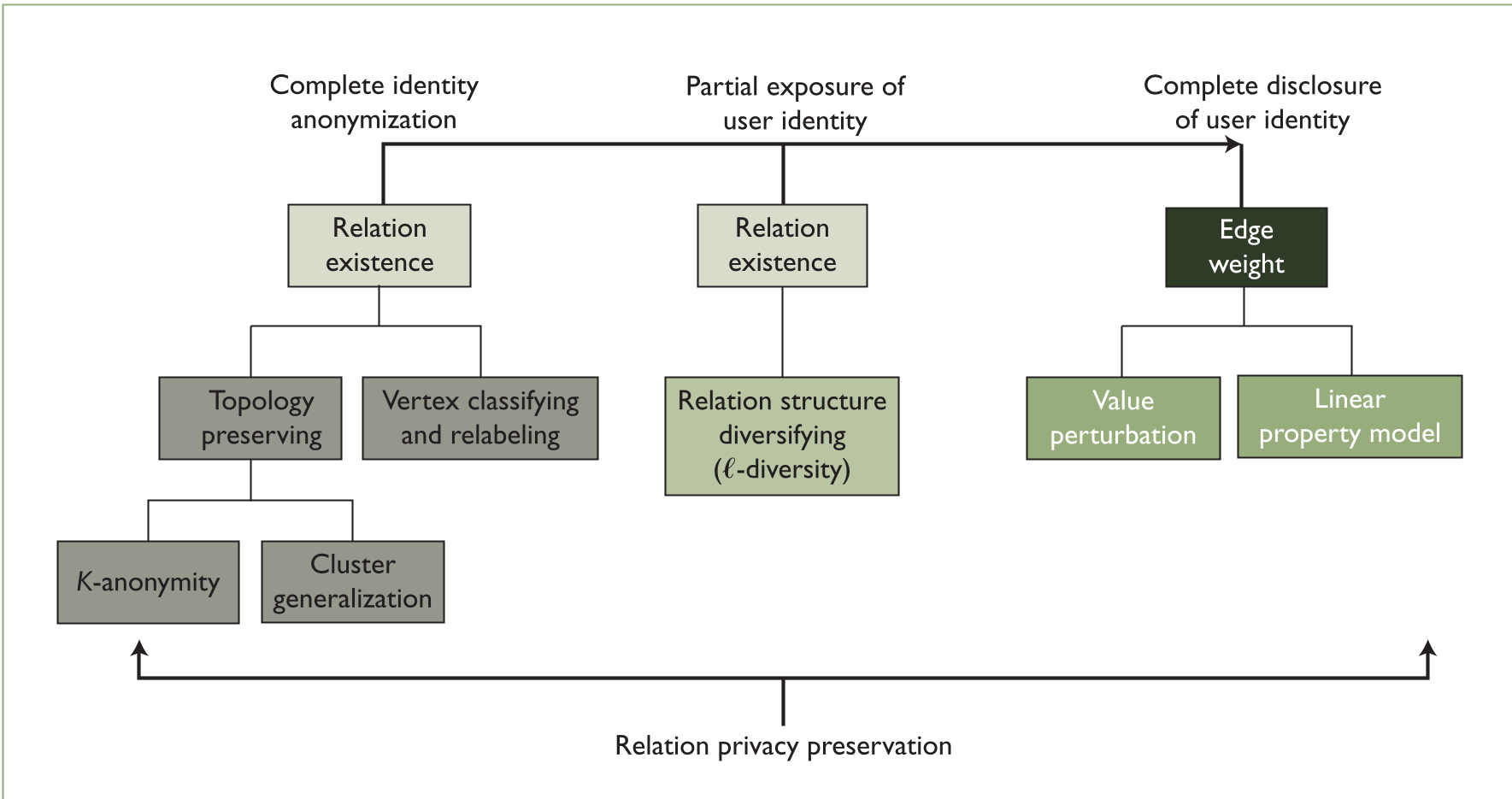
The authors organize privacy techniques along a continuum based on how much of the user's identity is exposed.
### 1. Completely Anonymized Identities
Here, the goal is to make a user's local graph structure indistinguishable from others.
* **k-Anonymity (k-degree/k-neighborhood)**: Ensuring at least $k$ nodes look the same.
* **k-Isomorphism**: This is the "gold standard" for structural defense. It partitions the graph into $k$ disjoint subgraphs and makes them identical.
* **Architecture Insight**: The paper highlights that even if identity is hidden, a lack of "structural diversity" can leak friendships if all degree-2 nodes are connected to all degree-3 nodes.
### 2. The ℓ-diversity Model (The Core Contribution)
The authors introduce **ℓ-diversity** to handle practical scenarios where some user attributes (quasi-identifiers like "American student") are known.
* **The Goal**: Even if an attacker identifies a user, they shouldn't be able to confirm a specific relationship with more than $1/\ell$ confidence.
* **The Mechanism**: The algorithm injects dummy vertices or removes edges to ensure that vertices in a class do not share common neighbors in other classes.
## Experiments & Results: The Utility Trade-off
Privacy always comes at a cost to **Data Utility**. The authors evaluate this using:
* **Topology-based metrics**: Measuring changes in edge distribution and average shortest paths.
* **Workload-based metrics**: Assessing how much an anonymized graph affects the results of common queries like "find the shortest path between A and B."
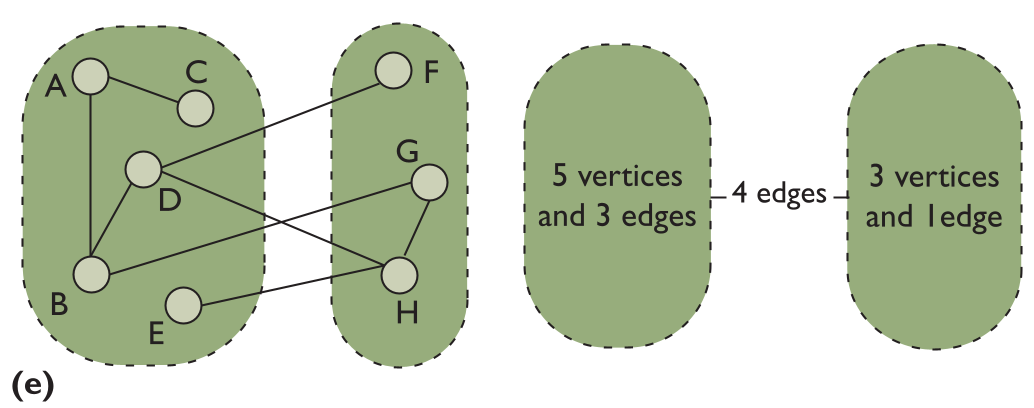
The results show that while **Cluster Generalization** (grouping nodes into "super-nodes") offers high privacy, it destroys the utility for granular social dynamics research. In contrast, **k-Isomorphism** preserves significant topological properties while maintaining a strict privacy bound.
## Critical Analysis & Conclusion
This paper serves as a vital bridge between traditional database privacy and modern graph theory.
**Strengths**:
* Clearly identifies that "relation privacy" involves multiple stakeholders.
* Provides a robust mathematical framework (ℓ-diversity) for partial-exposure scenarios.
**Limitations**:
* The methods are largely designed for **static snapshots**. In the real world, OSNs are dynamic. Predicting how privacy holds up across multiple time-series snapshots remains a significant challenge.
* Computation overhead: Achieving **k-Isomorphism** on graphs with millions of nodes is NP-hard, requiring heuristic approximations that may leak information.
**Future Work**: The authors predict that as social networks grow exponentially, the focus must shift towards **differential privacy** and defending against **active injection attacks**, where attackers create fake accounts (sybils) to map the network from the inside.