
Forest Fire Attacks: How Your Social Circle Could Be Your Account's Downfall
On the Security of Trustee-Based Social Authentications
The paper presents a systematic security analysis of trustee-based social authentication, introducing the "Forest Fire Attack" framework. By modeling account recovery as a cascading process, the authors demonstrate how a few compromised "seed" users can lead to tens of thousands of account takeovers across platforms like Facebook and Google+.
TL;DR
Trustee-based social authentication—recovering your account via codes sent to friends—is more dangerous than it looks. This paper reveals that security in these systems is correlated, not independent. An attacker starting with just a few "seed" accounts can trigger a "Forest Fire Attack," spreading through the social graph to compromise thousands of users. By simply changing how trustees are selected and raising the verification threshold, we can stop the fire.
The Hidden Vulnerability: Correlated Security
In traditional security, if your neighbor's password is stolen, your account remains safe. In trustee-based social authentication (like Facebook's Trusted Contacts), if your friends' accounts are stolen, yours is effectively stolen too.
The authors identify a major oversight in industry implementations: service providers allow users to pick trustees without considering the global "Trustee Network." If a popular user is a trustee for hundreds of people, they become a high-value target—a "bridge" that allows an attacker to jump across the social graph.
Methodology: The Forest Fire Attack
The attack consists of two main phases:
- Ignition: The attacker compromises a small set of "seed users" (via phishing or leaks).
- Propagation: The attacker iteratively targets the friends of these seeds. If the attacker controls (the threshold) trustees of Alice, Alice is compromised. If they control fewer, they use spoofing messages—impersonating Alice to her remaining trustees to trick them into giving up the recovery codes.
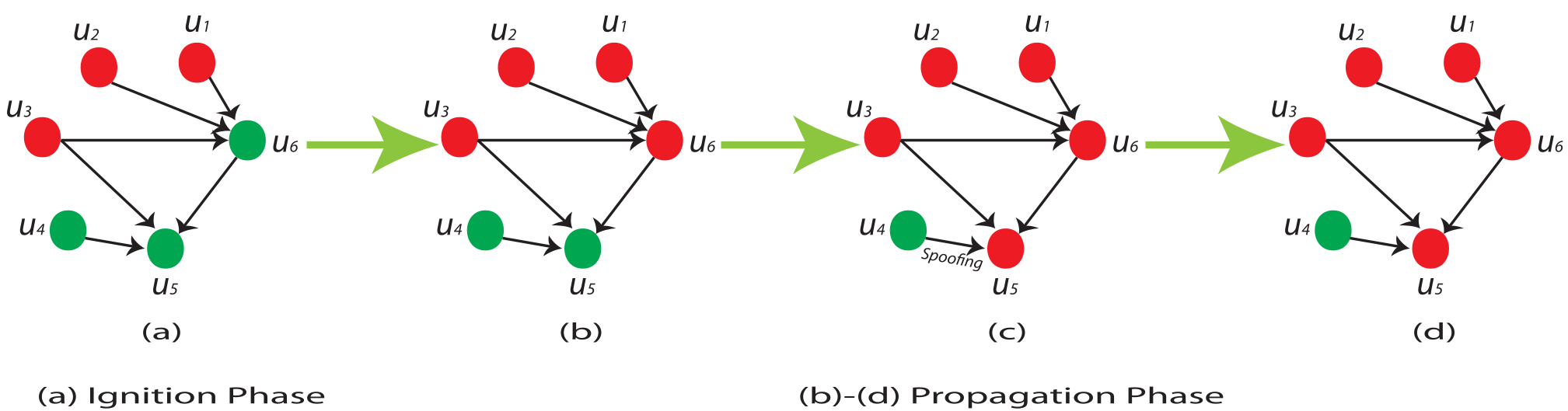 Figure 1: A visualization of the propagation phase where compromised nodes (red) help "ignite" their neighbors.
The Mathematical Intuition
The paper formalizes the threat using a local update rule. The probability of user being compromised () depends on the aggregate probability of their trustees being compromised in previous steps, weighted by the probability that a spoofing attack succeeds ().
Defense: Cutting the Fuel Line
The most effective defense isn't hiding the network (which hurts usability), but Constraining Trustee Selection.
The authors propose T-Degree. Instead of letting Alice pick any friend, the system suggests or enforces friends who aren't already serving as trustees for too many people. This keeps the "out-degree" of the trustee network low, preventing any single node from becoming a catastrophic point of failure.
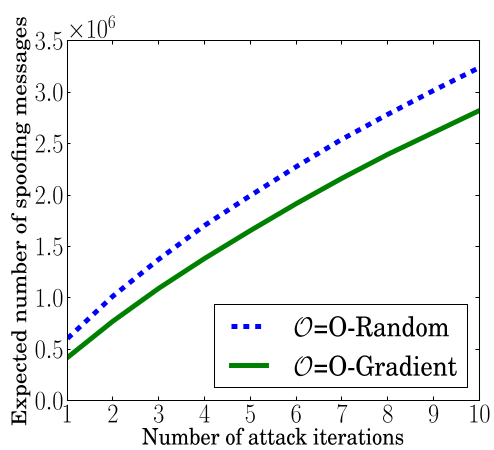 Figure 2: Experimental results showing how T-Degree (pink/bottom lines) drastically reduces the number of compromised users compared to standard selection (T-CF).
Experimental Insights
- Scaling up: On Twitter data, 1,000 seeds could lead to nearly 4 million compromised accounts if social links are used naively (T-CF).
- The Magic Number: Moving the recovery threshold () from 3 to 4 provides a massive security boost. While 3 is the industry standard for Facebook and Microsoft, 4 is the "sweet spot" for balancing security and the likelihood of friends being available to help.
- Spoofing is Optional: Even with zero spoofing success, the "fire" still spreads significantly just through the sheer connectivity of social networks.
Critical Analysis & Future Outlook
This work is a wake-up call for "Social MFA." The fundamental insight is that topology matters in security.
Limitations: The model assumes attackers can easily map the trustee network. While the authors argue this is possible through "username probing," modern platforms have implemented stricter rate-limiting since this study. Furthermore, the recovery probability ()—how fast users reclaim accounts—is a critical variable that requires more real-world behavioral data.
Future Work: As we move toward decentralized identity (Web3) and "Social Recovery" wallets, the lessons of the Forest Fire Attack are more relevant than ever. We must design these systems to be "topology-aware" to ensure that the social fabric that protects us doesn't become the very thing that helps burn our digital lives down.