
Seed-Based De-Anonymizability: Quantifying the Inherent Fragility of Social Privacy
Seed-Based De-Anonymizability Quantification of Social Networks
This paper presents the first comprehensive theoretical quantification of social network de-anonymizability. It establishes conditions for "perfect" and "partial" de-anonymization using structural information and seed mappings, validated through a massive evaluation of 24 real-world datasets including Twitter, Google+, and Facebook.
TL;DR
Is your "anonymized" social data truly private? This seminal paper provides the mathematical proof that structural information alone is often enough to unmask users. By analyzing 24 real-world networks, the authors demonstrate that as long as an adversary has an "auxiliary" graph (like a public friend list) and a few "seeds" (known users), they can reconstruct the identities of almost everyone else. In fact, if your social circle is dense enough, they might not need any seeds at all.
Background: The Gap Between Attack and Theory
For years, researchers like Narayanan and Shmatikov showed that they could de-anonymize the Netflix prize dataset or Twitter graphs using heuristic "crawling" algorithms. However, we lacked a fundamental "Safety Limit" for graph data. We didn't know why these attacks worked or exactly how many users remained at risk. This paper bridges that gap, moving from "we can hack this specific graph" to "this is why graphs are mathematically vulnerable."
The Core Insight: Edge Difference and Graph Sampling
The authors model the problem using two graphs, (Anonymized) and (Auxiliary). They assume both are sampled from a "true" social graph .
The key metric is the Edge Difference (). If we try to map a user from to , the "correct" mapping should minimize the differences in their local connections. The paper proves that for most real-world social densities, the correct mapping is not just likely—it is asymptotically almost certain to be the one with the minimum edge difference.
Methodology: From ER Models to General Scenarios
The research progresses through three layers:
- Erdös-Rényi (ER) Model: Using random graphs to establish baseline bounds.
- General Scenarios: Extending the theory to arbitrary network models (Power-law, Small-world) using graph density () and connectivity ().
- Overall Information: Proving that the structure between anonymized users is actually more informative than the link to a known "seed" user.
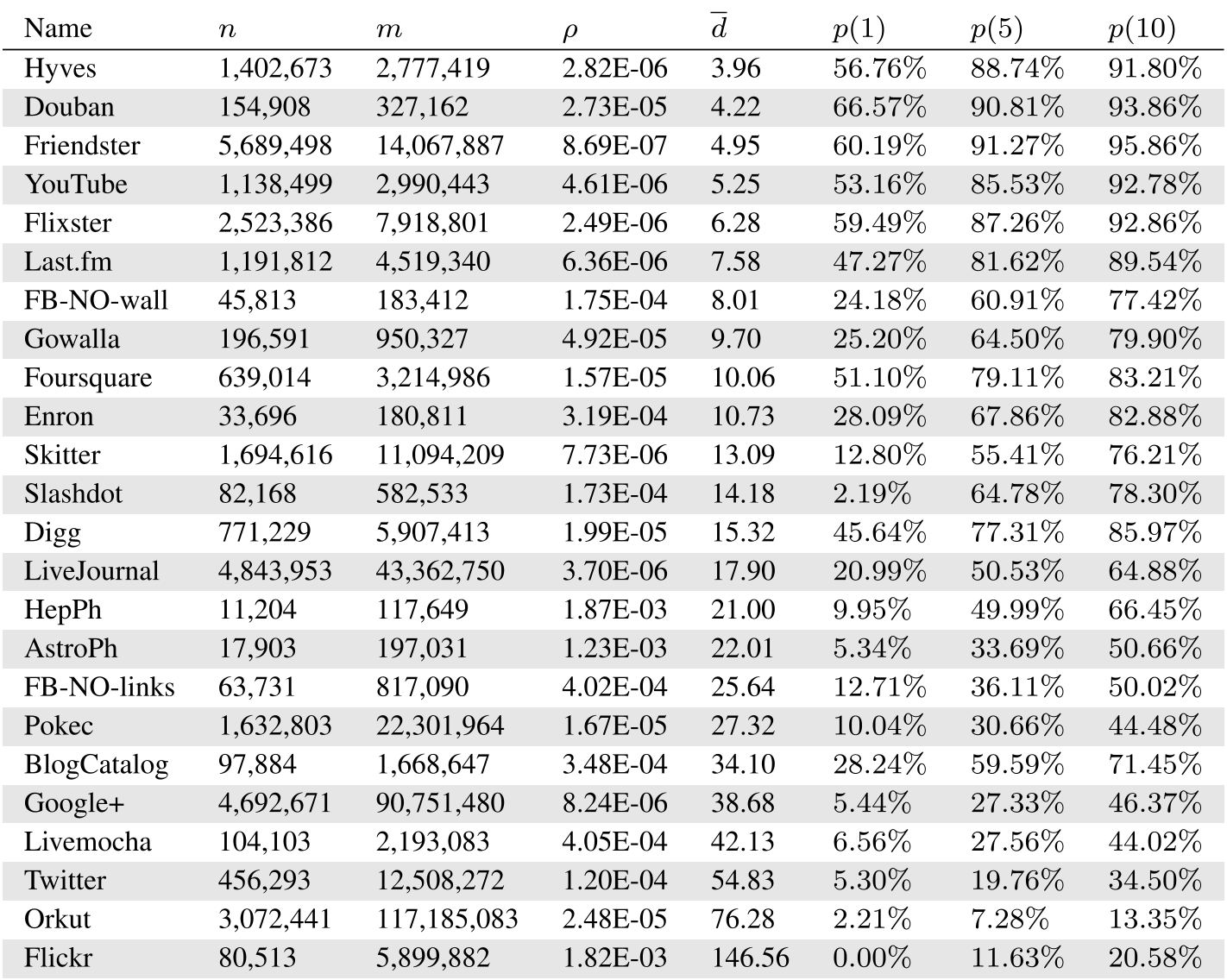 Table II: The 24 datasets analyzed, ranging from Hyves to Twitter, showing varying degrees of sparsity and user counts.
Experimental Battleground: 24 Networks Put to the Test
The authors didn't just stay in the realm of theory. They tested their bounds on 24 datasets. The results are startling:
- Degree Matters: High-degree users (those with many friends) act as structural anchors. Even if a network isn't "perfectly" de-anonymizable, these "VIP" users are almost always unmasked.
- The Power of s: As (the sampling probability, or the overlap between the two graphs) increases, the error tolerance drops to zero.
- The Zero-Seed Threat: In "*-A" scenarios (Overall Structural Information), networks like Google+ or Twitter become vulnerable even when the adversary starts with zero known identities.
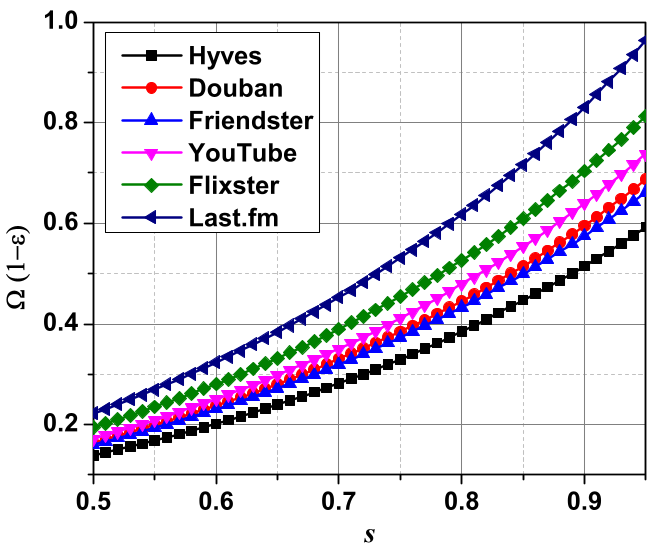 Figure 1: Percentage of de-anonymizable users as a function of the sampling probability s. Significant jumps occur as structural similarity increases.
Critical Analysis: Why This Matters for the Future
The most profound takeaway is that Structural Anonymity is a Myth. Simple ID removal or -anonymization (adding/deleting random edges) is insufficient because the macroscopic structure of the social manifold is too robust.
Limitations & Future Work
The study focuses on undirected graphs. While the authors acknowledge that directed edges (following vs. followers) would provide even more signal—making the data even more vulnerable—this paper establishes a "lower bound" of danger. Future research will likely focus on "Structural Differential Privacy," where noise is added in a way that provides mathematical guarantees of privacy without destroying the utility of the data for social science research.
Conclusion
This work provides the "Theoretical Foundation" for privacy in the age of big data. It confirms that our digital footprints are written in the shapes of our networks, not just our names. For data owners, the message is clear: evaluate your graph's vulnerability before clicking "publish," because the math is not on your side.