
Beyond Reach: Maximizing User Satisfaction in Mobile Social Networks via Multi-Layer Seed Selection
Evaluating Seed Selection for Information Diffusion in Mobile Social Networks
This paper introduces a novel interest-based multi-layer model for seed selection in Mobile Social Networks (MSNs). The core method, "Multi-layer Based Utility," prioritizes initial information sources based on heterogeneous user preferences to maximize content utility rather than just reach, outperforming classical centrality-based approaches in diverse mobility scenarios.
TL;DR
Information diffusion in Mobile Social Networks (MSN) has long focused on the quantity of reach. This paper shifts the focus to quality, proposing a multi-layer interest-based model. By selecting "seeds" (initial information sources) based on the specific heterogeneous interests of their neighbors—rather than just their social popularity—the proposed method increases content utility by up to 11% over traditional centrality-based benchmarks.
The "Blind Diffusion" Problem
Most viral marketing strategies in MSNs assume that every user is a potential valid target. Current SOTA methods often use Centrality (Degree, Betweenness, or Closeness) to find popular nodes to act as "seeds." While these nodes are good at spreading information quickly, they are often "blind" to whether the recipients actually care about the content.
In a world of information overload, a user interested in "Sport" might find a "Theater" advertisement to be spam. The authors argue that maximizing the Content Utility Rate—a quantitative measure of user satisfaction—is more important than maximizing the raw number of covered nodes.
Methodology: The Multi-Layer Interest Model
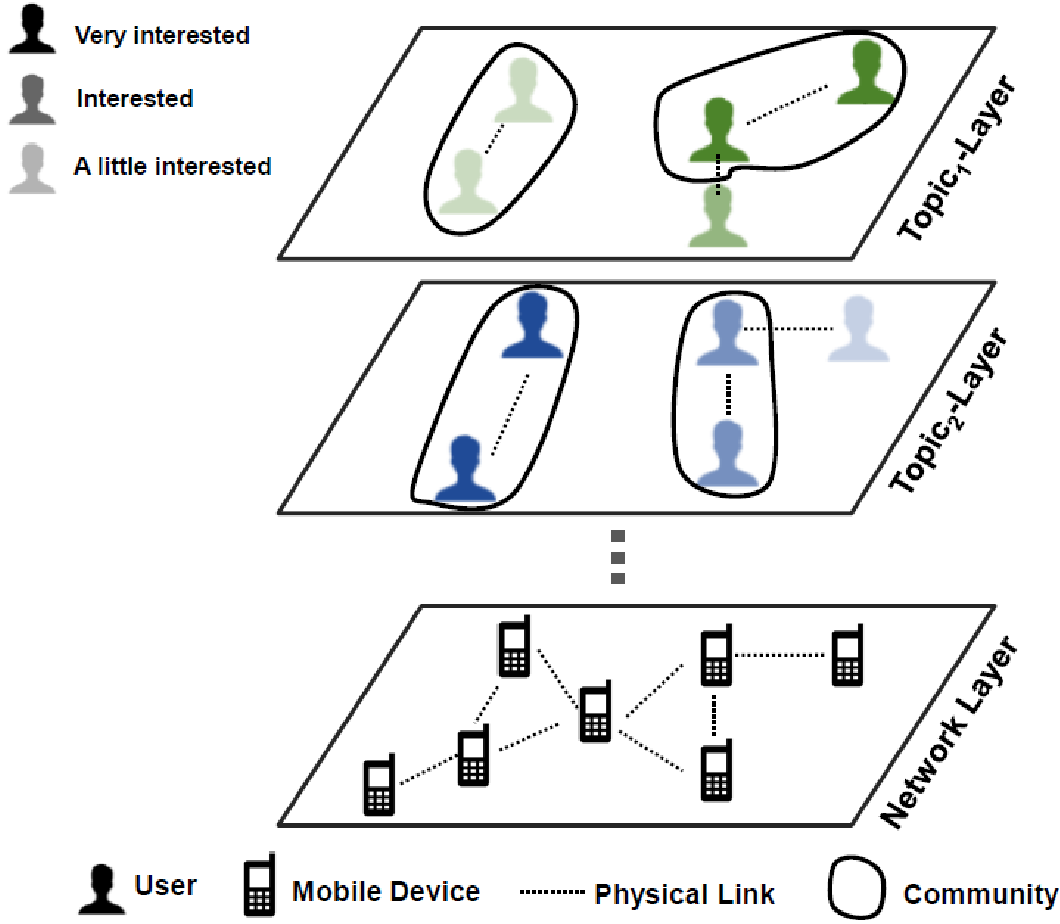
The authors propose a system that separates the physical network from logical interest groups.
1. The Architecture
The model consists of two primary tiers:
- Network Layer: The physical reality of mobile devices moving and interacting via WiFi/Bluetooth.
- Topic Layers: Virtual layers where nodes are grouped by their specific interest level (e.g., 0 for uninterested, up to 3 for very interested) for a specific topic (e.g., Restaurant Recommendations).
2. Utility-Based Seed Selection
The breakthrough is the Multi-layer Based Utility algorithm. Instead of asking "How many neighbors does this node have?", it asks:
"What is the sum of the interest levels of this node's immediate neighbors for THIS specific topic?"
The formula is elegantly simple: where represents the intensity of user 's interest in content .
Experimental Insights: Quality Over Quantity
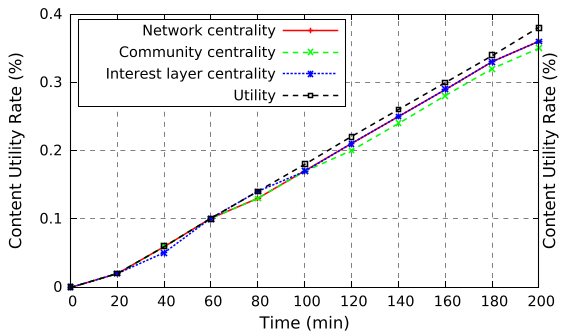
Using The ONE (Opportunistic Network Environment) simulator, the authors compared their utility-based approach against classical Network Centrality and Community-based methods.
Key Findings:
- Movement Matters: In "Cluster Movement" (dense urban environments), the Utility-based approach reached 52% Utility, while classical centrality lingered at 41%.
- The Seed/Transmission Trade-off: The authors discovered that it is far better to have more seeds with fewer transmissions each than to have a few seeds blasting the same message repeatedly. High transmission counts from a single seed often lead to "duplicated diffusion," which clogs the network without reaching new, interested users.
Critical Analysis & Takeaways
The brilliance of this work lies in its Inductive Bias: it assumes that local social influence is only as valuable as the local interest alignment.
Limitations:
- Privacy: The model assumes a centralized server can track real-time locations and interests, which raises significant privacy concerns in a real-world deployment.
- Stateless Interests: The model treats interests as static, whereas user preferences often shift based on time of day or context.
Future Outlook: This research paves the way for "Context-Aware Advertising" in 5G/6G D2D networks. By integrating this multi-layer logic, future service providers can drastically reduce cellular overhead by offloading traffic to "Interest-Optimized Seeds" who handle the "last-mile" dissemination via short-range communication.
Conclusion
This paper serves as a reminder that in the era of big data, precision beats volume. By modeling user interests as a distinct layer of the network architecture, we can turn a noisy broadcast into a harmonious, utility-driven exchange.