
Stratified User Modeling: Enhancing Response Prediction via Dynamic Activity Segmentation
Segment-wise Users' Response Prediction based on Activity Traces in Online Social Networks
The paper proposes a segment-wise response prediction method for social networks that categorizes users based on a modified RFD (Recency, Frequency, Duration) model. By combining user behavior dynamics with post characteristics like topic modeling (LDA) and sentiment analysis, the framework achieves more accurate prediction of "likes" compared to aggregate community-wide models.
TL;DR
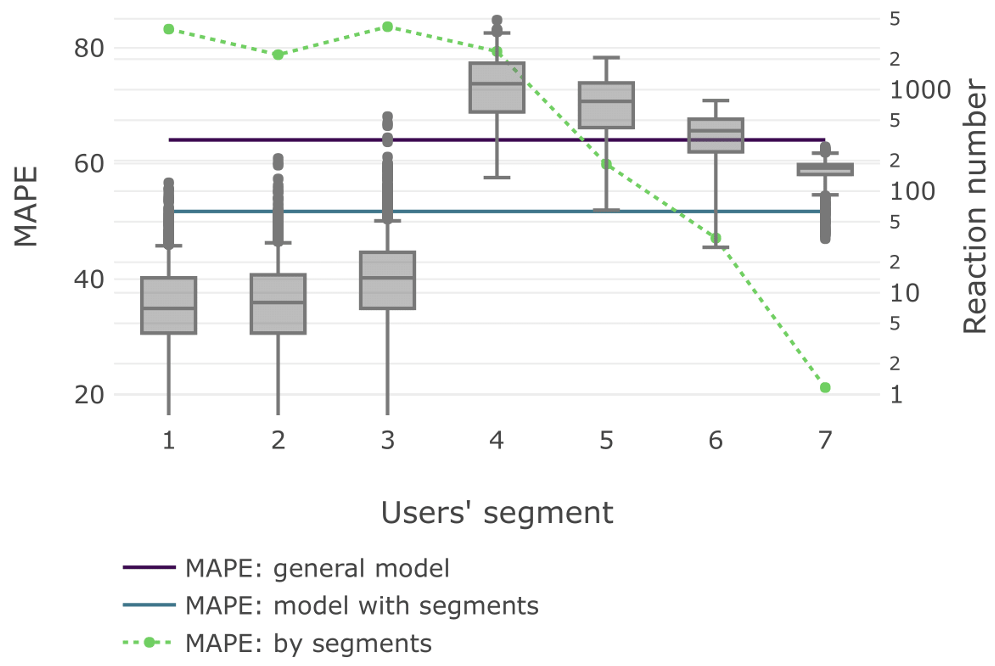
Predicting how a community reacts to a post is a cornerstone of digital marketing and social science. This paper introduces a novel framework that moves away from "one-size-fits-all" community forecasting. By segmenting users into eight dynamic profiles based on their Recency, Frequency, and Duration (RFD) of activity and combining this with sentiment and topic analysis, the authors reduced prediction error (MAPE) from 64% to 52% on real-world data from the VK social network.
Background & Motivation
Most social media prediction models operate at either the micro-level (individual users, which suffers from data sparsity) or the macro-level (the whole community, which ignores behavioral diversity). The authors identify a "meso-level" opportunity: Segments.
The core intuition is that a "Highly Active" user reacts differently to a political post than a "New" user. By acknowledging that users move between activity states (e.g., a "New" user becoming "Low Activity" or "Highly Active"), the model can adapt to the evolving state of the community's engagement.
Methodology: The Triple-Threat Analysis
The proposed method merges three critical data streams to inform the final prediction:
1. Dynamic RFD Segmentation
Instead of static clusters, the authors use a modified RFD approach:
- Recency: Time interval or number of posts since the last reaction.
- Frequency: Proportion of reactions since the first recorded action.
- Duration: Time elapsed since the user's first interaction with the community.
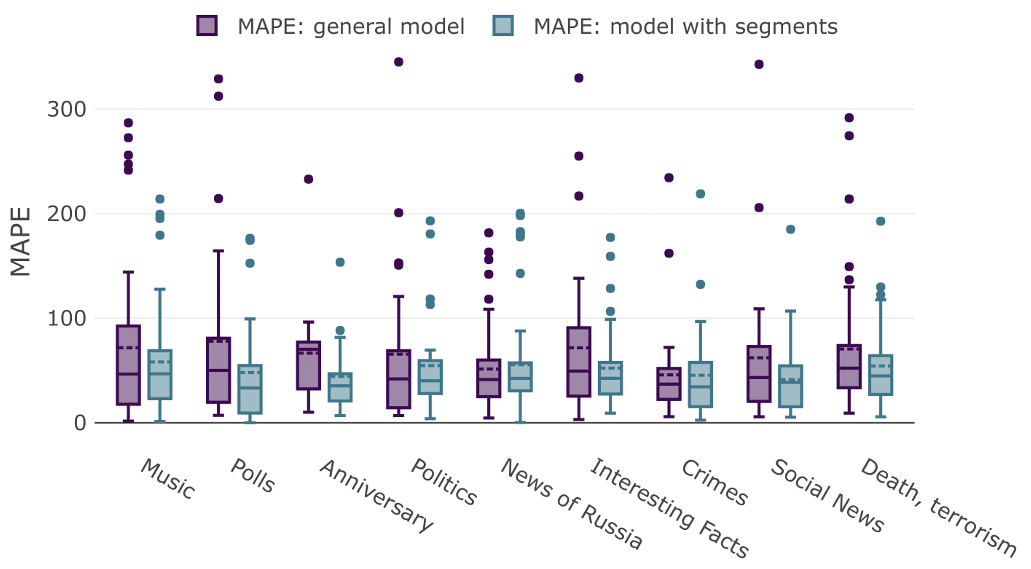
2. Post Content Analysis
- Topic Modeling: Using Latent Dirichlet Allocation (LDA) to classify posts into sub-topics (e.g., Music, News, Polls).
- Sentiment Analysis: Using the
indicoiolibrary to assign a tonality score (0 for negative, 1 for positive).
3. Stratified Prediction Model
The engine behind the forecast is XGBoost. Instead of one model for the whole population, the researchers trained sub-models for different segments. The total predicted reaction is the sum of the predicted responses across all eight segments.
Experimental Results & Insights
The study analyzed 6 months of data from the "Old Lentach" community on VK, involving 2 million subscribers and 4,500 posts.
Key Finding 1: Predictability varies by activity. Segments 5, 6, and 7 (Average to High Activity) showed much lower MAPE than segments 1-4. In short: it is much easier to predict the behavior of "super-fans" than "lurkers" or "newcomers."
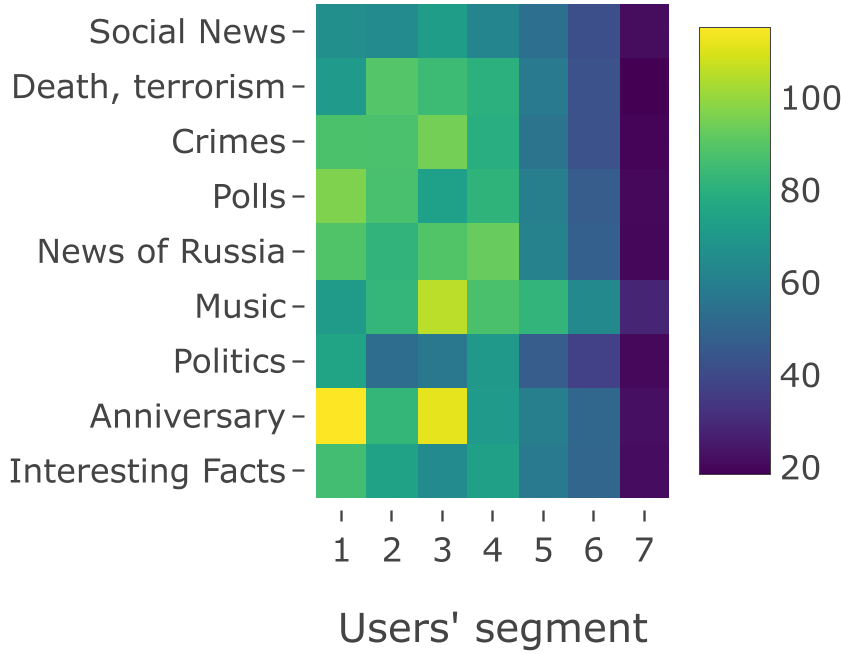
Key Finding 2: Topics impact predictability. A fascinating visualization of error rates (heatmaps) revealed that "Polls" and "Anniversary" posts are highly predictable for frequent users, likely because these formats trigger habitual reactions regardless of the specific text content. Conversely, "Music" posts remained difficult to predict across the board.
Critical Analysis & Conclusion
Takeaways
The transition from aggregate models to stratified models is a significant win for accuracy. The 10%+ reduction in MAPE demonstrates that user context (their history) is just as important as the content of the post itself.
Limitations
- Data Sparsity for New Users: The model still struggles with new and low-activity segments, where the error rate can exceed the baseline.
- Metric Choice: While MAPE is standard, it can be sensitive to small denominators in low-activity segments.
Future Work
The authors suggest a hybrid approach: using a general model for users with sparse data and switching to the stratified model once a user accumulates enough history to be accurately segmented. This "warm-up" strategy could be the key to ultra-high-precision social media analytics.