Beyond Chronology: Personalizing Social Feeds via Tie Strength and Action Affinity
Selecting Items of Relevance in Social Network Feeds
This paper presents a personalization framework for Social Network (SN) feeds designed to mitigate information overload. By calculating relevance scores based on user-to-user tie strength and user-to-action affinity, the system re-ranks feed items to prioritize updates from meaningful connections and interesting content.
TL;DR
Social media feeds are often overwhelming "firehoses" of data. This paper moves beyond simple chronological lists by implementing a personalized ranking system based on Tie Strength (how close you are to the poster) and Action Affinity (how much you like the type of activity). A live 12-week study involving nearly 3,000 users proved that this personalized approach significantly increases user engagement and click-through rates.
The "Chronological" Problem: Information Overload
In the early days of social networking, seeing every update from every friend in order of appearance was manageable. However, as the authors note, the average user quickly accumulated hundreds of friends, resulting in a "ferociously fast-changing environment."
The fundamental flaw of Reverse Chronological Ordering is its primary assumption: that the most recent item is the most important. In reality, a post from a best friend three hours ago is likely more relevant than a post from a distant acquaintance three minutes ago.
Methodology: Quantifying Relevance
The researchers proposed a scoring function that evaluates the relevance of a feed item to a target user . The score is a weighted sum of two core dimensions:
- User-to-User Relevance (): Measuring the "Tie Strength" between the viewer and the poster.
- User-to-Action Relevance (): Measuring the viewer's interest in the specific type of activity (e.g., posting a photo vs. joining a group).
Architecture of the Scoring Model
The authors assigned a high weight (0.8) to the user component, signaling that who performed the action is more critical than what the action was.
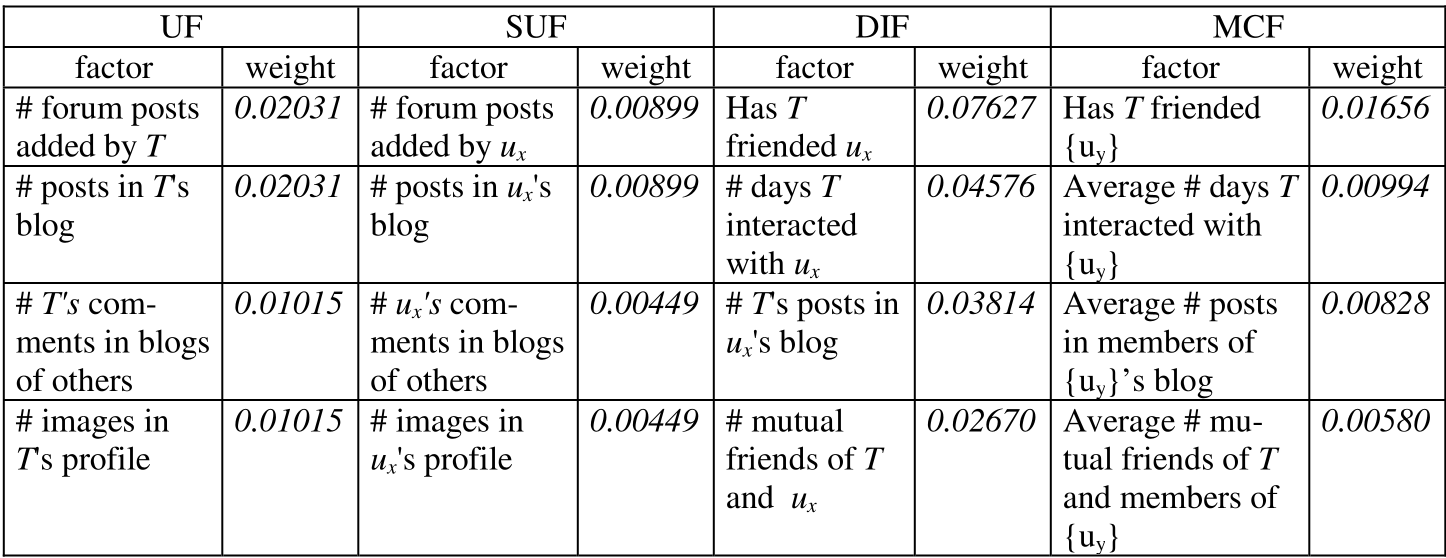
The score is further decomposed into four categories:
- Direct Interaction Factors (DIF): Personal messages, "friending" status, and interaction history. (Weighted highest at 0.61).
- Mutual Connection Factors (MCF): Shared friends and social overlaps.
- User / Subject Factors: General activity levels of the users involved.
Live Evaluation and Results
Unlike many papers that rely on offline simulations, this study was conducted as a live A/B test on an eHealth portal.
Key Findings:
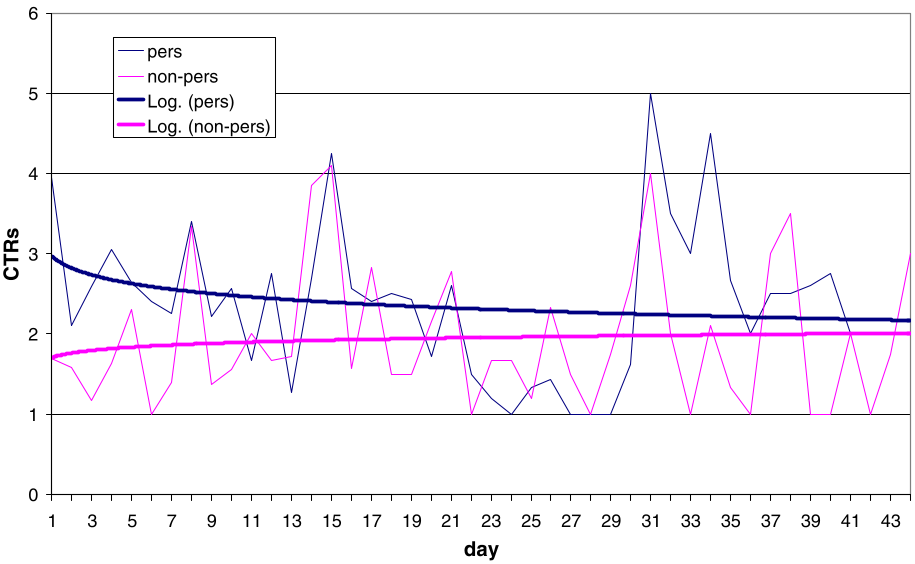
- Engagement Lift: The personalized group showed a higher Click-Through Rate per Session (CTRs = 2.31) compared to the non-personalized group (CTRs = 2.11).
- Sustained Superiority: As shown in the regression curves below, the gap between personalized and chronological feeds widened over time as the system "learned" more about user relationships.
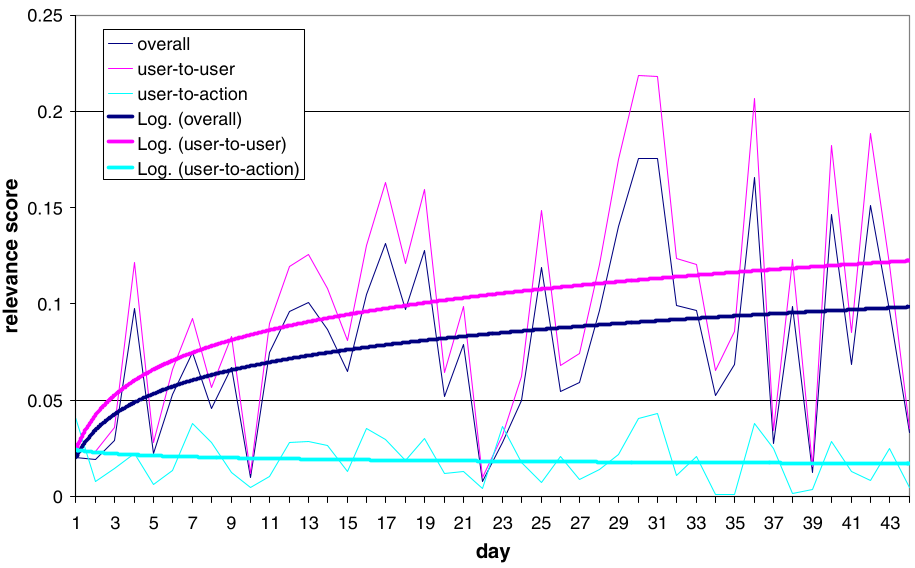
- The Power of Data: The user-to-user relevance scores steadily increased over the 12-week period, validating that the accuracy of personalization improves as the interaction history grows richer.
Critical Insights & Future Directions
The success of this approach lies in its Inductive Bias toward social relationships. By prioritizing "Tie Strength," the algorithm mimics human social psychology—we care more about our inner circle's mundane updates than an outsider's exciting news.
However, there are two points of professional critique to consider:
- Ranking Bias: The authors acknowledge that high-ranked items are clicked more often simply because of their position. Future models need to decouple "relevance" from "positional bias."
- Static Weighting: The weights (e.g., ) were manually assigned. Modern systems would likely use RankNet or LambdaMART to learn these weights dynamically from user feedback.
Conclusion
This work serves as a robust proof-of-concept for personalized social feeds. It demonstrates that combining observable interaction factors into a cohesive relevance score effectively battles information overload and creates a more engaging social experience.