
Precise Scrambling: A Selective Encryption Approach for H.264/AVC in Social Networks
A selective encryption scheme for protecting H.264/AVC video in multimedia social network
This paper introduces a fast selective encryption scheme for H.264/AVC video tailored for multimedia social networks. By encrypting specific syntax elements—Intra Prediction Modes (IPMs), Motion Vector Differences (MVDs), and sign bits of DCT coefficients—it achieves high security with minimal computational overhead and zero impact on bitrate.
TL;DR
To protect video privacy in multimedia social networks without sacrificing performance, researchers have developed a selective encryption scheme that only masks critical parts of the H.264/AVC bitstream. By intelligently choosing which bits to encrypt based on the Quantization Parameter (QP) and Macroblock type, this method achieves total visual scrambling with an 83% reduction in time consumption and zero bitrate overhead.
Problem & Motivation: The Real-Time Security Dilemma
In the era of YouTube, TikTok, and Facebook, video data is the dominant traffic. However, traditional encryption (AES-encrypting the whole file) is a "brute-force" solution that creates two major hurdles:
- Computational Bottleneck: Mobile devices struggle to decrypt high-resolution streams in real-time.
- Format Incompatibility: Standard players cannot recognize "raw" encrypted data, making the stream unplayable and untransmittable via standard protocols.
The authors observed that previous "selective" methods were often inefficient—encrypting bits that didn't contribute to visual distortion or failing to account for how compression levels (QP) affect the encryption's effectiveness.
Methodology: The "Selective" Insight
The paper's breakthrough is based on two critical observations of the H.264 architecture:
1. The QP-T1s Relationship
In H.264's CAVLC entropy coding, "Trailing Ones" (T1s) are coefficients with values of ±1. The authors discovered that when the Quantization Parameter (QP) is low, encrypting T1s does almost nothing to hide the image because most energy is stored in the "Remaining Levels" (RLevel). Consequently, they introduced a threshold () to determine whether T1s encryption is worth the CPU cycles.
2. Intra vs. Inter Macroblock Priority
The researchers found that encrypting Intra-macroblocks (I-MB) provides massive visual distortion that propagates through the video, whereas encrypting Inter-macroblocks (P-MB) only adds slight noise. By focusing encryption on I-MBs and the signs of Motion Vector Differences (MVD), they achieved maximum "scrambling" with minimum data modification.
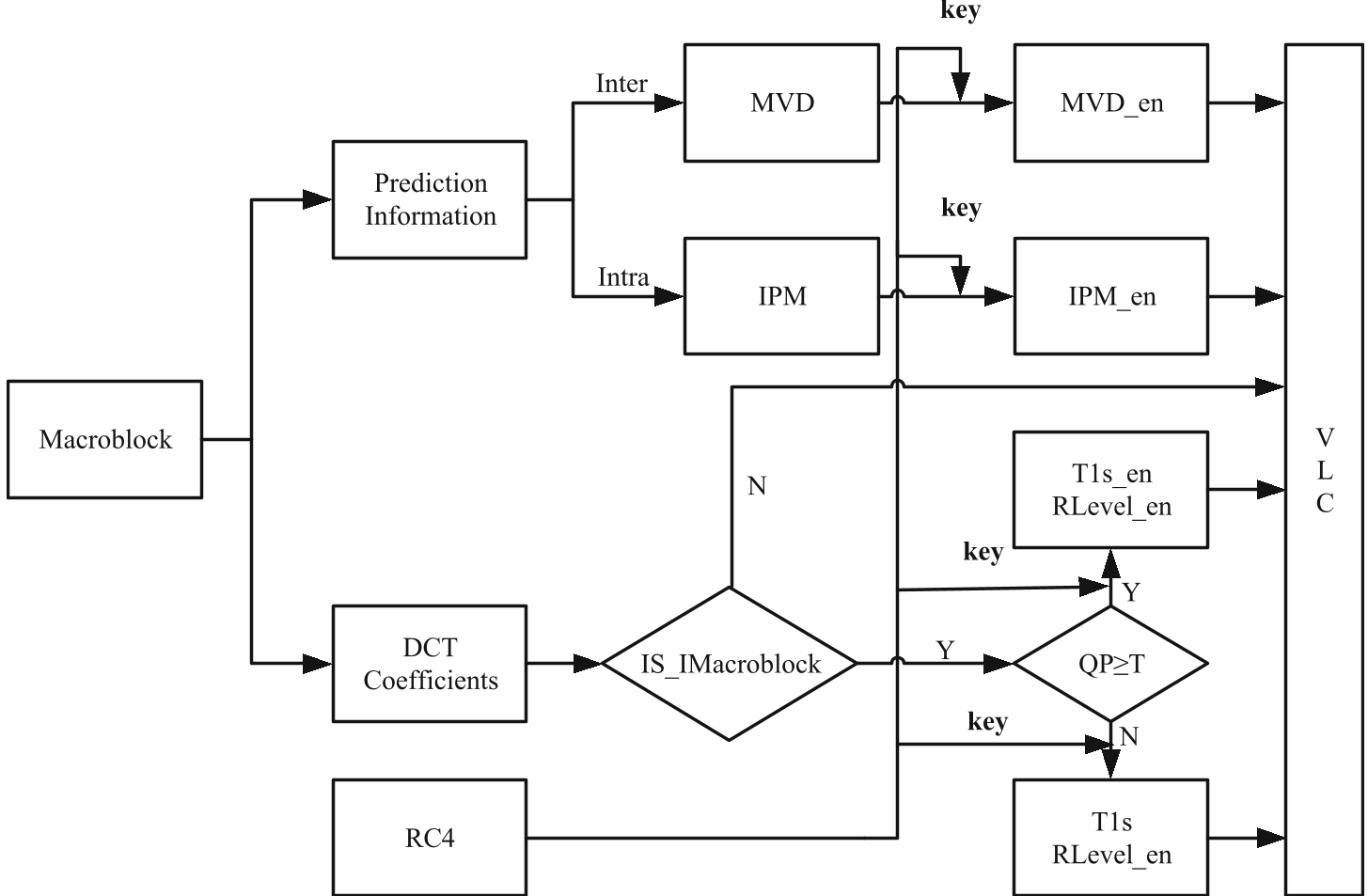 Figure 1: The framework of the proposed selective encryption scheme integrated into the H.264 encoding pipeline.
Experiments & Results: Efficiency without Compromise
The scheme was tested against 9 benchmark video sequences (e.g., Foreman, Bus, City).
- Visual Protection: The Average PSNR dropped to ~15 dB and SSIM to ~0.11. To a human eye, the video is rendered as unrecognizable noise, making it useless to unauthorized eavesdroppers.
- High Performance: Because the algorithm utilizes XOR operations on selected syntax elements and the RC4 stream cipher, it is incredibly fast.
- Bitrate Neutral: Unlike some watermarking or encryption schemes that add padding, the bitrate increment here was found to be a mere 0.001%.
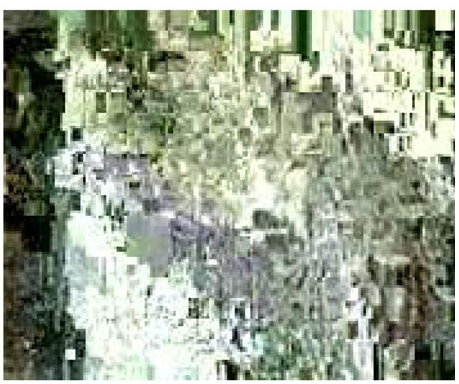 Figure 2: Visual comparison between original frames and encrypted content. The content is completely obscured.
| Metric | Prior SOTA (Method [31]) | Proposed Method | Improvement |
|---|---|---|---|
| Encrypted Bits | ~580,000 | ~70,000 | ~87% Reduction |
| Time (ms) | ~35.0 | ~6.0 | ~83% Faster |
| Bitrate Change | No change | No change | - |
Critical Analysis & Conclusion
Takeaway
This paper serves as a masterclass in "Application-Aware Security." By understanding the underlying physics of video compression (DCT energy distribution and motion prediction), the authors created a solution that is tailored for the specific constraints of social networks.
Limitations
While RC4 is used for speed, it is worth noting that RC4 has known cryptographic vulnerabilities in some contexts. Future work could benefit from using more modern stream ciphers or lightweight iterations of AES-CTR. Furthermore, as the world moves toward H.265 (HEVC) and H.266 (VVC), the specific syntax elements would need to be re-mapped to the newer standards.
Future Outlook
As Multimedia Social Networks (MSN) transition toward more decentralized or cloud-based distribution, selective encryption will be vital for Digital Rights Management (DRM), allowing platforms to preview content without revealing privacy-sensitive details.