
Relational Capitals: The Hidden Engine of Social Media Self-Disclosure
Self-disclosure at social networking sites: An exploration through relational capitals
This research investigates the drivers of self-disclosure on social networking sites (SNS) using Social Capital Theory. It identifies trust, reciprocity, and community identification as critical "relational capitals" that fuel member interactions and content generation, achieving a validated structural model with a sample of 222 users.
TL;DR
Why do we share our personal lives on social media? While most research frets over privacy risks, this classic paper by Rui Chen and Sushil Sharma argues that Relational Capital—the assets built through human connection—is the real driver. By validating a model involving Trust, Reciprocity, and Identification, the authors prove that people disclose more not when they feel "safe," but when they feel like they belong.
Motivation: Beyond the Privacy Paranoia
For years, the academic consensus on Social Networking Sites (SNS) was dominated by the "Privacy Paradox": users say they care about privacy but share everything anyway. Most literature focused on the inhibitors—what stops us from sharing.
Chen and Sharma argue this is only half the story. If self-disclosure is the lifeblood of Web 2.0 (fueling user-generated content and targeted advertising), we must understand the catalysts. They posit that Social Capital Theory (SCT) holds the key, specifically the Relational Dimension.
Methodology: The Relational Capital Framework
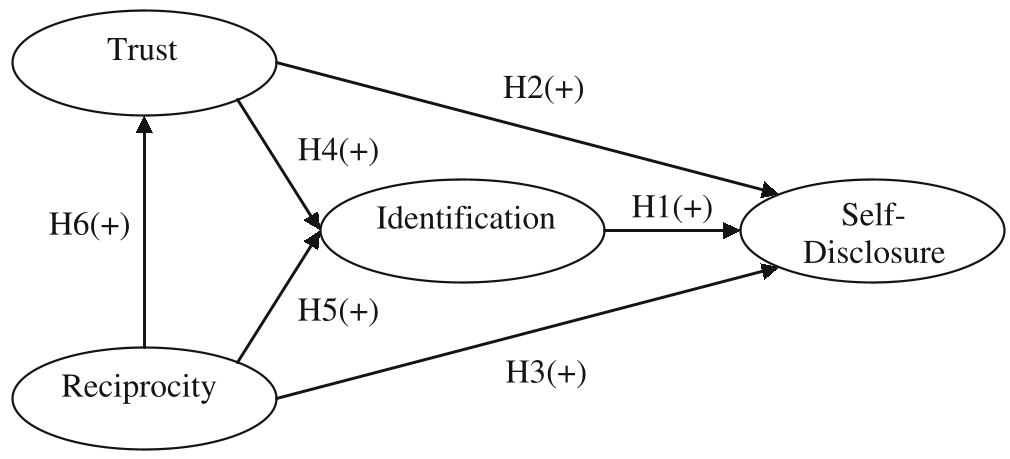
The authors break down relational capital into three distinct but interconnected pillars:
- Trust: The expectation of predictable, fair behavior from others.
- Reciprocity: The "I scratch your back, you scratch mine" social contract.
- Identification: The sense of "togetherness" or belonging to the digital community.
The unique insight here is treating self-disclosure as a "Citizenship Behavior"—a voluntary act that benefits the collective, much like helping a colleague at work.
Key Findings: Disclosure Begets Disclosure
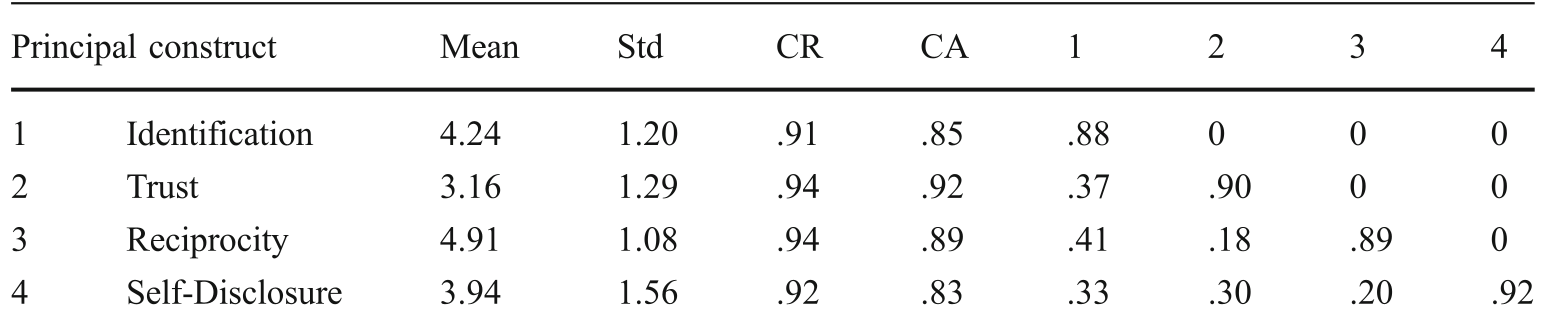
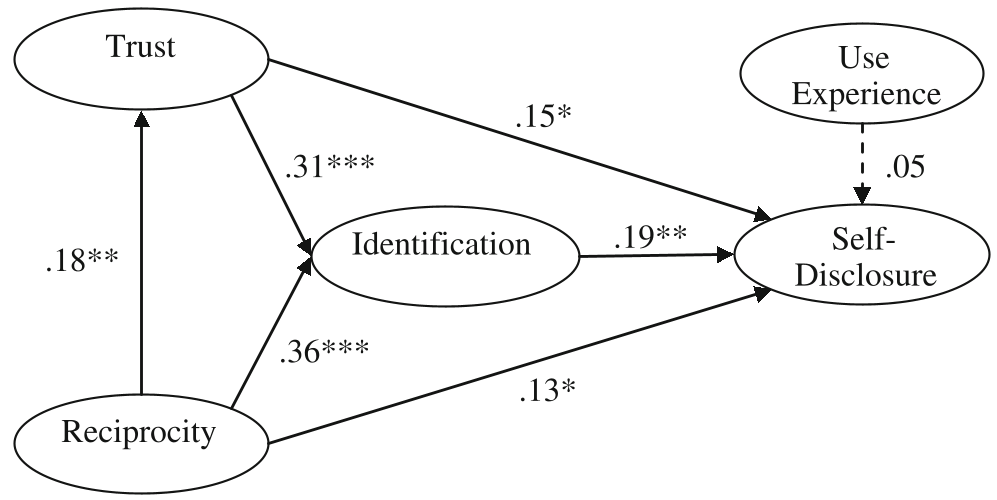
Using survey data from 222 SNS users and Partial Least Squares (PLS) analysis, the study confirmed:
- The Trinity of Sharing: Identification, Trust, and Reciprocity are all significant positive predictors of self-disclosure.
- The Chain Reaction: Reciprocity doesn't just drive sharing; it also builds Trust (β = 0.18) and Identification (β = 0.36).
- Belonging is Power: Community Identification had the strongest relative path to self-disclosure, suggesting that platform loyalty is the ultimate driver of content creation.
Critical Insight: The Internal Mechanics of Capital
The paper’s most significant contribution to Social Capital Theory is uncovering the internal relationships between these capitals. Previously, researchers often treated Trust and Reciprocity as parallel. Chen and Sharma demonstrate a hierarchy: Reciprocity acts as a "testing ground." By reciprocating small disclosures, users progressively build the Trust and Identification necessary for deeper, more sensitive self-disclosure.
Strategic Implications
For product managers and platform architects, the "Takeaway" is clear:
- Don't just fix privacy settings: Building better "blocking" tools won't increase engagement.
- Engineered Reciprocity: Features that encourage low-stakes mutual interaction (like "likes" or "nudge" features) are the foundational steps toward building high-trust communities.
- Identity Building: Honoring long-term users and creating subgroup identities (Identification) is more effective for content growth than simple gamification.
Conclusion
While the study's reliance on self-reported data from college students is a noted limitation, it remains a foundational work in shifting the SNS narrative from "risk management" to "relationship management." It proves that in the digital age, our willingness to be known is directly proportional to how much we value the community we are in.