
The Rhythm of Society: How Dual Phase Evolution Shapes Social Networks
Self-organization in Simulated Social Networks
2009-01-01
Summary
Problem
Method
Results
Takeaways
Abstract
The paper explores the emergence of social network topologies using a Boolean Network model. It introduces Dual Phase Evolution (DPE), a mechanism alternating between local interactions (selection based on similarity) and global interactions (random variation), effectively producing modular and chained structures found in real-world social systems.
## Executive Summary
**TL;DR**: Why do human social networks form distinct modules and long chains rather than just being a chaotic mess of connections? This paper demonstrates that social structure emerges from a "two-beat" pulse called **Dual Phase Evolution (DPE)**. By alternating between making random new friends (Global phase) and keeping only those similar to us (Local phase), societies spontaneously organize into the complex patterns we see in the real world.
**Academic Positioning**: This work bridges the gap between simple network models (like Erdos-Renyi) and complex sociological observations, providing a mechanistic explanation for the "Small World" and "Chains of Affection" phenomena through the lens of complexity science.
## The Problem: The Failure of Single-Phase Thinking
Prior research into social networks often focused on either extreme:
1. **Purely Local Interaction**: People only talk to those exactly like them. In simulations, this "echo chamber" effect leads to total fragmentation—eventually, everyone becomes an isolated island.
2. **Purely Global Interaction**: Random connections are made without preference. This results in a dense, disorganized "spaghetti" of links with no internal structure or distinctive "cliques."
The authors argue that real life isn't just one or the other; it's a dynamic oscillation between the two.
## Methodology: The Boolean Social Model
To strip away human complexity and focus on *network* complexity, the authors used **Boolean Networks**.
- **Nodes**: Represent individuals with "Attributes" (e.g., age, ethnicity, or interests).
- **Edges**: Represent social ties with a "weight." Ties get stronger when people meet and weaker over time if they don't.
- **The DPE Mechanism**:
- **Global Phase**: Occurs intermittently. It’s like a "social disturbance" (a large party or a town hall) where random new links are formed.
- **Local Phase**: The daily grind. People preferentially interact with those who share similar attributes. If you aren't similar, the link eventually breaks.
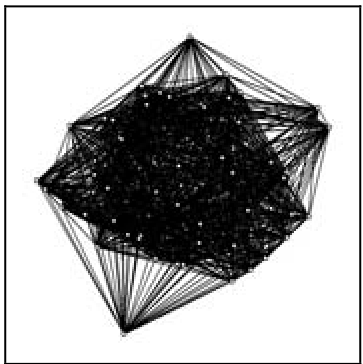
*Fig 1. Visualizing the transition: (a) Initial state, (b) Local phase decay, (c) Global phase randomness, and (d-f) The emergence of modularity via DPE.*
## Key Experiments and Results
### 1. The Emergence of Modularity
In Experiment 1, when DPE was applied, the network didn't collapse or become a mess. Instead, it formed **Modules**. Nodes with similar attribute values clustered together, creating high internal connectivity but few links to "outsiders."
### 2. Sensitivity and "M" Modularity
The researchers measured modularity using a metric called **M**. They found that the integrity of these social modules depends heavily on the "Social Pulse":
- **Diversity of Attributes**: If there are too many unique attribute states, permanent links become too hard to maintain, and modules break down.
- **Frequency of Global Events**: If global "disturbances" happen too rarely, the modules wither away. The "noise" of random encounters is actually what keeps the structure alive.
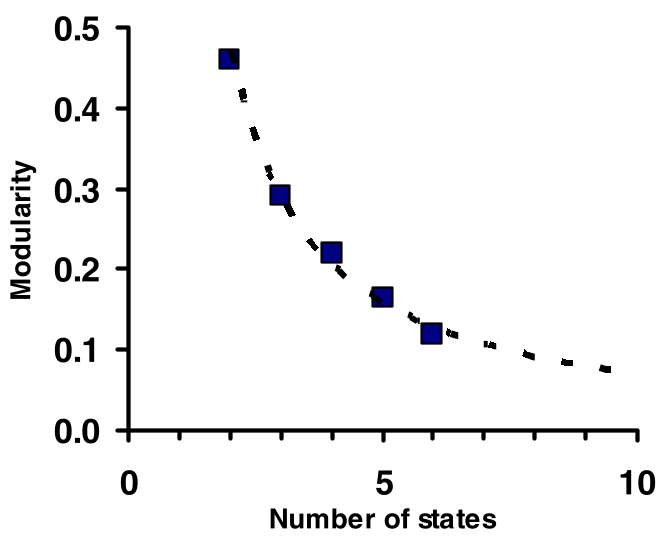
*Fig 2. How the number of attributes and the time between global events affect the M-modularity of the system.*
### 3. Replicating the "Jefferson High" Effect
In Experiment 3, by switching from one complex attribute to several binary ones (yes/no traits), the model produced a striking result: **Long chains and loops**. This perfectly mirrors the famous Bearman study on adolescent romantic networks. While Bearman suggested this happened because people "avoided their friends' exes," this paper shows such a structure can emerge *simply* from the fundamental DPE process.
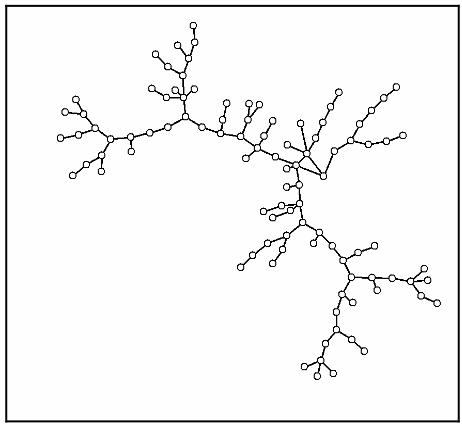
*Fig 3. Simulated social chains that mirror real-world sociological observations.*
## Critical Analysis & Conclusion
**Takeaway**: The study proves that self-organization in social contexts doesn't require complex individual strategies. Simple "selection" (local similarity) plus intermittent "variation" (global randomness) is enough to build the scaffolds of society.
**Limitations**: The model assumes attributes are static. In reality, peer influence causes people to change their opinions to match their friends. Future research needs to combine **DPE** with **Opinion Dynamics** to see how the network topology and the people's minds co-evolve.
**Future Outlook**: This DPE framework is a powerful tool for understanding how "disturbances"—like technological shifts or migrating populations—actually help reorganize and sustain social structures rather than just breaking them.