
SOBELC: Mimicking Brain Plasticity for Robust Mobile Robot Control
15404_Self-Organizing Brain Emotional Learning Controller Network for Intelligent Control System of Mobile Robots.
The paper introduces the Self-Organizing Brain Emotional Learning Controller network (SOBELC), a neuro-inspired adaptive control system for mobile robot trajectory tracking. It combines Brain Emotional Learning (BEL) with self-organizing Radial Basis Function (RBF) networks to handle uncertain disturbances and achieve SOTA tracking accuracy.
TL;DR
Researchers have developed a new neuro-inspired controller called SOBELC that mimics the human brain's emotional learning and structural plasticity. By dynamically adding and pruning neurons in real-time, it solves the long-standing problem of trajectory tracking for mobile robots under unpredictable external disturbances, outperforming traditional static neural networks in both accuracy and computational efficiency.
Background: The Problem with "Static" Intelligence
Autonomous mobile robots operate in a world of noise. Whether it's floor friction, wind, or payload shifts, these "uncertain disturbances" make precise trajectory tracking a nightmare for standard controllers. Traditional Artificial Neural Networks (ANNs) often feature a fixed architecture. If the network is too small, it can't approximate complex non-linear forces; if it's too large, it wastes battery life and slows down real-time response.
The motivation behind this research was to create a controller that doesn't just learn weights, but learns its own shape.
Methodology: The SOBELC Architecture
The proposed Self-Organizing Brain Emotional Learning Controller (SOBELC) is built on a dual-pathway mechanism inspired by the Mammalian limbic system:
- Orbitofrontal Channel (The Logic): Responsible for the "judgment" and emotional response, providing a stable baseline for control.
- Amygdala Channel (The Sensory Reactivity): This is where the magic happens. It uses a Self-Organizing RBF Network that changes its size based on the task demand.
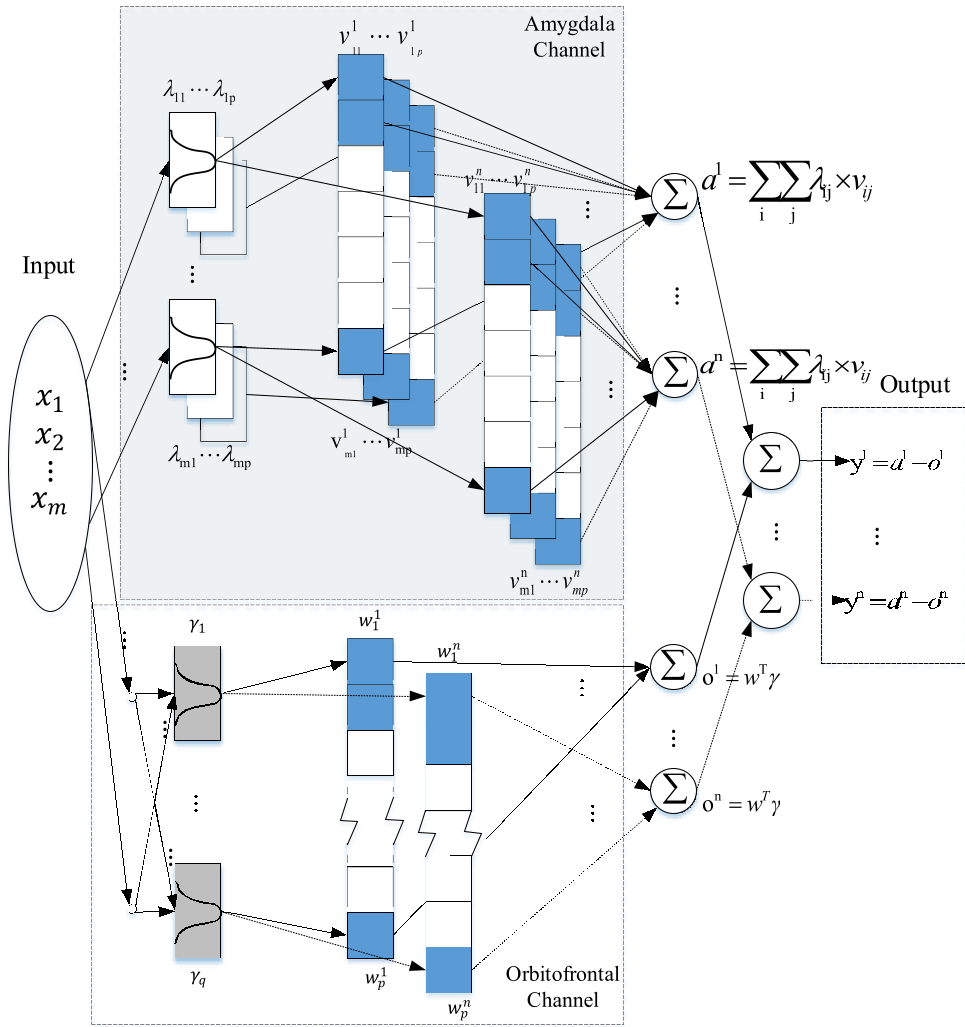
The Growth and Pruning Mechanism
Unlike standard networks, SOBELC employs a two-step structural update:
- Neuron Increasing: If the current neurons don't "recognize" a new disturbance (low activation), a new neuron is instantly spawned to handle the error.
- Neuron Decreasing: A "significance" index tracks each neuron's contribution. If a neuron becomes redundant or its influence fades, it is pruned to save computational energy.
Proving Stability via Math
A major contribution of this work is the use of Lyapunov Stability Theory. The authors didn't just design a "black box"; they mathematically proved that the tracking error effectively converges to zero (), guaranteeing that the robot won't spirally go out of control during the learning phase.
Experimental Showdown
The team tested SOBELC against three cutting-edge baselines: TSK-CMAC, BELC, and AF-BELC. They simulated a robot following a complex "Figure-8" trajectory while being hit with varying levels of sinusoidal disturbances.

Key Findings:
- Higher Precision: SOBELC achieved the lowest Root Mean Square Error (RMSE) across all test cases.
- Robustness to Scale: Interestingly, SOBELC performed even better relative to competitors when the disturbance level was doubled (), demonstrating the power of its adaptive structure.
- Efficiency: The network size fluctuated between 8 and 20 neurons, maintaining a lean profile compared to high-dimensional fixed networks.
Critical Analysis & Future Outlook
While SOBELC shows remarkable resilience, it is currently validated in a simulated environment. The true test will be its implementation on physical hardware where sensor noise is non-Gaussian and communication latency exists.
The authors suggest that the next frontier is integrating Type-2 Fuzzy Logic, which could provide an even higher level of abstraction for "uncertainty about uncertainty."
Takeaway for Roboticists
In the world of high-speed robotics, structural plasticity is as important as parameter optimization. If your controller cannot adapt its complexity to the environment, it will eventually be overwhelmed by the "noise" of the real world.