
ASTERIS: Redefining the Limits of the Deep Universe via Spatiotemporal Denoising
Deeper detection limits in astronomical imaging using self-supervised spatiotemporal denoising
The paper introduces ASTERIS, a self-supervised transformer-based denoising algorithm designed for astronomical imaging. It leverages spatiotemporal correlations across multiple dithered exposures to surpass conventional co-addition (stacking) limits, achieving a ~1.0 magnitude improvement in detection depth for JWST data while maintaining photometric and PSF integrity.
Executive Summary
TL;DR: ASTERIS is a new self-supervised deep learning framework that pushes the detection boundaries of telescopes like JWST by 1.0 magnitude—a feat that would typically require increasing exposure times by nearly an order of magnitude. By learning the "hidden" correlations in the noise across multiple exposures, it uncovers faint, high-redshift galaxies (z > 9) previously buried under the background.
Background Positioning: This work represents a shift from traditional image stacking (co-addition) to AI-native signal reconstruction. While co-addition has been the bedrock of astronomy for decades, ASTERIS proves that the assumption of independent noise is a bottleneck that deep learning can now break.
Problem & Motivation: The "Exposure Time" Trap
In observational astronomy, the "depth" of an image depends on the Signal-to-Noise Ratio (S/N). To see targets twice as faint, you typically need to observe for four times as long. For the James Webb Space Telescope (JWST), moving the detection limit from 31 to 32 magnitudes in certain bands would require extending observation from 4 days to an entire month.
The culprit is not just photon noise, but structured background noise (e.g., zodiacal emission, instrumental artifacts). Standard "co-addition" methods simply average frames, assuming noise is random and independent at each pixel. However, the telescope's own Point Spread Function (PSF) and atmospheric effects create spatial and temporal correlations that traditional averaging simply cannot erase.
Methodology: Mining Diamonds in the Noise
1. The Spatiotemporal Transformer Architecture
ASTERIS moves beyond 2D convolution. It treats a stack of dithered exposures as a 3D voxel grid (Spatial , + Temporal ).
- 3D Multi-Deconvolved-Head-Transposed-Attention (3D-MDTA): Unlike standard CNNs with local receptive fields, this attention mechanism captures long-range dependencies across both the image area and the exposure sequence.
- Hierarchical Features: A 3D U-Net structure allows the model to fuse multi-scale features, ensuring that tiny point sources and large diffuse nebulae are equally well-preserved.
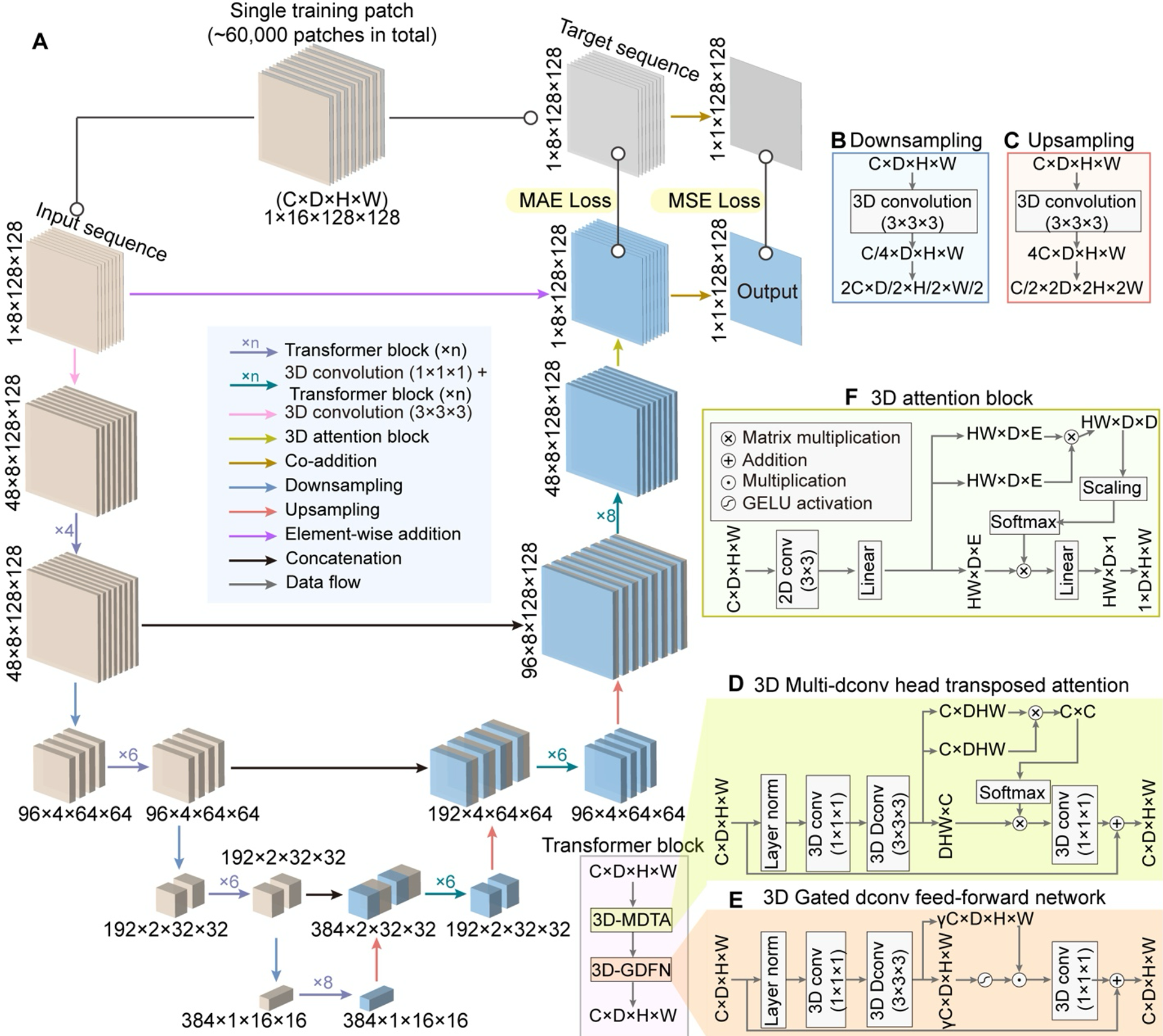 Fig 1. The ASTERIS spatiotemporal transformer architecture.
2. Self-Supervised Learning (No "Clean" Data Needed)
The primary challenge in space denoising is that "ground truth" (noise-free) images do not exist. ASTERIS solves this using an extension of the Noise2Noise concept:
- It splits 16 exposures into two independent sets (Input/Target).
- Dual Loss Function: It minimizes MSE (Mean Squared Error) to estimate the signal expectation and MAE (Mean Absolute Error) to reject outliers (like cosmic rays).
- 3σ Clipping: Crucially, ASTERIS only processes the "faint" pixels. Bright stars (S/N > 3) are preserved via standard median co-addition, preventing the neural network from "hallucinating" or distorting known high-quality signals.
Experiments & Results: Tripling the Discovery Rate
Quantitative Superiority
Compared to standard stacking and single-frame deep learning denoisers (like Restormer or N2N), ASTERIS shows a massive gap in performance:
- Completeness: At 90% completeness, it is ~1.0 magnitude deeper than traditional methods.
- High-Redshift Count: Applied to the JADES Origins Field (JOF), ASTERIS detected 162 high-redshift galaxy candidates (z > 9)—nearly triple the ~50-60 candidates identified by previous SOTA studies.
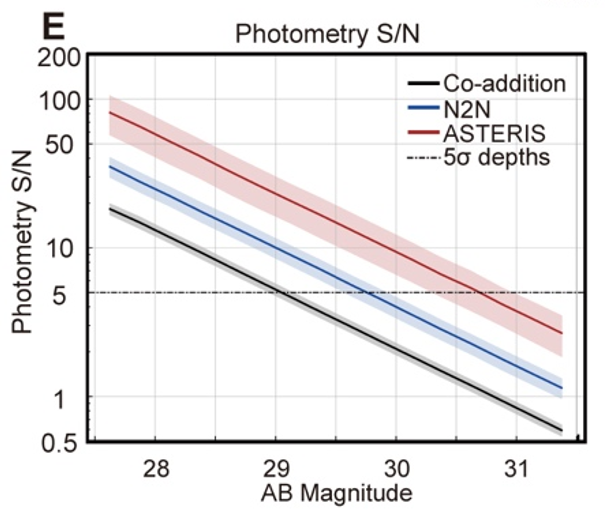 Fig 2. Detection completeness and purity comparison, showing ASTERIS (red) far outperforming co-addition (black).
Preserving Science
A major fear with AI in astronomy is the "hallucination" of sources. ASTERIS addresses this through:
- PSF Fidelity: A Kolmogorov–Smirnov test proved the PSF shapes remained identical to original data ().
- Photometric Accuracy: Flux measurements of faint sources remained consistent with theoretical expectations.
Critical Analysis & Conclusion
Takeaway
ASTERIS effectively turns a 1-day observation into the equivalent of a 10-day observation in terms of depth. By utilizing the temporal dimension (the sequence of dithers) rather than treating exposures as isolated 2D snapshots, it recovers information that was previously considered "lost" to the noise floor.
Limitations & Future Work
- Even-Number Constraint: Currently, the architecture requires an even number of input exposures.
- Instrument Tuning: While it generalizes well, a model trained on JWST requires retraining for ground-based telescopes (like Subaru) due to different noise characteristics (atmospheric turbulence).
- Future Prospects: This logic could be applied to any high-dimensional scientific imaging, from cryo-electron microscopy to medical tomography, where repeated low-dose exposures are the norm.
Scientific Citation: Guo, Y. et al. (2026). Deeper detection limits in astronomical imaging using self-supervised spatiotemporal denoising. Science / arXiv.