
Self-Taught Learning: Making Clinical AI Cost-Effective via Exponential Family Sparse Coding
Self-taught learning via exponential family sparse coding for cost-effective patient thought record categorization
The paper introduces a cost-effective framework for categorizing patient Thought Records (TR) in Cognitive Behavior Therapy (CBT) using Self-Taught Learning via Exponential Family Sparse Coding. By leveraging large-scale, unlabeled auxiliary text (e.g., from the internet) to learn semantic prototypes, the method achieves SOTA categorization accuracy (66.9%) even with extremely limited labeled clinical data.
TL;DR
In the specialized world of Cognitive Behavior Therapy (CBT), "Thought Records" (TR) are goldmines of diagnostic data but are notoriously expensive to collect and label. This paper presents a breakthrough: instead of demanding more clinical data, the authors use Self-Taught Learning to "borrow" semantic structures from the open internet. By upgrading the underlying mathematics from Gaussian to Exponential Family Sparse Coding, they achieved a significant leap in categorization accuracy (reaching 66.9%), providing a blueprint for high-performance AI in data-scarce medical environments.
1. The Bottleneck: The High Price of Clinical Expertise
Automating the categorization of Patient Thought Records is a vital task for assisting new therapists and monitoring depression. However, traditional machine learning hits a wall:
- Data Scarcity: Patient records are private and rare.
- Labeling Costs: Only trained clinicians can accurately label "Thinking Errors" (e.g., Catastrophizing or Mind-reading), making large labeled datasets prohibitively expensive.
- Distribution Mismatch: Standard semi-supervised learning assumes your unlabeled data looks like your labeled data. In CBT, this isn't true—the broad internet doesn't look like a clinical session.
2. The Insight: Learning to Learn from the Internet
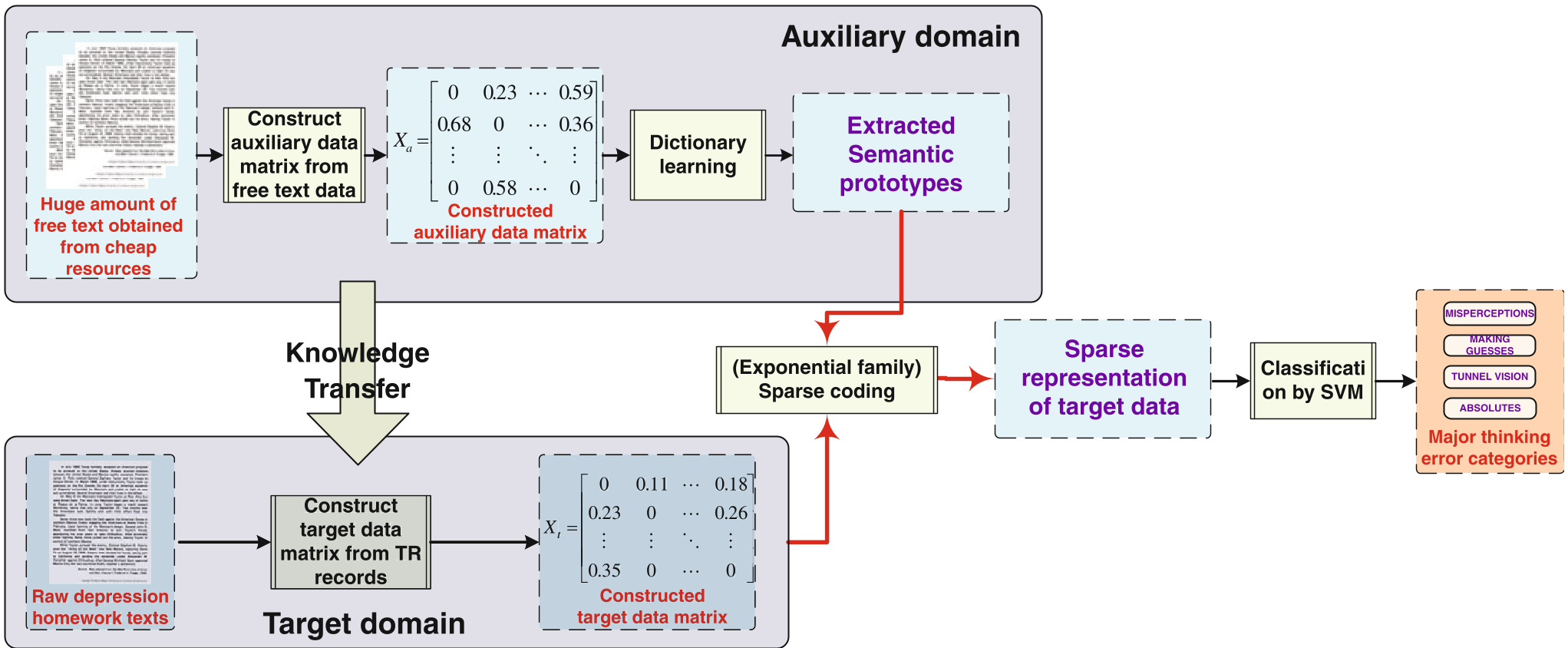
The authors pivot from "supervised learning" to Self-Taught Learning (STL). The core intuition is that even if a Wikipedia article about "Science" has nothing to do with a patient's depression, the semantic patterns and word relationships (prototypes) are universal to the English language.
By learning a "dictionary" of these patterns from the internet, the model creates a higher-level feature space. When a rare patient record is processed, it is mapped onto these robust prototypes, making the classification task much easier for a standard SVM.
3. Methodology: Why Gaussian Isn't Enough
Standard Sparse Coding often assumes data follows a Gaussian Distribution. While fine for images or audio, text data consists of discrete word counts (0, 1, 2...).
The authors argue that a Gaussian assumption leads to a poor fit for discrete clinical text. Instead, they employ Exponential Family Sparse Coding, specifically utilizing the Poisson Distribution. This allows the model to:
- Model the natural parameter as a linear combination of basis vectors and activations .
- Use a log-likelihood objective that is naturally suited for "count" data.
- Ensure convexity in the optimization, making the solution computationally tractable despite the complexity of clinical language.
4. Experimental Evidence: Beating the Baselines
The researchers tested their framework against 36 primary CBT homework texts and 6,345 auxiliary web pages.
SOTA Comparison
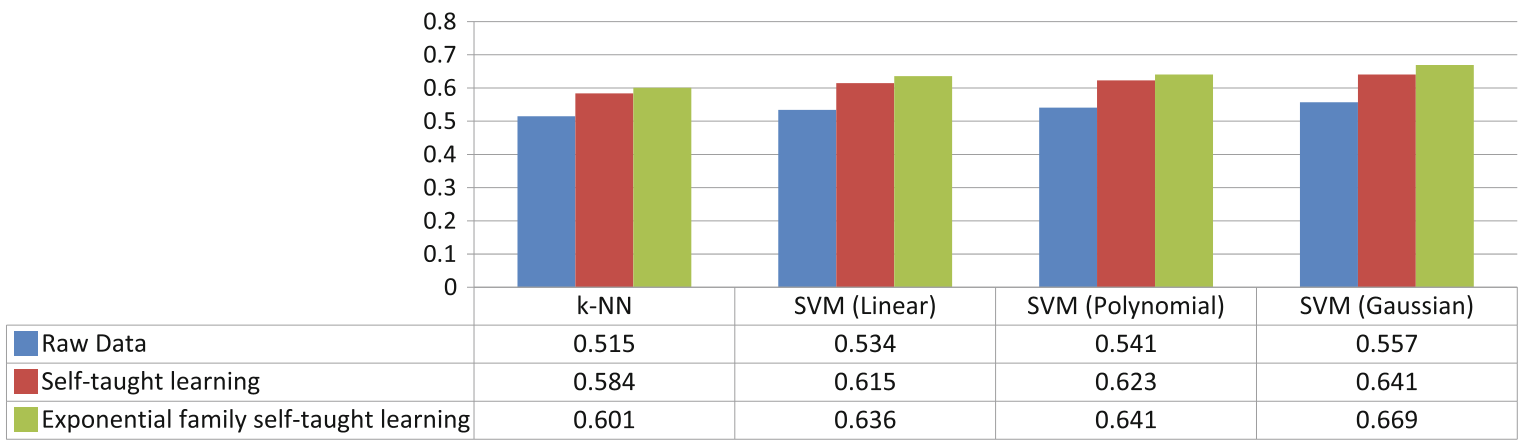
The results were clear: the STL approach significantly outperformed both semi-supervised (TSVM) and other transfer learning (DKT) frameworks.
| Method | Accuracy |
|---|---|
| TSVM (Semi-Supervised) | 0.541 |
| DKT (Transfer Learning) | 0.621 |
| Self-Taught Learning (Proposed) | 0.669 |
The Impact of Distribution Selection
The study also confirmed that matching the math to the data matters. Representing TR records via Poisson-based sparse coding provided a measurable edge over traditional Gaussian encoding.
5. Critical Analysis & Future Outlook
Core Takeaway
The paper proves that for niche domains like psychotherapy, representation learning is more valuable than raw data collection. By extracting a "semantic backbone" from the public web, AI can understand clinical nuances with a fraction of the specialized data usually required.
Limitations
While effective, the dataset (36 records) remains small. Furthermore, the "Bag-of-Words" model used here ignores the temporal sequence of thoughts, which is often crucial in psychological diagnosis.
Future Directions
With the advent of modern Transformers, the "semantic prototypes" learned here via sparse coding can be viewed as an early precursor to "Large Language Model Pre-training." The leap from Poisson sparse coding to Self-Attention mechanisms marks the next step in this journey, but the core lesson remains: Universal knowledge from auxiliary domains is the key to solving specialized high-cost problems.