
Selfie Cafe: Breaking Social Silence with Interactive Urban Computing
Selfie cafe: socialization in public spaces
Selfie Cafe is an Urban Computing application designed to revitalize social interaction in public spaces using interactive projected interfaces. By transforming a common wall into a touchable surface for group selfies, the system successfully acted as a social "ice-breaker" in a university campus setting.
TL;DR
Selfie Cafe is an innovative Urban Computing project that tackles the modern epidemic of "digital isolation." By turning a physical wall into a giant, interactive touch-screen for taking group selfies, researchers successfully doubled the time people spent in public spaces and transformed "Familiar Strangers" into active social participants.
Background: The Paradox of Connectivity
We live in an era where we are more connected than ever digitally, yet increasingly isolated physically. If you walk into any cafe or park, you will likely see a sea of people staring at private screens. The "Selfie Cafe" project, presented at SAC 2015, positions itself not as another app on a phone, but as a shared technological experience designed to pull people’s eyes away from their personal devices and toward the people standing right next to them.
The "Ice-Breaker" Methodology
The authors realized that social barriers are high because people lack a "reason" to talk to a stranger. They leveraged the UbiDisplays framework to create a collaborative environment.
The System Architecture
The setup transforms a mundane kitchen/cafe wall into a social hub through several integrated components:
- Interactive Projection: A Kinect sensor tracks hand movements, allowing users to "touch" a projected interface on a standard wall.
- The Social Loop: Users take a photo (Step 1), which is then instantly broadcast to a large TV display in a carousel (Step 2). Others can then vote for their favorite photos via a mobile website (Step 3).
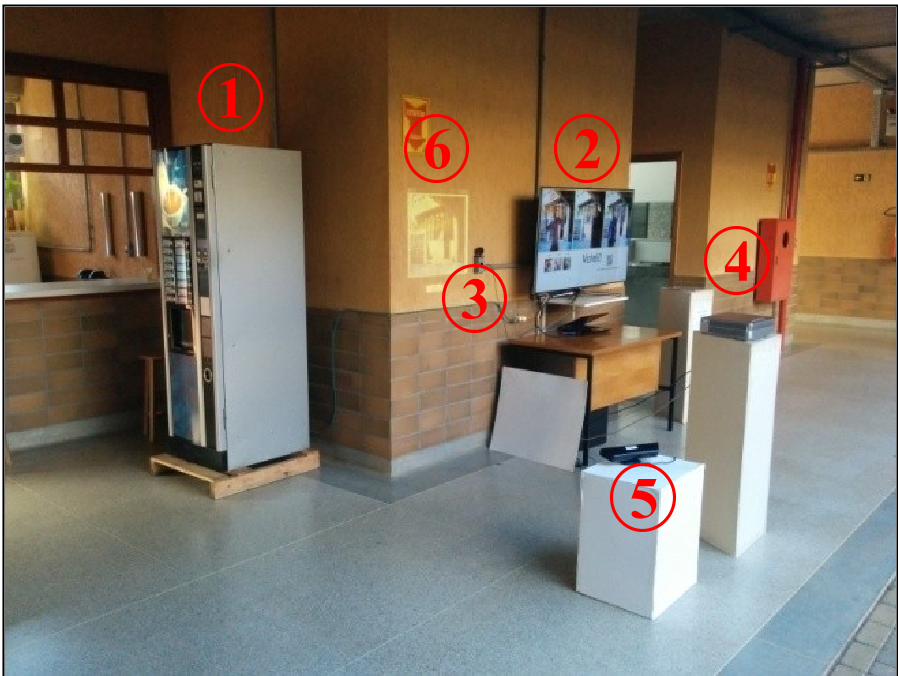 Figure: The Selfie Cafe installation at the Department of Computing, UFSCar.
Why It Works: The Playful Mood
The researchers identified that the novelty of a touchable wall acts as a powerful lure. People are naturally curious about "how it works," which provides a neutral topic for strangers to discuss. This "triangulation"—where a third element (the interface) facilitates a link between two people—is the core mechanism of the experiment.
Experimental Insights: From Minutes to Moments
The "In-the-Wild" deployment provided quantifiable proof of social impact:
- Increased Dwell Time: The average stay in the coffee area jumped from 5 minutes to 10 minutes.
- Collaborative Participation: Only 23% of participants took photos alone. The vast majority (76%) were groups of two, three, or even more, many of whom were strangers before the interaction.
- The "Teacher" Effect: Regular users began teaching strangers how to use the wall, creating a self-sustaining cycle of social tutoring and engagement.
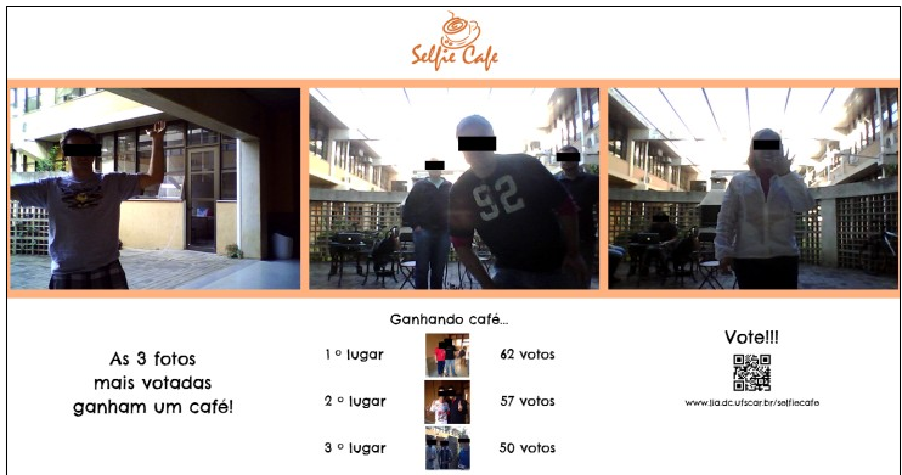 Figure: The display interface showing the photo carousel and voter ranking.
Critical Analysis & Conclusion
While the Selfie Cafe was successful, the authors noted the "Shy User" problem—some individuals only engaged when the space was empty. This suggests that future Urban Computing designs must account for varied levels of social anxiety.
Takeaway for Future Tech
The Selfie Cafe proves that technology doesn't have to be a wall between people; it can be the "bridge." By focusing on tangible, shared interfaces rather than private mobile apps, researchers can reclaim the "playful" nature of public architecture and build more resilient, connected communities.
Key Takeaways:
- Visibility is Vital: Showing social results (the photo carousel) publicly creates a sense of belonging.
- Low Friction/High Reward: Taking a selfie is a low-effort task that yields high social validation (votes/prizes).
- Physicality Matters: Using a wall instead of a tablet makes the interaction a "performance" that invites others to join.