
The Learning Paradox: Why More Security Alerts Can Lead to More Infections
11696_Selfish Response to Epidemic Propagation.
The paper introduces a non-linear dynamical model (SIPS) to study the interaction between epidemic propagation (worms) and the selfish security decisions of network users. Utilizing differential inclusions and game theory, it identifies a "learning paradox" where increasing the rate of security advisories counterintuitively leads to higher equilibrium infection levels.
Executive Summary
TL;DR: In a network of selfish agents, frequently informing users about infection levels (high "learning rate") actually increases the long-term persistence of viruses. This counterintuitive finding suggests that myopic human behavior—switching off security when things seem "safe"—creates a feedback loop that sustains the epidemic.
Context: This work sits at the intersection of Epidemiology and Game Theory. While most models focus on how viruses spread, this paper focuses on how human response to information dictates the virus's survival. It shifts the focus from "how do we stop the virus" to "how do we manage the agents."
The Problem: The Cost of Complacency
In a centralized system, security is mandatory. But in the open Internet or corporate BYOD environments, security is a choice. Users face a tradeoff:
- Protection Cost (): Money, system slowdown, or reduced utility.
- Infection Cost (): Data loss or repair effort.
Prior work often assumed security is a one-time installation. In reality, users are "myopic"—they look at the current state, and if the threat seems low, they turn off their VPNs, skip scans, or disable firewalls to regain performance. This paper explores the danger of this "on-off" behavior triggered by periodic security advisories.
Methodology: The SIPS Model
The authors propose the SIPS (Susceptible-Infected-Protected) model. Unlike the standard SIR model, "Protected" (P) users can return to "Susceptible" (S) if they perceive the risk is low.
The Best-Response Dynamic
Users execute a Best-Response strategy based on a threshold :
- If reported infection : Switch to Protected.
- If reported infection : Switch to Susceptible (to save costs).
The system is modeled as a differential inclusion because at the exact threshold , user behavior becomes multi-valued (indeterministic).
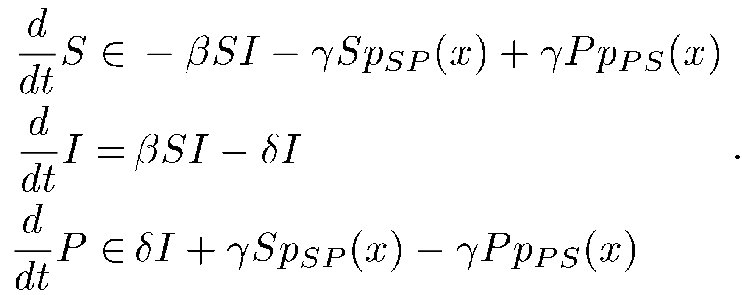 The equations above describe the rate of change for Susceptible (S), Infected (I), and Protected (P) populations.
The Paradox: Why "Learning" Fails
The most striking result is the relationship between the Update Rate ()—how often users are informed—and the Infection Level.
One might assume that better-informed users would stay safer. However, the authors prove that:
- Lower : Users stay in their current state longer. If they are protected, they stay protected even as the virus subsides, keeping the total infection low.
- Higher : Users react instantly to a drop in infection by disabling security. This immediately increases the pool of susceptible hosts, allowing the virus to rebound quickly.
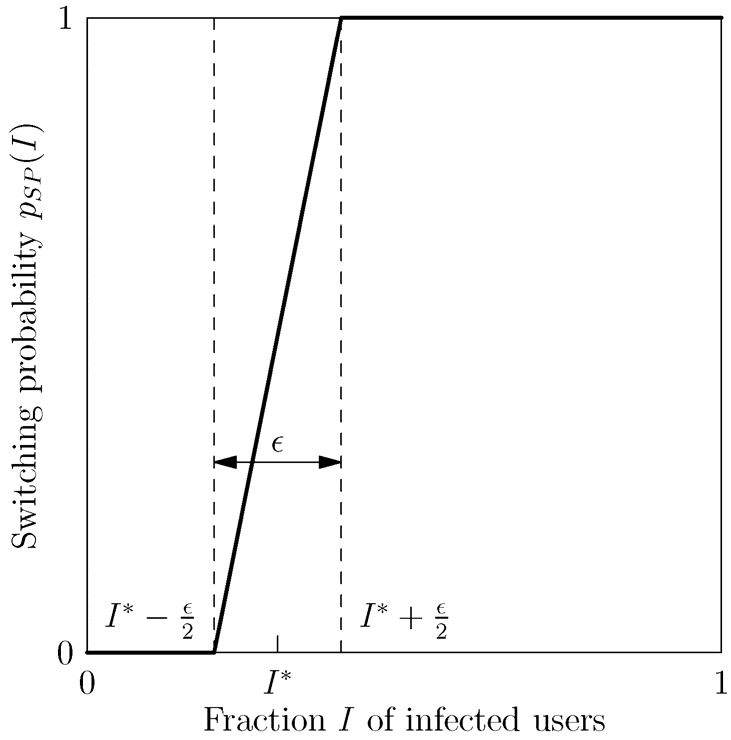 The figure shows that the fraction of infected users increases as the update rate increases, until it hits the threshold .
Experimental Proof: From Math to Human Traces
The authors validated their theoretical proofs using Bluetooth contact traces of 41 humans. They tested scenarios with:
- Homogeneous groups: Everyone has the same risk tolerance.
- Heterogeneous groups: "Responsible" users (low threshold) vs. "Selfish" users (high threshold).
Even with complex, non-uniform human contact patterns, the result held: the more often you tell people the virus is gone, the faster it comes back.
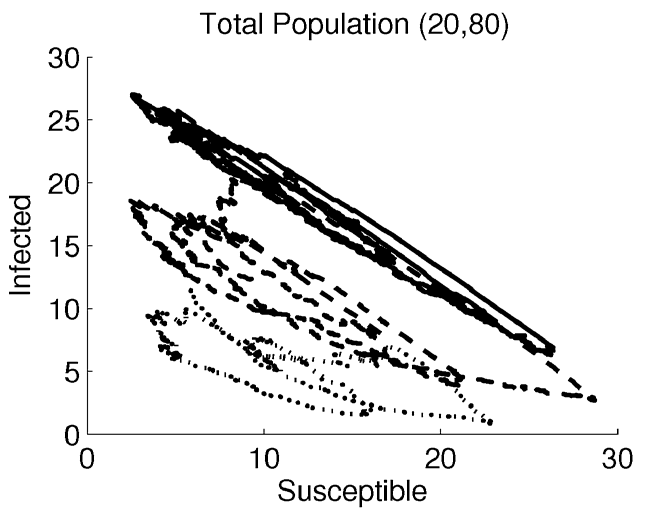 Traces showing how different subpopulations behave. Selfish users (high threshold) drive the overall infection higher when updates are frequent.
Critical Insight & Policy Implications
This paper reveals a fundamental flaw in "transparency-only" security policies. If agents are selfish and myopic, transparency fuels volatility and endemicity.
Proposed Solutions:
- Threshold-based Advisories: Only inform users when infection is above the threshold. Stop informing them when it stays low to prevent them from prematurely disabling security.
- Shifting Costs: Make the cost of protection lower (subsidies) or the cost of infection higher (liability/fines) to naturally lower the threshold .
- Automated Continuity: Move security decisions away from the user to prevent myopic deactivation.
Conclusion
The "Selfish Response" paper provides a rigorous mathematical foundation for why human-in-the-loop security is often the weakest link. By proving that information frequency can be an "epidemic driver," it forces a rethink of how we design security notification systems in decentralized networks.