
Beyond Metadata: Decoding the Semantic-Affective Coupling in Multimedia Databases
Towards semantic and affective coupling in emotionally annotated databases
This paper introduces the concept of "semantic-affective coupling," a deterministic relationship between a multimedia document's descriptive content and the emotions it elicits. By formalizing this link, the authors propose a semi-automatic construction method for emotionally annotated databases (like IAPS), significantly reducing the manual labor required for affective tagging.
TL;DR
Researchers from the University of Zagreb have formalized the semantic-affective coupling—the deterministic link between what a multimedia file contains (semantics) and how it makes us feel (affect). By recognizing that similar objects and events trigger predictable emotional responses, they propose an algorithmic framework to automate the creation of emotionally annotated databases, moving away from slow, manual human tagging experiments.
Background: The Cost of Emotion
In fields like stress-disorder therapy and human-computer interaction (HCI), researchers rely on Emotionally Annotated Databases (e.g., IAPS, GAPED). These repositories are meticulously tagged with emotional values such as Valence (pleasure) and Arousal (intensity).
However, the current workflow is a bottleneck:
- Expert Heaviness: Requires psychological experiments with statistically significant populations.
- Rigidity: Hard to add new stimuli without repeating the entire validation process.
- Semantic Gap: Metadata often fails to capture the "knowledge" within the stimulus that drives the emotion.
The Core Insight: Semantic-Affective Coupling
The authors argue that the relationship between semantics () and emotion () is not random. It is governed by personal experience and collective memory. They define a surjective function , where similar coordinates in the semantic space (descriptors like "cheeseburger" and "cake") result in neighboring coordinates in the emotion space.
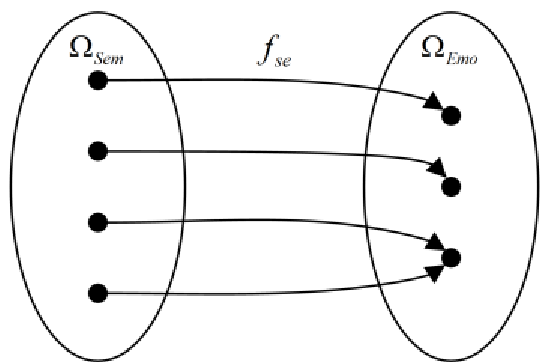 Figure: The mapping from a complex semantic space to the simplified Val-Ar (Valence-Arousal) emotion plane.
Validating the Theory with IAPS
To prove this, the team analyzed the International Affective Picture System (IAPS). By clustering images by semantic tags (Animals, Food, Sports), they found that these clusters formed tight, predictable "clouds" on the emotional map.
- The Food Cluster: Generally high valence, moderate arousal.
- The Attack Sports Cluster: Lower valence, very high arousal.
- The Danger/Death Cluster: Low valence, high arousal.
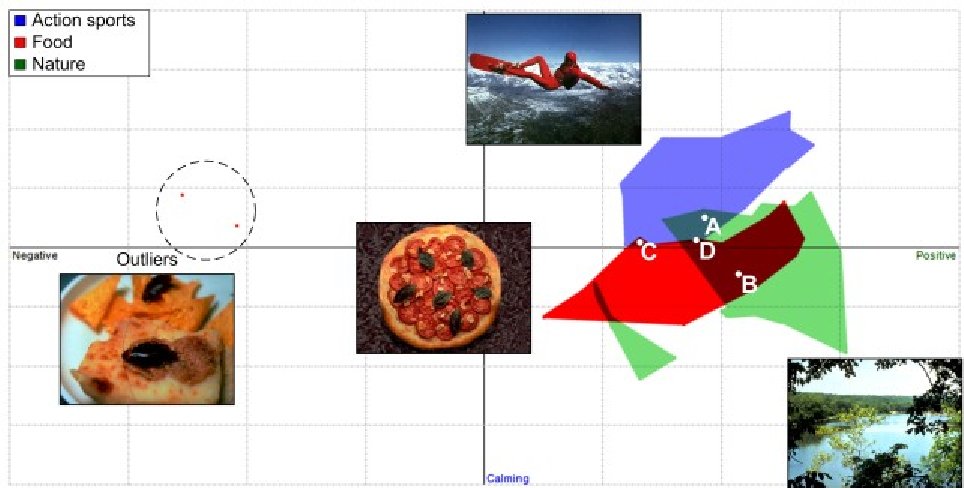 Figure: Clear evidence of coupling. Stimuli with similar semantics (Food, Nature, Sports) group into distinctive affective areas.
The Proposed Algorithm: Accelerating Database Growth
The centerpiece of the paper is an iterative algorithm for "Supported Construction." Instead of starting from scratch:
- Input: A new stimulus with known semantics (e.g., via automated image recognition).
- Retrieval: The system compares its semantics to existing stimuli in the database.
- Estimation: The algorithm suggests the most probable emotional tags.
- Feedback: A human expert confirms or refines the tag, improving the system's mapping over time.
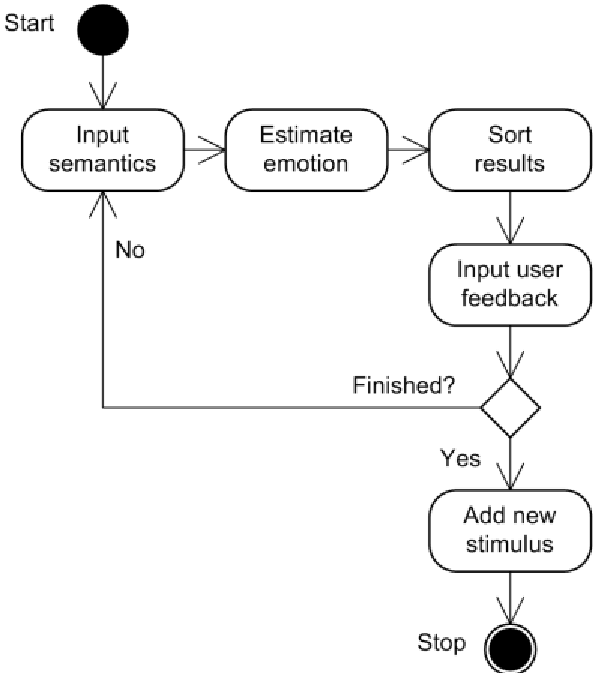 Figure: The proposed workflow for semi-automatic affective tagging.
Critical Analysis & Outlook
While the coupling theory is robust, the authors admit a major hurdle: semantic ambiguity. A tag like "food" can represent a delicious cake (positive) or "revolting food" (negative).
The future of this work lies in Ontologies. By moving from simple keywords to structured knowledge representations like WordNet or SUMO (Suggested Upper Merged Ontology), the system can better differentiate context, leading to higher-fidelity emotional predictions.
Conclusion: This research provides the theoretical foundation for scalable affective computing. By treating emotion as a function of content, we move closer to systems that can autonomously understand and curate the "emotional temperature" of the digital world.