
Beyond Topology: Injecting Semantic Intelligence into Social Networks via Ontology
Semantic Description of Social Network Based on Ontology
This paper proposes a semantic description method for social networks using Web Ontology Language (OWL). By integrating "attribute data" with "relational data," the authors transform traditional homogeneous graphs into machine-understandable semantic networks capable of sophisticated logic inference.
Executive Summary
TL;DR: This research shifts social network analysis from "just dots and lines" to a meaningful, machine-understandable knowledge base. By applying OWL (Web Ontology Language), the paper demonstrates how to annotate nodes and edges with rich semantic attributes, allowing for automated reasoning and more granular organizational insights.
Positioning: This work serves as a methodological bridge, connecting classical Social Network Analysis (SNA) with Semantic Web technologies. It acts as a guide for researchers looking to handle heterogeneous data in social organizations.
The "Homogeneity" Problem
Traditional SNA has a significant blind spot: it treats all nodes (people) and edges (relations) as basically the same. In a real-world scientific institute:
- An Academician impacts the network differently than an Undergraduate.
- A "Co-authored Paper" represents a different strength and type of tie compared to "Working on the same project."
Standard statistical tools (density, centrality) struggle to account for these qualitative differences. The author's insight is that Ontology—a formal specification of shared conceptualization—can bridge this gap by providing a logical framework to describe these distinctions.
Methodology: The Architecture of Meaning
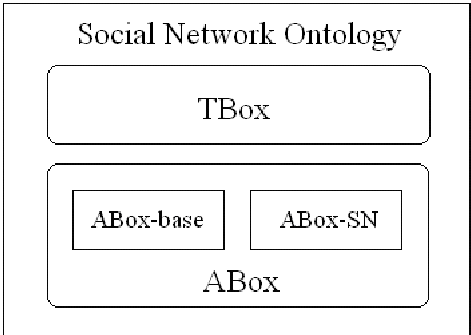
The core of the method lies in the division of the Knowledge Presentation System into two distinct "boxes" based on Description Logic (DL):
- TBox (Terminology Box): Defines the "grammar" of the network (e.g., defining that a
PhD_Candidateis a subclass ofGraduate_Student). - ABox (Assertion Box): Contains the actual data. The authors uniquely split this into:
- ABox-base: Node attributes (e.g., Dr. Smith is a Professor).
- ABox-SN: The structural triples (e.g., Dr. Smith --[CollaboratesWith]--> Prof. Brown).
By using OWL-DL, the network becomes an "inference-able knowledge base." For example, a computer can automatically infer that if A is the supervisor of B, and B is a PhD candidate, then A must be an advisor for PhD candidates, even if not explicitly labeled.
Implementation & Case Study: The SRC Network
The authors applied this to a Scientific Research Cooperation (SRC) network. Unlike traditional graphs, this semantic graph allows for Multi-relations. Two nodes can be connected by multiple edges of different types (e.g., a "Project" edge and a "Paper" edge), which is crucial for evaluating multifaceted cooperation.
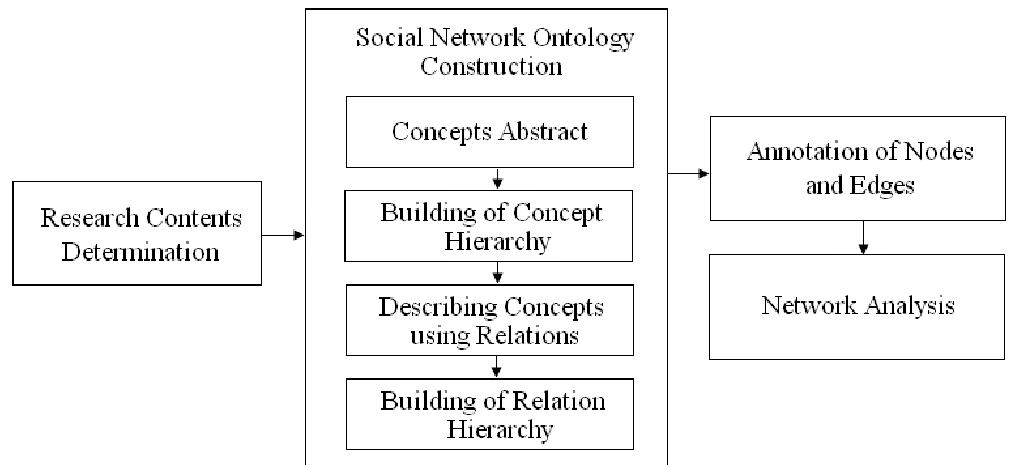
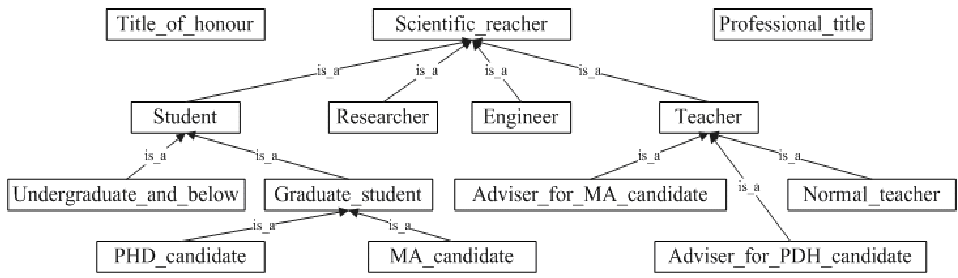
Using Protégé 3.3, they modeled 16 researchers. The hierarchy (shown below) allows the network to maintain high-level categories (Teachers/Students) while preserving granular roles (PhD candidates).
Critical Insight & Future Outlook
The true value of this approach is Interoperability. Because the network is exported in RDF/XML format, it can be queried using SPARQL or transformed back into traditional formats using XSLT for legacy SNA tools.
Limitations: The paper focuses on a relatively "static" ontology. In modern environments, social roles and relationship weights change dynamically. Future work would benefit from integrating Temporal Ontologies to model how a "Student" evolves into a "Teacher" within the same network.
Takeaway: By giving "meaning" to the graph, we move from simply counting connections to understanding the logical fabric of an organization.