
Socializing the Grid: A Semantic Framework for Autonomous Building Automation
A Semantic-Enabled Social Network of Devices for Building Automation
This paper introduces a semantic-enabled social network framework for Building Automation Systems (BAS), where IoT devices act as autonomous agents using "social" interaction paradigms. By combining Service-Oriented Architecture (SOA) with OWL 2 semantic matchmaking via the Mini-ME engine, it enables decentralized device self-configuration and automated service orchestration.
TL;DR
This research transforms passive IoT gadgets into autonomous "social agents." By utilizing Semantic Web technologies and social networking metaphors, devices can now "befriend" each other and negotiate service orchestration automatically. Tested on hardware as simple as an Arduino, the framework proves that intelligence in smart buildings doesn't require massive central servers—just a shared language of logic.
Background: Beyond the Static Smart Home
In the current IoT landscape, a "smart home" is often just a collection of remote-controlled switches. If you buy a new sensor, you usually have to manually configure its interaction with your existing AC or lights. This paper argues that the bottleneck isn't the hardware, but the interaction model.
The authors position their work as a leap from "Smart Objects" to "Social Objects." In their vision, the Building Automation System (BAS) is a decentralized social network where devices interact, share context on "walls," and collaborate based on high-level goals rather than rigid if-then rules.
The Core Insight: Social Paradigms + Semantic Logic
The authors adapt five Social Network Service (SNS) primitives for Machine-to-Machine (M2M) interaction:
- Profiles: Devices describe their hardware and functional capabilities.
- Friendships: Established between devices (e.g., a shutter and a weather station) to allow direct data exchange.
- Walls: A dynamic log where a device posts its current status or environmental readings.
- Tagging: Used to explicitly request a specific service from a "friend."
- Likes: Act as an acknowledgment/confirmation that a task was successfully orchestrated.
The Semantic Engine
The "magic" happens in the Knowledge Manager layer. Instead of simple keyword matching, the system uses Mini-ME, a lightweight matchmaking engine. It uses Description Logics (DL) to understand what a device does. If a sensor says it detects "High Luminosity" and a shutter knows it can "Prevent Solar Radiation," the engine recognizes the semantic link even if the words "sun" or "light" aren't explicitly shared in a hard-coded command.
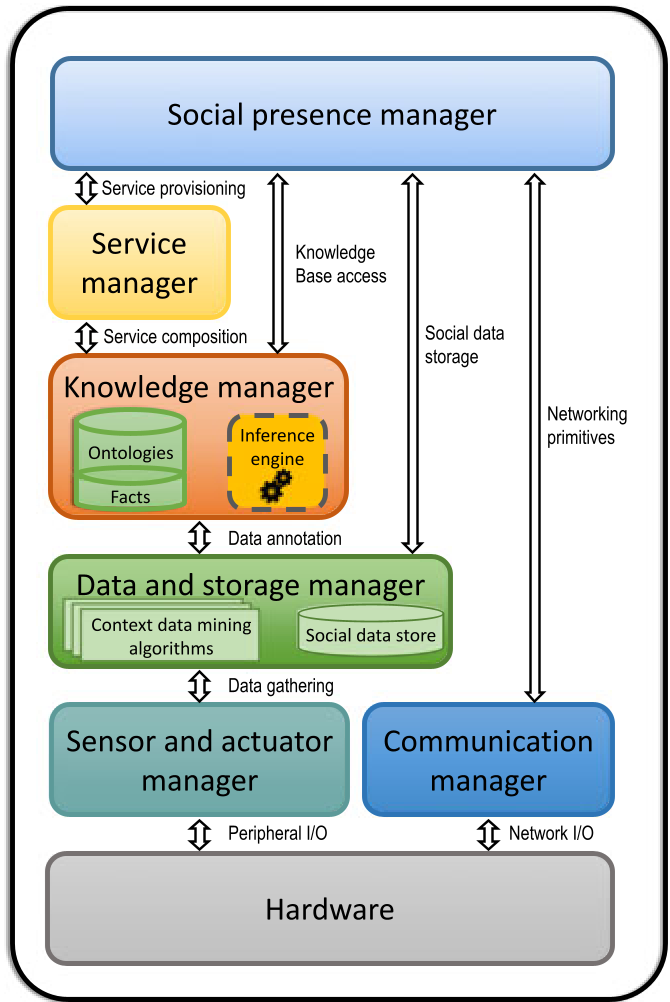
Methodology: Orchestration through Non-Standard Inferences
Standard logic usually returns a binary "Match" or "No Match." This is useless in the real world where conditions are messy. The researchers leverage three advanced inference tasks:
- Concept Contraction: If a request and service conflict, it figures out why and suggests what constraints to give up.
- Concept Abduction: If a service only partially meets a request, it identifies what is missing.
- Concept Covering: The most powerful tool—it picks a combination of services (e.g., Shutter + AC + Dimmer) to satisfy a complex goal like "Maintain 22°C with natural light."
Experiments: Can an Arduino Handle It?
The researchers tested the framework on two setups:
- Low-Resource (LR): Arduino Due (96 KB SRAM).
- Medium-Resource (MR): Intel Edison / Raspberry Pi.
The results were illuminating. While Arduinos were slower at network I/O, the Mini-ME engine performed the actual logic (Concept Covering) in roughly 447ms.
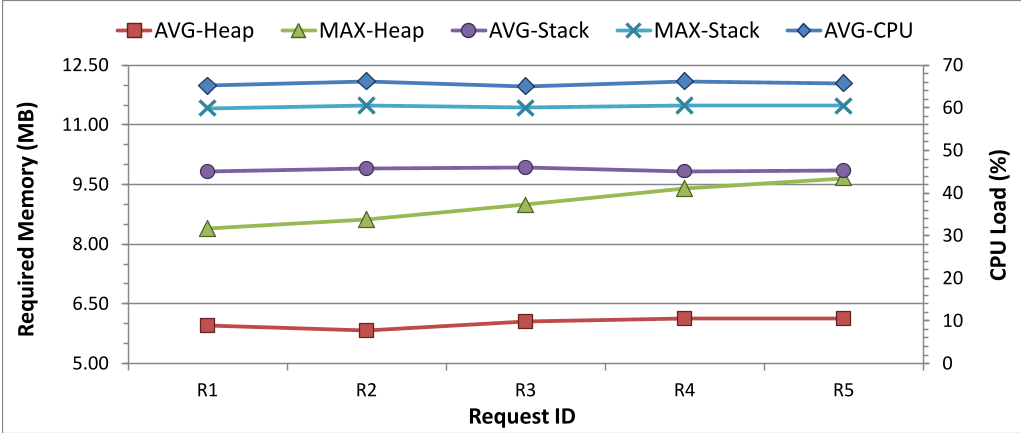
As shown in the table above, the "Social" interaction (Login and Friendship) is significantly faster on MR devices, but the complexity of the "Request" (the number of semantic concepts) had a surprisingly low impact on memory usage, peaking at only 11.5 MB on the Central Unit.
Critical Insight & Future Outlook
The beauty of this framework is its resilience. Because it is decentralized, the "Smart Home" doesn't die if the Wi-Fi or a central hub goes down; friends keep talking to each other.
Takeaway: This work demonstrates that the future of IoT isn't just about faster chips, but about better ontologies. By giving devices a social framework and a logical "brain," we move closer to environments that truly understand and adapt to human needs without us having to open an app.
Limitations: The "Friendship" establishment still requires some initial logic to prevent security risks (unauthorized devices joining the network), and the current study focuses on small-scale home scenarios. Scaling this to a "Smart District" with thousands of nodes remains the next major hurdle.