
AEKW: Mapping the Landscape of Depression via Twitter Semantic Graphs
Constructing a Semantic Graph with Depression Symptoms Extraction from Twitter
The paper introduces a novel framework for identifying depression symptoms from Twitter data using a hybrid text-mining approach. The core method, AEKW (Automatic Extract Keyword for specific terms), constructs a semantic graph that visualizes the strength of associations between "depression" and various behavioral symptoms.
TL;DR
Diagnosis of mental health conditions like depression often suffers from a lack of objective "gold standards" and the high wall of clinical data privacy. This paper presents a breakthrough by extracting depression symptoms directly from public Twitter streams. By implementing the AEKW (Automatic Extract Keyword for specific terms) algorithm, the researchers combine statistical co-occurrence with deep learning-based word embeddings to build a Semantic Graph that uncovers vital correlations between the term "depression" and its behavioral symptoms.
Problem & Motivation: The Data Privacy Wall
In precision medicine, the most accurate diagnostic data is locked behind hospital firewalls. Clinical records are difficult to aggregate for research due to strict privacy regulations. However, social media platforms like Twitter provide a "living laboratory" where users openly discuss their mental states.
The challenge, however, is noise. Social media text is unstructured, filled with slang, and lacks labels. Previous works often used simple frequency counts or basic supervised learning on small labeled datasets. The authors of this paper recognized that a more robust, unsupervised approach was needed to identify not just common keywords, but meaningful semantic symptoms that might be overlooked by humans.
Methodology: The AEKW Hybrid Architecture
The heartbeat of this research is the AEKW Algorithm. It moves beyond simple word counts by triangulating three technical perspectives:
- Statistical Strength (Co-occurrence): Measuring how often a term appears alongside "depression."
- Semantic Context (Word2Vec): Utilizing the CBOW and Skip-gram models to project words into a high-dimensional vector space, calculating cosine similarity to ensure terms are contextually related.
- Structural Importance (RAKE): Using the Rapid Automatic Keyword Extraction algorithm to score words based on their "degree"—how often they appear in complex phrases.
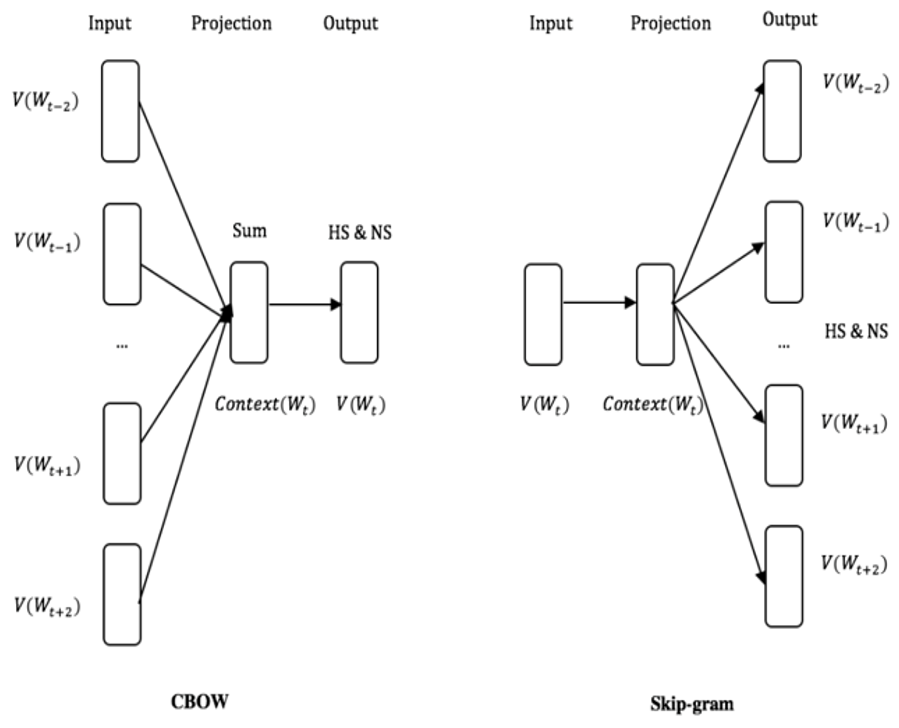 Fig 1: The underlying Word2Vec architectures used to generate the similarity component of the AEKW score.
The final score for any symptom entity is calculated as: Where is co-occurrence, is the RAKE score, and is the Word2Vec similarity.
Experiments and Insights
After gathering 120,000 tweets and narrowing them down to 64,000 unique instances, the algorithm produced a weighted semantic graph.
Key Findings:
- Common vs. Rare Symptoms: High-frequency symptoms like "anxiety" and "insomnia" were easily identified.
- Granular Distinction: The graph revealed that "disorder" (0.249 relevance) is more tightly coupled with the discourse of depression than the generic term "disease," reflecting how patients and professionals actually describe the condition.
- Hidden Indicators: By expanding the graph to more vertices (e.g., top 100), the method reveals "unfamiliar but helpful" symptoms that could assist doctors in spotting potential cases earlier.
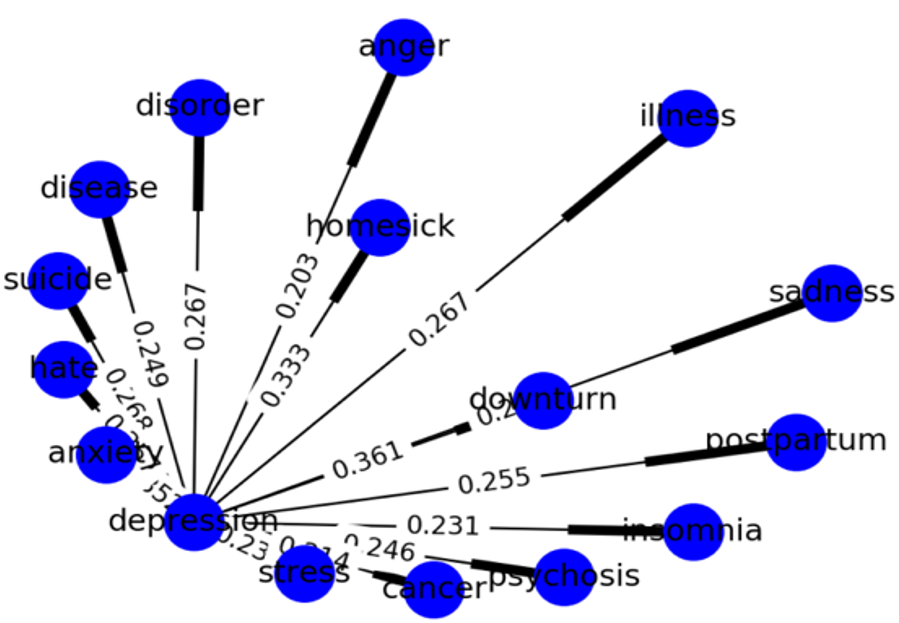 Fig 2: The resulting Semantic Graph showing "depression" as the central node and symptoms as surrounding vertices with weighted edges.
Critical Analysis & Conclusion
Takeaway
The AEKW algorithm provides a systematic way to turn the "noise" of Twitter into a structured "knowledge map." This is a significant step toward building self-screening tools that can help individuals identify warning signs before they reach a crisis point.
Limitations & Future Work
The primary limitation is the evaluation gap. Since the data is unlabeled and the field lacks a "gold standard" for Twitter-based symptoms, the authors acknowledge that validating these findings against clinical diagnoses remains a future task.
Looking ahead, the researchers plan to:
- Apply Association Rule Mining to find relationships between symptoms (e.g., how often insomnia leads to stress in tweets).
- Develop a grammar-based approach to better distinguish between users who have depression and users who are simply discussing the topic.
This work paves the way for intelligent, automated diagnostic support systems that bridge the gap between social media behavior and clinical intervention.