
SCSHG-ES: Bridging Knowledge and Social Graphs for Smarter Microblog Search
Extended search method based on a semantic hashtag graph combining social and conceptual information
The paper introduces SCSHG-ES, a novel extended search method for microblog short texts. It combines Conceptual Semantics derived from an improved Wikipedia analysis and Social Semantics via a semantic hashtag graph to overcome the inherent sparsity of short-text data.
TL;DR
Microblogging platforms are a goldmine of real-time information, but searching them is notoriously difficult because a 140-character post is often too "sparse" for traditional search engines. This paper introduces SCSHG-ES, a framework that enriches short texts by injecting "brainpower" from Wikipedia (Conceptual Semantics) and "social wisdom" from hashtag relationship graphs (Social Semantics).
The "Sparsity" Wall: Why Keyword Search Fails
In the microblogging world, a post like "The big explosion in Tianjin" is semantically thin. Standard search engines look for those exact words. If another post says "The 8.12 Binhai disaster," a standard search might miss it entirely, even though they refer to the same tragic event.
Existing solutions like Explicit Semantic Analysis (ESA) or Topic Models (LDA) try to bridge this gap, but they struggle because:
- They treat text literally, ignoring the rich metadata of social networks.
- They don't utilize the internal structure of knowledge bases (like Wikipedia links and anchors) effectively.
Methodology: The Two Pillars of Enrichment
The authors break the problem down into two distinct stages of "Semantic Extension."
1. E&ISA: Deeply Mining Wikipedia
Unlike traditional ESA, which treats a Wikipedia page as a flat bag of words, the proposed E&ISA (Explicit & Implicit Semantic Analysis) recognizes that a page's Title, Anchor Files, and Internal Links (Implicit) are often more descriptive than the general body text (Explicit). By giving implicit information a higher weight (), the system maps "Tianjin Explosion" to deep concepts like "mushroom cloud" and "hazardous chemical warehouse."
2. SCSHG: The Semantic Hashtag Graph
This is the "Social" secret sauce. The authors built a Graph Model (SCSHG) where nodes are hashtags. Edges aren't just random; they are formed based on three Social Connection Rules:
- Mid Co-occurrence: Do these hashtags appear in the same post?
- Mention (@) Co-occurrence: Are they mentioned by the same organization (e.g., China News Net)?
- URL Co-occurrence: Do they point to the same news link?
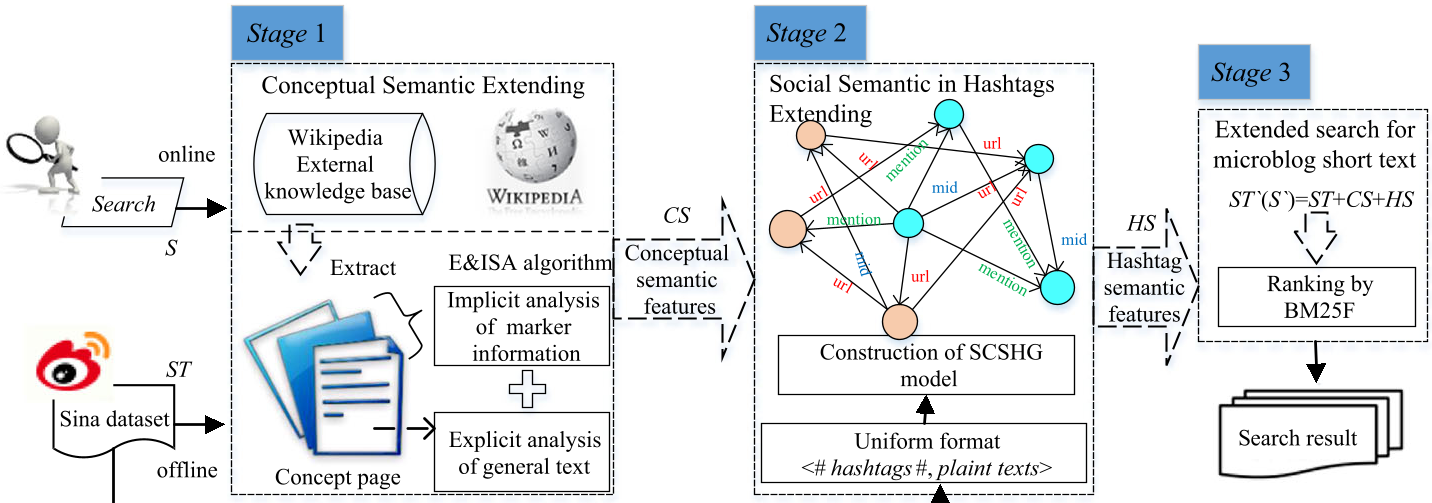 Figure 1: The framework consisting of Conceptual Semantic Extending and Social Semantics via SCSHG.
Connecting the Dots: Graph Implementation
By using the Neo4j graph database, the authors successfully linked disparate hashtags like #Rainstorm in Hubei# and #Wuhan Flood# into a unified semantic cluster. For posts without hashtags, the system "borrows" hashtags from semantically similar posts, ensuring that no data is left isolated.
Experimental Battleground
The researchers tested their method against four major baselines using Sina Weibo data related to national security and disasters (e.g., the 2015 Tianjin explosion).
- Baseline Comparison: SCSHG-ES outperformed everyone.
- Ablation Insight: The inclusion of "Implicit" knowledge () significantly improved results over standard , but the "Social" extension provided the final leap to SOTA performance.
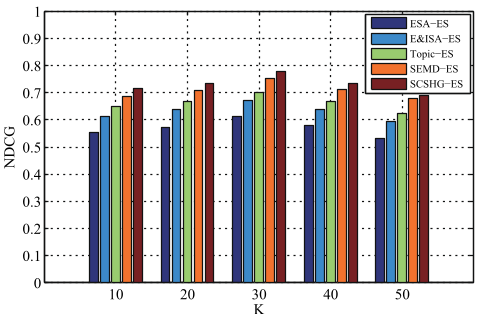 Figure 2: Performance comparison (P@K) showing SCSHG-ES (blue line) consistently leading other methods.
Critical Analysis & Future Outlook
The beauty of this work lies in its Inductive Bias: it assumes that if two people mention the same URL or the same user, they are likely talking about the same thing, even if their words are different.
Limitations:
- The system relies heavily on the availability of social auxiliary info; if a post has no hashtags, URLs, or mentions, the "Social" gain is minimized.
- The manual adjustment of and parameters suggests a need for automated hyperparameter tuning in future iterations.
The Takeaway? In the age of AI, "meaning" is found at the intersection of what we say (Text), what we know (Wikipedia), and how we interact (Social Graph).
Conclusion
SCSHG-ES proves that by treating a microblog as a "structured virtual document" (Text + Concept + Social), we can turn the "noise" of social media into a highly searchable, high-precision knowledge network.