
Bridging the Semantic Gap: Multimodal Retrieval in Medical Social Networks
Semantic medical image retrieval in a medical social network
The paper proposes a multimodal semantic retrieval model for medical images within collaborative social networks. It leverages Bag-of-Words (BoW) for text and Bag-of-Visual-Words (BoVW) for images, integrating them through Latent Semantic Analysis (LSA) to achieve SOTA-level multimodal fusion on the ImageCLEFMed’2015 dataset.
TL;DR
This research addresses the "semantic gap" in medical imaging by proposing a multimodal retrieval framework that fuses expert textual opinions with visual image features. By leveraging Latent Semantic Analysis (LSA) and Bag-of-Words methodologies, the model outperforms single-modality systems, achieving a 56% improvement in Mean Average Precision (MAP) compared to text-only baselines on the ImageCLEFMed benchmark.
Backgound: The Rise of Medico-Social Intelligence
The explosion of medical social networks like PatientsLikeMe and MedPics has created a unique data landscape: images paired with unstructured, collaborative expert commentary. Unlike traditional datasets, this "social" data is noisy but rich in semantic context. The authors position this work as a solution to navigate these vast, heterogeneous collections by treating text and images as two halves of a single semantic whole.
The Problem: Beyond Pixels and Labels
Traditional Content-Based Image Retrieval (CBIR) fails in medicine because:
- Low-Level Features: Colors and textures (pixels) don't naturally map to complex diagnoses like "Aortic Stenosis."
- Segmentation Sensitivity: Most models rely on precise organ segmentation, which is notoriously difficult and computationally expensive.
- Static Knowledge: Many systems cannot adapt to new medical terms or evolving diagnostic criteria without offline re-training.
Methodology: Fusing Modalities via Latent Space
The authors propose a dual-stream pipeline that avoids the pitfalls of segmentation.
1. Feature Extraction (BoW & BoVW)
- Textual Stream: Reports are cleaned using the UMLS (Unified Medical Language System) thesaurus and converted into TF-IDF vectors.
- Visual Stream: The system tests two descriptors—Mean-std (color/texture) and SIFT (keypoints). These local features are clustered into "Visual Words" using K-Means.
2. The LSA Fusion
Instead of simple concatenation, the model applies Singular Value Decomposition (SVD) to a joint term-document matrix. This maps both text and visual words into a reduced Latent Space. Why this works: LSA uncovers the "hidden" correlations—e.g., the visual pattern of a calcified valve frequently co-occurring with the word "stenosis"—allowing the system to retrieve relevant images even if the query text doesn't perfectly match the annotation.
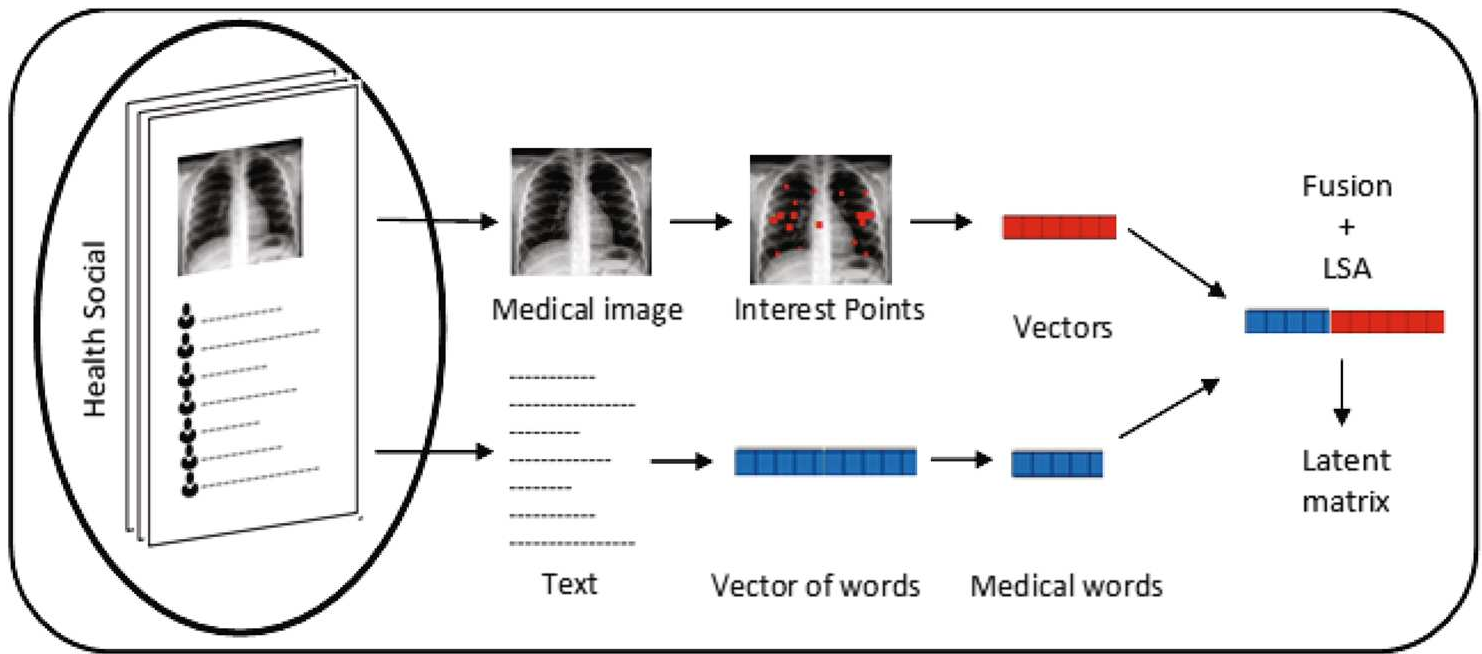 Figure 1: The multimodal research model integrating textual and visual processing via LSA.
Experimental Results: Fusion is King
The model was validated using the ImageCLEFMed’2015 dataset (~45,000 documents).
| Modality | MAP (Mean Average Precision) |
|---|---|
| Visual (SIFT) | 0.1287 |
| Text-Only | 0.2346 |
| Fusion (Text + SIFT) | 0.3667 |
The results clearly indicate that visual data alone is insufficient for medical precision, but when used to augment text, it provides an essential "visual anchor" that improves retrieval accuracy.
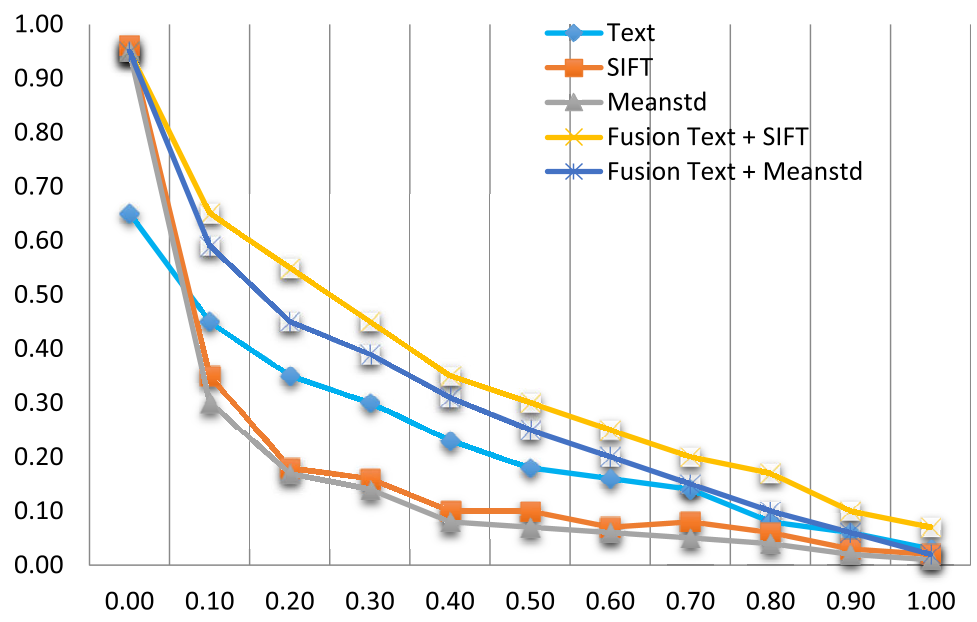 Figure 2: Precision/Recall curves showing the clear superiority of the Fusion approach over single modalities.
Critical Insight: The Role of Expert Interaction
A standout feature of this model is its incremental learning capability. Unlike "a priori" models that require pre-labeled gold-standard datasets, this system learns from user interactions (relevance feedback). This makes it uniquely suited for social networks where knowledge is dynamic and experts are constantly updating interpretations.
Conclusion & Future Outlook
The study proves that Latent Semantic Analysis effectively bridges the gap between how doctors talk and how diseases look. However, the reliance on K-Means for visual vocabulary remains a bottleneck (as it focuses on dense rather than informative spaces).
The next frontier for this work involves Trajectory Tracing—linking different versions of images over time to track disease progression—a vital step toward converting social networks into structured clinical decision support systems.
Keywords: Latent Semantic Analysis, SIFT, Medical Social Networks, SOTA, Multimodal Fusion.