
Semantic Pyramids: Solving Gender and Action Recognition Through Pose Normalization
Semantic Pyramids for Gender and Action Recognition
The paper introduces "Semantic Pyramids," a novel pose-normalization approach for gender and action recognition in still images. It combines spatial pyramid representations from full-body, upper-body, and face regions, achieving state-of-the-art results on major benchmarks like Stanford-40 and Human-attribute.
TL;DR
The paper "Semantic Pyramids for Gender and Action Recognition" tackles the inherent difficulty of describing people in unconstrained images. Instead of using a single global bounding box, the authors propose a Semantic Pyramid approach. By automatically detecting and combining features from the face, upper-body, and full-body, the system achieves a significant performance boost across seven major datasets, proving that localized semantic information is the key to robust recognition.
Problem & Motivation: The Limitation of Global Views
Most traditional computer vision systems treat person recognition as a single-scale problem. They take a full-body bounding box and extract features. However, real-world images are messy:
- Pose Variation: A person might be sitting, running, or turned away.
- Occlusion: The face might be hidden, but the clothing (upper-body) still reveals gender or action.
- Scale: Small faces in large images often get "washed out" in a global histogram.
Existing Spatial Pyramids (dividing a box into a 3x3 grid) help, but they are "blind" to the actual anatomy. If a person is crouching, the "head" grid cell might actually contain a knee. The authors' insight is simple but powerful: Use specialized detectors to find the actual semantic parts first, then build pyramids on top of them.
Methodology: Building the Semantic Pyramid
The core contribution is a fully automatic pipeline that requires no manual part annotations.
- Multi-Part Detection: The system runs pre-trained state-of-the-art detectors for the face and upper-body within the initial person bounding box.
- Part Selection (The Optimization): A detector might return multiple hits. The authors use an energy minimization function: Where is the appearance mismatch (negative detector score) and is the deformation cost (how far the part is from the expected relative position). This ensures that a "face" detected near the feet is ignored.
- Feature Integration: They extract complementary features:
- CLBP for texture.
- PHOG for shape.
- WLD for luminance/contrast.
- SIFT/Color Names (for action recognition via Bag-of-Words).
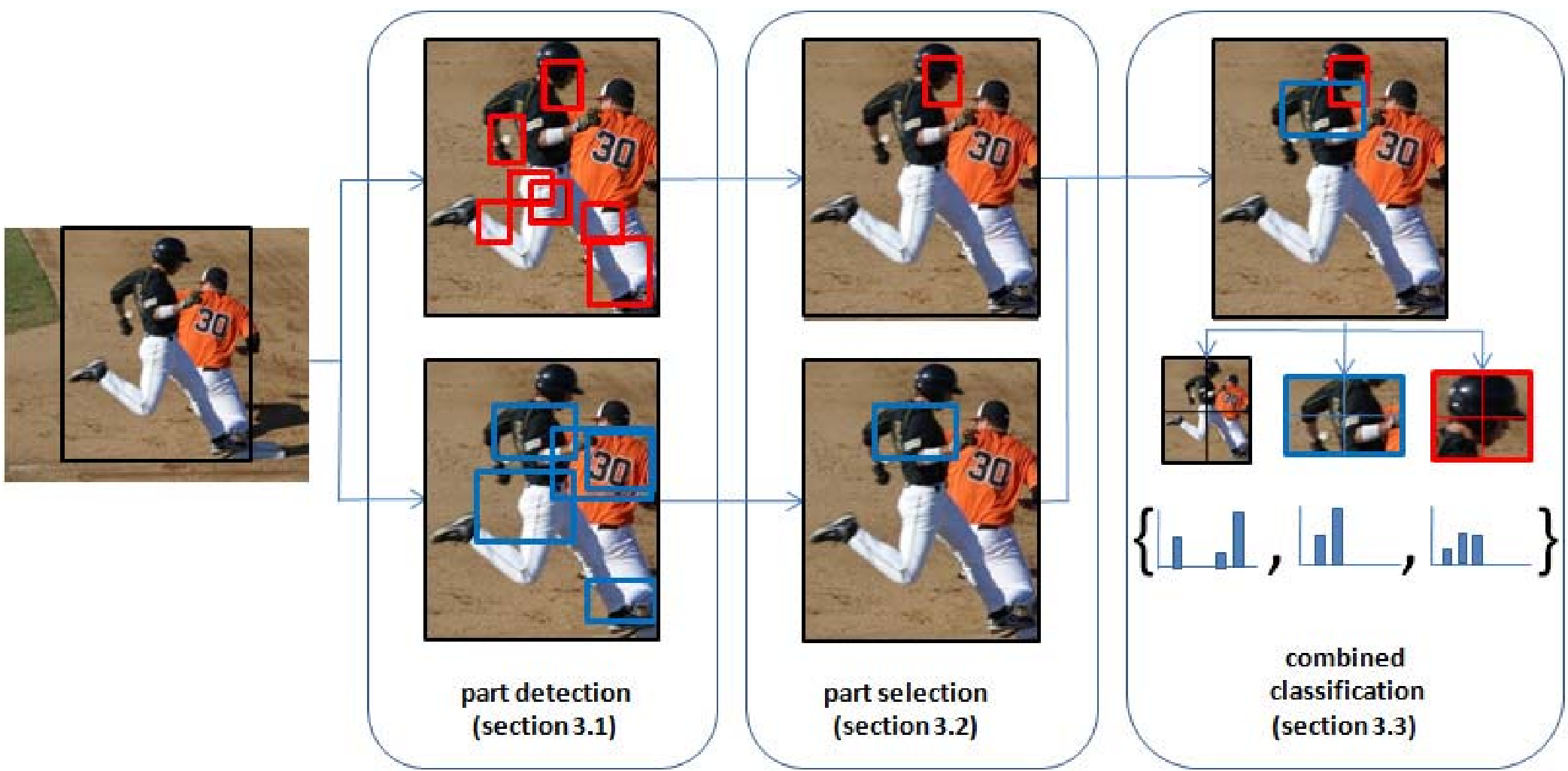 Figure 1: The pipeline—from detection to semantic selection and feature concatenation.
Experiments: Proving the Power of Parts
The authors tested their method on a staggering number of datasets, including PASCAL VOC, Stanford-40, and Human-attribute.
1. Gender Recognition
On the Human-attribute dataset, the semantic pyramid (84.8% AP) outperformed Cognitec (75.0%), a leading commercial biometric tool. This highlights that in "in-the-wild" shots, body cues and clothing (captured by the upper-body detector) are often more reliable than facial pixels alone.
2. Action Recognition
In the action recognition tasks, the "Semantic" version consistently beat the "Common" Spatial Pyramid (SP).
- Stanford-40 (mAP): SP (40.6%) vs. Semantic Pyramid (44.2%).
- Sports Dataset: Achieved a record 92.5% accuracy.
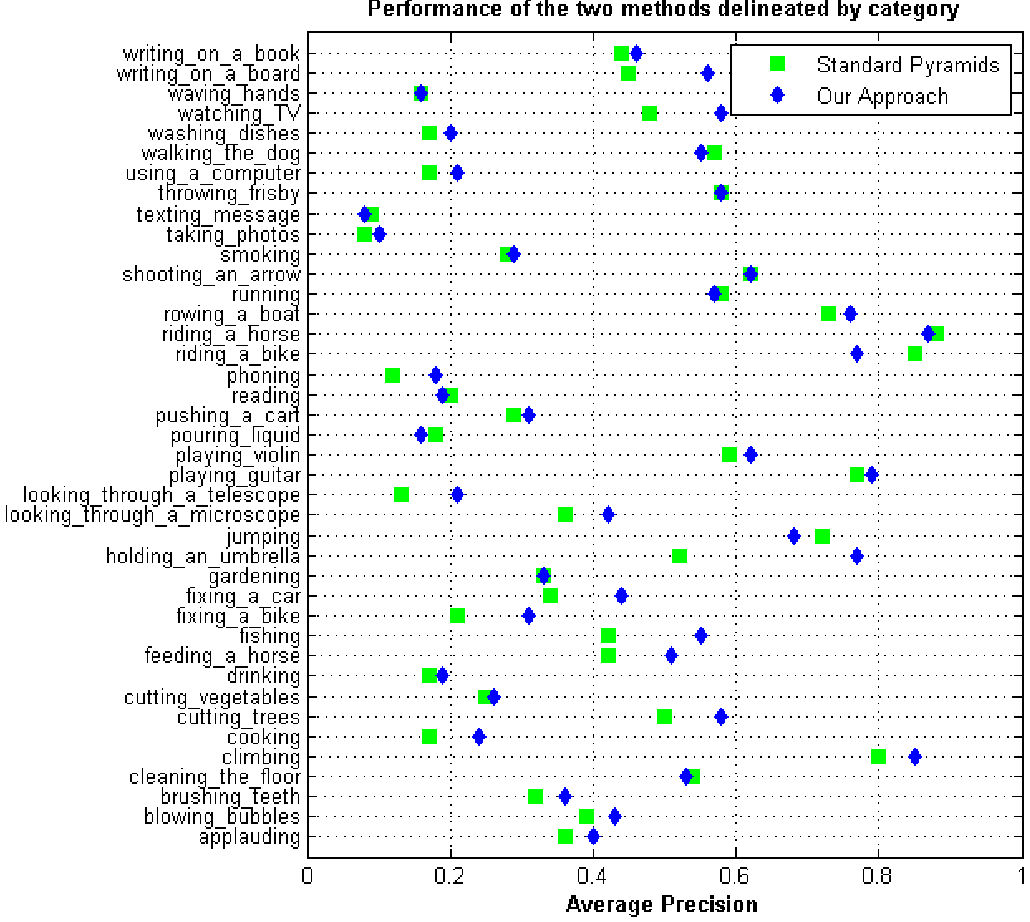 Figure 2: Performance gain across 40 action categories. Note the massive improvements in categories like "Fixing a car" or "Fishing" where object-hand interaction is concentrated in the upper-body.
Critical Analysis & Conclusion
The Takeaway: This work demonstrates that "Pose Normalization"—aligning our feature extraction to the actual semantic parts of the human body—is non-negotiable for high-performance person description.
Limitations:
- Detector Dependence: The system's performance is capped by the accuracy of the underlying face and upper-body detectors. If these fail (e.g., extremely low resolution), the semantic benefit vanishes.
- Computational Overhead: Running three detectors and extracting three sets of pyramids is more expensive than a single-pass global approach.
Future Outlook: While this paper uses Bag-of-Words and SVMs (standard at the time of publication), the logic of Semantic Pyramids has paved the way for modern "Region Proposal" and "Part-based CNN" architectures. For today's practitioners, the lesson remains: don't just look at the person; look at where the parts are.