
Semantically Rich Recommendations: Moving Beyond Single Items to RDF Context Graphs
Semantically Rich Recommendations in Social Networks for Sharing, Exchanging and Ranking Semantic Context
The paper introduces a framework for semantically rich recommendations in social networks, moving beyond single-item suggestions to complex RDF graph-based context exchange. It leverages extended FOAF (Friend of a Friend) vocabularies to share metadata and a modified ObjectRank algorithm to provide personalized resource ranking within research-oriented interest groups.
TL;DR
This research shifts the recommendation paradigm from "You liked Book A, you might like Book B" to a complex, graph-based exchange of knowledge. By using RDF graphs and extended FOAF vocabularies, the authors allow members of social networks (like research groups) to share not just documents, but the entire semantic context (citations, conferences, authors) surrounding them. Their ranking algorithm, based on ObjectRank, ensures that recommendations are filtered through the lens of personal trust and reputation.
Problem & Motivation: The "Context-Free" Email Trap
In a typical research environment, we share knowledge via email. However, the authors argue that email is a graveyard for context. When Bob sends Alice a PDF, the metadata—why this paper is important, which references in it are crucial, and what conference it belongs to—is lost.
Current desktop searches treat files as isolated text blocks. To solve this, the authors propose that every resource should exist within a Semantic Desktop, where files are nodes in a rich graph of relationships. The challenge is: How do we share these graphs across a social network and rank them according to their relevance to an individual user?
Methodology: Authority Transfer and Social Trust
The core of the system is the integration of metadata generation with a social discovery layer.
1. The Context Ontology
The system uses an ontology to define relationships like cites, author of, presented at, and downloaded from. This transforms a folder of PDFs into a structured knowledge base.
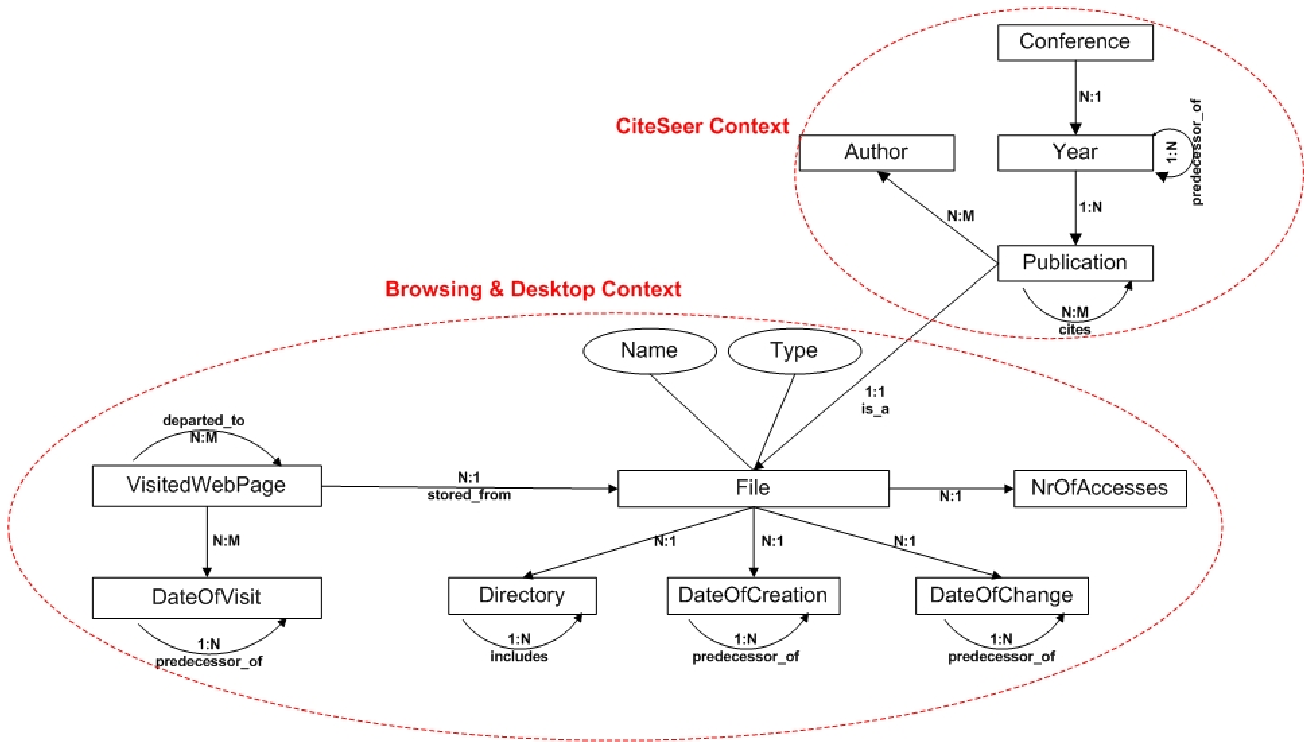
2. Authority Transfer (ObjectRank)
To rank these items, the authors apply ObjectRank. Unlike standard PageRank, which treats all links equally, ObjectRank uses a Schema Graph with weights. For example, a "Publication" node might transfer 70% of its authority to its "Citations" but only 20% to its "Authors."
3. The Trust-Biased Ranking Formula
The ranking is calculated using: Where:
- is the adjacency matrix derived from the ontology.
- is the "random jump" vector.
- Personalization via Trust: When Alice receives data from Bob, she adjusts the values in vector . If she trusts Bob 100%, his resources get a high weight in . If she barely knows him, the weight is low, ensuring his "recommendations" don't pollute her high-quality search results.
Experiments: How Metadata Exchange Changes Truth
The researchers tested the system within the L3S Research Group scenario. They observed how Alice’s local ranking changed after Bob sent her a paper along with its surrounding metadata.
Key Findings:
- Recursive Discovery: When Alice integrated Bob’s metadata, papers she already owned (like "ObjectRank") saw a rank increase because the new data provided "incoming links" that were previously unknown to her local system.
- Trust Sensitivity: The ranking of new resources is highly sensitive to the trust factor. At a 1% trust level, Bob's suggestions appear at the bottom of the list, whereas at 90% trust, they seamlessly integrate into Alice's top-tier resources.

Critical Analysis & Conclusion
Takeaway
The real value of this work lies in its vision of a Social Semantic Desktop. It acknowledges that "importance" is not a universal constant (like Google PageRank tries to suggest) but is local, social, and context-dependent.
Limitations
- Scalability: Maintaining and merging RDF graphs for every email attachment could lead to significant overhead as the network grows.
- Privacy: Sharing browsing and desktop context raises massive privacy concerns that aren't fully addressed in the "Trust" weighting system.
Future Outlook
As we move toward a world of AI agents, this "shared semantic context" becomes even more relevant. Modern RAG (Retrieval-Augmented Generation) systems could benefit from this method by using social trust to weight which "context" in a vector database should be retrieved for a specific user.