
Bridging People, Devices, and Services: The Semantic SIoT Revolution
A semantic service creation platform for Social IoT
The paper introduces a Semantic Social Network (SN) platform designed for the Social Internet of Things (SIoT), integrating users, devices, and RESTful Web services into a single ecosystem. It leverages ontologies and JSON-LD to enable automated service discovery and composition through a user-friendly Service Creation Environment (SCE).
TL;DR
This research presents a groundbreaking Social Network platform that serves as a Service Creation Environment (SCE). By treating devices and Web services as "Social Things" with their own profiles and walls, it enables non-technical users to build automated, event-triggered services (e.g., "If my sensor detects high heat, turn on the AC and notify my calendar") using semantic RESTful principles.
Problem & Motivation: The "Utopian" Semantic Web
For over a decade, the Semantic Web was seen as a "utopian promise." Despite the theoretical power of ontologies like RDF and OWL, the reality was bleak:
- Complexity: SOAP and WSDL were too verbose and difficult to maintain.
- Lack of Adoption: Only 1.5% of Web services were semantic by 2013.
- The Gap: Users lacked intuitive tools to connect their physical devices (IoT) with digital services (Web APIs).
The authors argue that for the Social Internet of Things (SIoT) to succeed, automation must be seamless and user-centric, moving away from hard-coded mashups toward dynamic, semantic interoperability.
Methodology: The Architecture of Social Things
The researchers propose a three-layered architecture designed to mask the complexity of semantic reasoning behind a familiar social media interface.
1. The Social Interface
Every device and Web service is a "Social Thing." Like a human friend, a temperature sensor has a "wall" where it posts updates. Users can interact with these walls via text commands or graphical icons.
2. Semantic RESTful Principles
Instead of bulky XML, the system uses JSON-LD and the Hydra vocabulary. This allows the platform to "learn" the semantics of a new service automatically upon registration. For legacy services (e.g., Twitter or Google Calendar), the authors utilize Social Wrappers to translate non-semantic data into the system's ontology.
3. The Ontology-Based Layer
This is the "brain" of the platform. It handles:
- Profile Management: How information is displayed.
- Rule Handling: Managing the IF (Condition) THEN (Action) logic.
- Recommendation Reasoning: Suggesting new automations based on the user's existing devices and context.
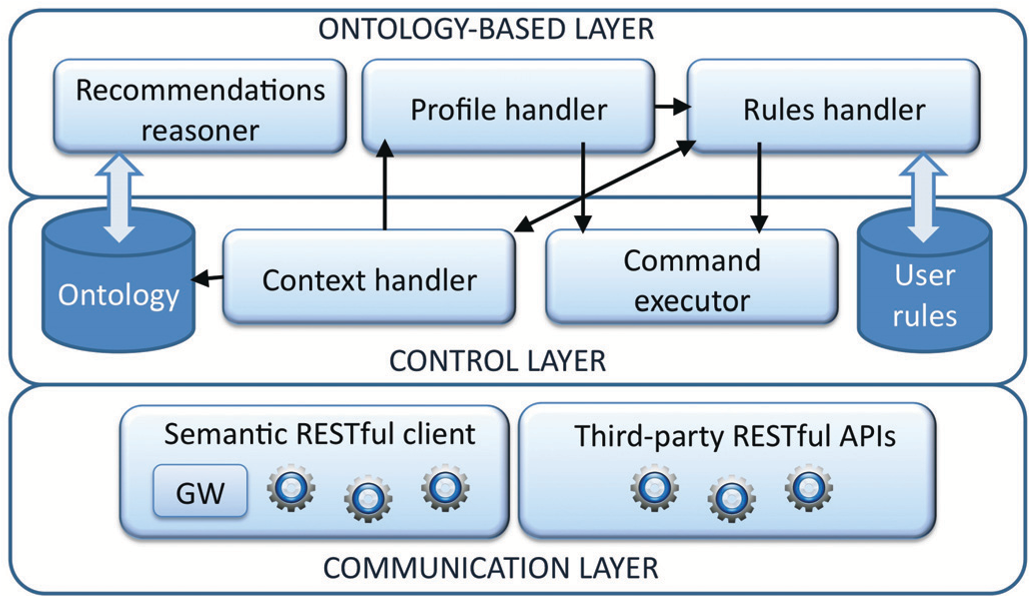 Figure 1: The three-layered architecture shows how the Ontology Database drives the Context Handler and Command Executor.
Experiments & Results: Making IoT "Social"
The platform was validated through its ability to handle diverse "Social Things." By moving to a resource-oriented style (REST), the platform aligned with the dominant trend of the Web (where 63% of APIs are RESTful).
Key Capabilities Demonstrated:
- Event-Triggered Composition: Users could connect a "Friend's Status" (e.g., Anne is busy) to a "Device Action" (e.g., Set phone to silent).
- Heterogeneous Integration: Effectively bridging the gap between a hardware gateway (controlling local sensors) and cloud-based Web APIs.
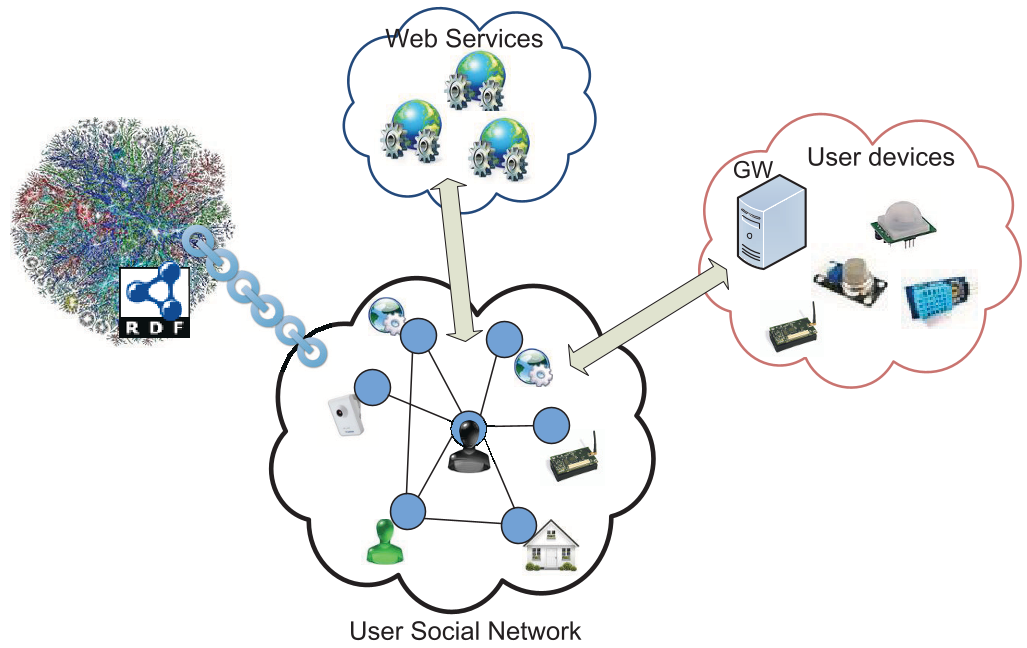 Figure 2: The synergy between users, their friends, and their "Social Things" (Devices and Services).
Critical Analysis & Conclusion
Takeaway
The genius of this approach lies in Social Abstraction. By hiding complex OWL/RDF logic behind a "Social Wall," the authors democratized service creation. It moves IoT from a hobbyist's "coding task" to a consumer's "social interaction."
Limitations & Future Work
The reliance on manually created Social Wrappers for non-semantic APIs remains a bottleneck. While JSON-LD reduces complexity, the heterogeneous nature of IoT protocols (ZigBee, Z-Wave, MQTT) still requires a robust Semantic Gateway to translate physical signals into ontological instances. Future iterations could explore LLM-based autonomous wrappers that can read API documentation and generate semantic mappings on the fly.
Summary
The Social Internet of Things is no longer just about connecting devices; it’s about creating a unified semantic language where humans, services, and objects can collaborate in one social loop.