
Semantic Social Event Evolution: Beyond Word Frequency to Deep Context
Semantic Social Event Evolution Discovering
This paper introduces a semantic-aware framework for discovering social event evolution from platforms like Weibo and Twitter. It proposes a novel 6-tuple event representation and utilizes domain-adaptive incremental training on pre-trained NLP models (RoBERTa) to calculate semantic similarity, effectively generating Directed Acyclic Graphs (DAGs) of event transitions.
TL;DR
Understanding how a social media headline transforms from a single post into a massive public opinion wave is a complex task. This paper presents a framework that moves beyond simple word counts to "understand" the semantic threads connecting social events. By representing events as 6-tuples and leveraging domain-adapted RoBERTa embeddings, the authors build a Directed Acyclic Graph (DAG) that maps the birth, fermentation, and death of hot topics with significantly higher accuracy than traditional statistical methods.
Background & Positioning
In the age of Weibo and Twitter, events are no longer static. A single government decision can split into international protests, scientific debates, and public fear within hours. While modern AI is good at detecting these events, tracing their evolution remains a challenge. This paper sits at the intersection of Event Detection and Forecasting, moving the needle from "What happened?" to "How did this event lead to that one?"
The Core Problem: Why Keyword Counting Fails
Most prior works rely on TF-IDF or Jaccard similarity. In the chaotic environment of social media, these fail because:
- Short Text Sparsity: Tweets are too short for robust statistical frequency.
- Semantic Variation: Two events might discuss the same topic using different words (e.g., "wastewater discharge" vs. "ocean pollution").
- Implicit Relations: Statistical methods miss the "evolutionary" link where the context changes but the core entity remains.
Methodology: The 6-Tuple and Semantic Weights
1. The 6-Tuple Representation
The authors define an event through six critical dimensions:
- : Time (with exponential decay weights).
- / : Locations and Participants (using Jaccard index).
- / / : Keywords, Summaries, and Messages (the semantic core).
2. Domain-Adaptive Training
To bridge the gap between general language and "internet slang," the authors took a pre-trained Chinese RoBERTa-wwm-ext model and performed incremental training on 1 million Weibo posts. This allows the word embeddings to capture the specific nuances of social media discourse.
3. Efficiency via Inverted Indexing
Calculating similarity between every pair of events in a massive stream is . To solve this, the authors used an Inverted Index based on nouns. This ensures the system only compares events that share at least some core entities, drastically speeding up the graph generation.
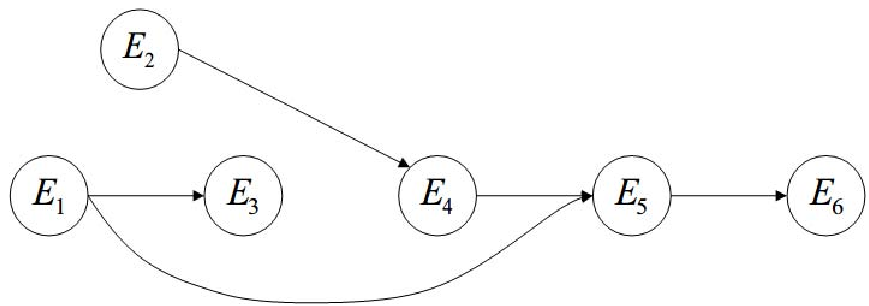 Fig 1: A conceptual DAG showing how Event 1 evolves into divergent and convergent paths.
Experimental Results: A Massive Leap in F1-Score
The authors tested their method on a real-world case study: "Japan's nuclear wastewater discharge." They compared their semantic approach against a baseline that only uses statistical similarity for posts, locations, and participants.
Quantitative Performance
| Method | Precision | Recall | F1-Score |
|---|---|---|---|
| Proposed (Semantic) | 0.696 | 0.727 | 0.711 |
| Baseline (Statistical) | 0.275 | 0.636 | 0.384 |
The results show a near doubling of the F1-score. Interestingly, the ablation study revealed that Keywords () and Summaries () were the most critical factors. If was given a high weight, the accuracy of finding the correct evolution path spiked.
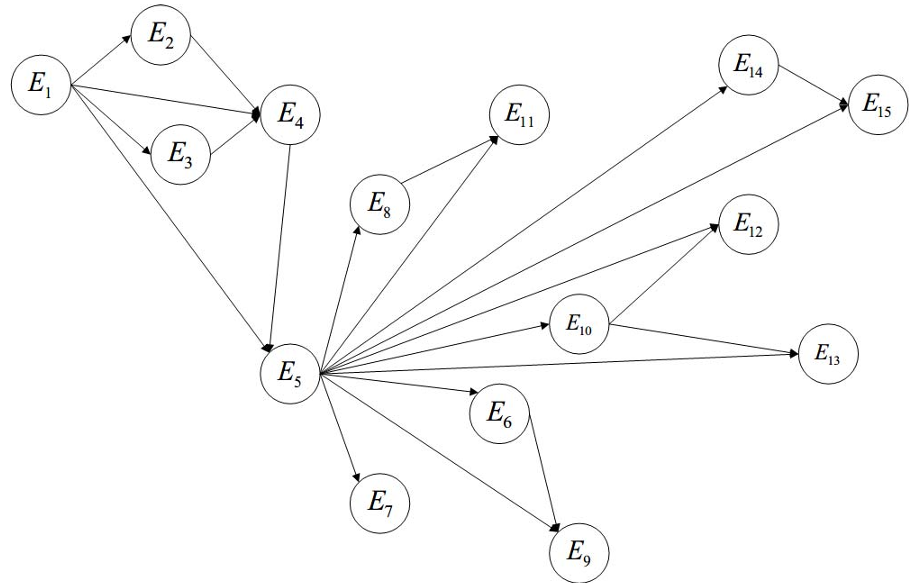 Fig 2: The Ground Truth evolution graph used for evaluation, illustrating the complex interconnections of the 15 identified events.
Critical Analysis & Insights
Why it works
The success of this method lies in feature fusion. By combining hard constraints (Location/Participants) with soft semantic constraints (Embeddings), the model mimics how humans perceive event connections. The domain-adaptive fine-tuning on Weibo data is the "secret sauce" that makes the embeddings relevant to the specific dataset.
Limitations
- Parameter Sensitivity: The weights (, etc.) are currently set manually. As the authors admit, different topics might require different weight distributions.
- Computational Overhead: Even with indexing, generating embeddings for millions of short messages is resource-intensive compared to simple TF-IDF.
Conclusion & Future Outlook
This paper proves that semantics matter more than statistics in the fast-paced world of social media. The move toward domain-specific incremental training is a robust strategy for any organization looking to monitor public opinion or predict the "next step" in a developing crisis. Future iterations involving Reinforcement Learning to dynamically tune weights could make this system fully autonomous and adaptive to any news cycle.