
CrTF: Bridging Social Networks and Semantic Knowledge via Cross-Domain Tensor Factorization
16677_Semantic Social Network Analysis by Cross-Domain Tensor Factorization.
The paper introduces Cross-Domain Tensor Factorization (CrTF), a framework for semantic social network analysis that predicts communication links between users and topics. By integrating DBpedia knowledge with multi-domain retweeting data, CrTF achieves SOTA performance in communication frequency prediction and social influencer identification.
Executive Summary
TL;DR: Analyzing "who talks to whom about what" is the holy grail of social network analysis. This paper proposes CrTF, a novel framework that uses DBpedia to ground social topics in a semantic space. By factorizing tensors across different political domains simultaneously, the authors solve the chronic problems of data sparsity and domain bias in link prediction.
Background: This work sits at the intersection of Semantic Web and Machine Learning. It moves beyond 2D matrix models (who follows whom) into 3D tensor spaces (user-topic-influencer), providing a more granular view of social dynamics.
The "Popularity Trap" and the Long Tail Problem
In social media, most users occupy a "long tail"—they discuss niche topics or interact infrequently. Standard Tensor Factorization (TF) models are "greedy"; they optimize for the most frequent interactions. This leads to two systemic failures:
- Domain Bias: If a dataset has 10x more tweets about Party A than Party B, the model will essentially ignore the nuances of Party B.
- Sparsity: Many potential (user, topic, influencer) combinations have zero recorded observations, making it impossible for the model to learn meaningful latent features for rare topics.
Methodology: The CrTF Insight
The core innovation of CrTF lies in its Semantic Augmentation and Coupled Factorization.
1. Semantic Grounding
Instead of treating hashtags or keywords as isolated strings, CrTF maps them to DBpedia entities. For instance, if users are discussing "Mohan Bhagwat," the system knows he is linked to the "RSS" (Rashtriya Swayamsevak Sangh).
2. Coupled Cross-Domain Analysis
The authors treat different social circles (e.g., supporters of different political parties) as separate domains. They create a tensor for each, but "couple" them during the factorization process.
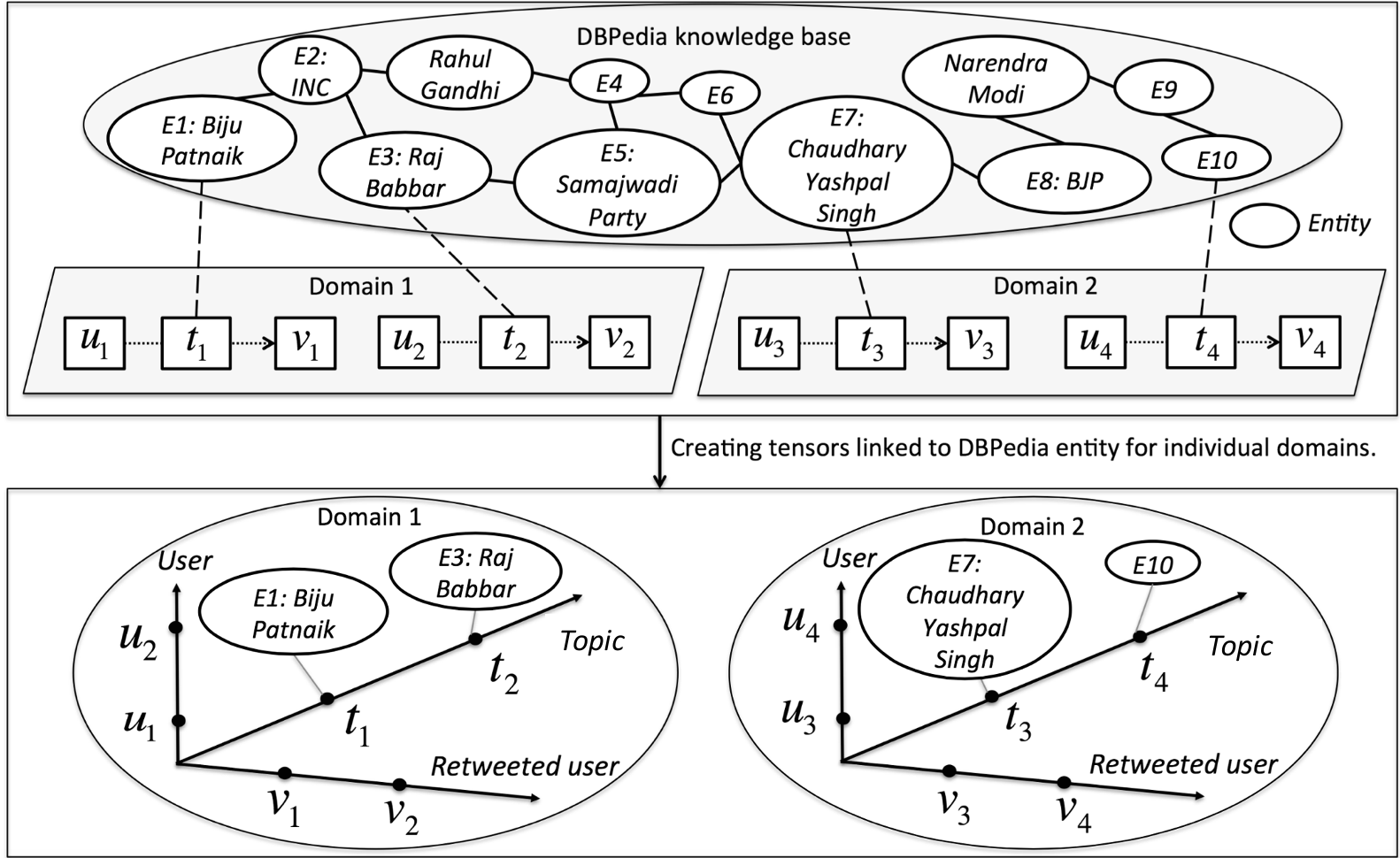 Figure 1: Illustration of how sparse topics (t1, t2) are propagated to neighboring entities (E2) in the DBpedia graph to solve the sparsity problem.
3. The Math behind the Magic
The model utilizes Variational Non-negative Tensor Factorization (VNTF). Unlike Gaussian-based models, VNTF uses Poisson-Gamma priors, which are much better at modeling "count data" (like retweet frequencies) that follow a long-tail distribution.
Performance Benchmarks
The researchers tested CrTF on two real-world datasets: Indian Political Twitter (INC vs. BJP) and Middle East Politics (Hamas vs. Hezbollah).
| Method | Indian Dataset RMSE (D=10) | Middle East RMSE (D=10) |
|---|---|---|
| VNTF (Standard) | 2.9984 | 1.8221 |
| Cr-GCTF (Coupled) | 2.9415 | 1.7724 |
| CrTF (Ours) | 2.9182 | 1.7417 |
The results confirm that incorporating semantic knowledge (especially for the most sparse topics, denoted as ) provides a significant accuracy boost.
 Table VI: CrTF's ability to cluster users, topics, and influencers with semantic labels, revealing hidden political structures.
Deep Insight: Why Semantics Matter
The real power of CrTF is demonstrated in its qualitative results. In some cases, a user might retweet an influencer about "Manmohan Singh" in the training set and "Atal Bihari Vajpayee" in the test set. A standard model sees two different strings. CrTF, seeing the "successor" relationship in DBpedia, recognizes the continuity in the user's political interest.
Critical Analysis & Conclusion
Takeaway
CrTF proves that social networks are not just graphs of people; they are graphs of meaning. By leveraging the Semantic Web (LOD), we can build social analytics tools that "understand" the context of a conversation.
Limitations & Future Work
While CrTF is powerful, it relies on the quality of the Knowledge Base (DBpedia). If a topic is not in the KB (e.g., new slang or emerging memes), the semantic advantage vanishes. Future research should look into dynamic knowledge graph construction to handle the rapid evolution of social media language. Additionally, extending this to a 4D tensor that includes Time would allow for tracking the evolution of social influence during active crises or election cycles.