
INGA: Building Semantic Social Overlays for Efficient P2P Information Retrieval
Semantic Social Overlay Networks
This paper introduces INGA, a semantic routing algorithm for unstructured P2P networks that leverages social network metaphors. By maintaining personal semantic shortcut indexes across four functional layers, INGA achieves significantly higher recall and lower message overhead than traditional flooding or interest-based locality methods.
Executive Summary
TL;DR: The paper proposes INGA, a routing mechanism for pure unstructured Peer-to-Peer (P2P) networks that mimics social networking behaviors. Unlike standard flooding methods, INGA uses semantic shortcuts—locally stored hints about which peers are "experts" in specific topics. By observing query traffic and using semantic similarity measures, INGA creates a "small world" effect where queries reach their destination in fewer hops with higher success rates.
Background: Within the P2P landscape, this work represents a major bridge between the "blind" flexibility of unstructured networks and the "rigid" efficiency of Distributed Hash Tables (DHTs). It places a premium on peer autonomy and locality, making it a landmark study in semantic search.
Problem & Motivation: The P2P Latency-Volatility Trade-off
Traditional P2P routing faces a "Pick Two" dilemma among Efficiency, Autonomy, and Robustness to Volatility.
- Flooding (Gnutella) is robust but drowns the network in messages.
- DHTs (Chord) are efficient but "break" when peers join and leave frequently (churn), as they must constantly re-map global indexes.
The authors' insight is grounded in Social Network Theory: humans find information by knowing who is likely to know the answer. They argued that P2P nodes should act like social agents, using local "expertise" indexes rather than global maps.
Methodology: The Four-Layer Shortcut Architecture
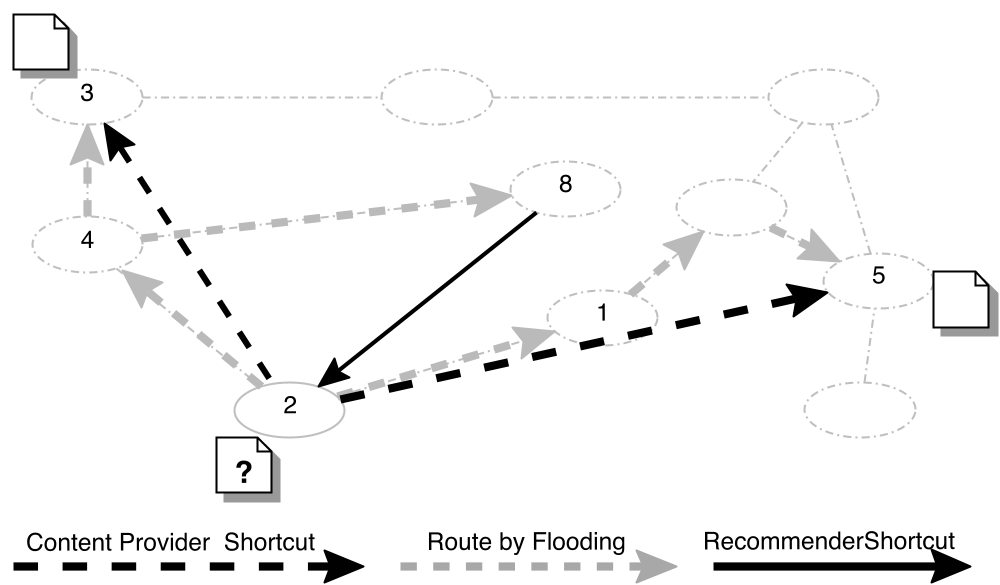
The core of INGA is the Shortcut Index, which categorizes potential neighbors into four distinct layers to balance discovery and efficiency:
- Content Provider Layer: Directly links to peers who have successfully answered queries in the past (Interest-Based Locality).
- Recommender Layer: Links to peers who have issued or forwarded similar queries. This is a unique contribution of INGA—learning from the traffic flowing through a node, not just results coming to it.
- Bootstrapping Layer: Identifies "hubs"—peers with high degree centrality (popularity) to help navigate the network when specific topic expertise is unknown.
- Network Layer: The fallback "random" connections to maintain the underlying graph connectivity.
Semantic Similarity & Ranking
INGA doesn't just look for exact keyword matches. It uses a Semantic Similarity Function based on topic hierarchies (taxonomies):

This allows the system to route a query about "Java Programming" to a peer known for "Software Engineering" because they are semantically close in the hierarchy.
The Selection Algorithm
The routing logic is a "Greedy k-Best" heuristic. A node identifies the top neighbors (typically ) whose shortcuts most closely match the query. If semantic matches are insufficient, it waterfalls down to bootstrapping hubs or random default neighbors.
Experiments & Results
The authors validated INGA against the IBL (Interest-Based Locality) strategy and Naive Flooding across three datasets: DMOZ (web directory), Bibster (bibliography), and a synthetic dataset for conjunctive (multi-predicate) queries.
Performance Gains
- Higher Recall: In dynamic environments with high churn, INGA achieved double the recall of the Gnutella baseline.
- Reduced Overhead: While current IBL methods often increase message counts over time as indexes grow, INGA’s message count dropped by 57% (from 105 to 45 per query) as the network "learned" and clustered into semantic communities.
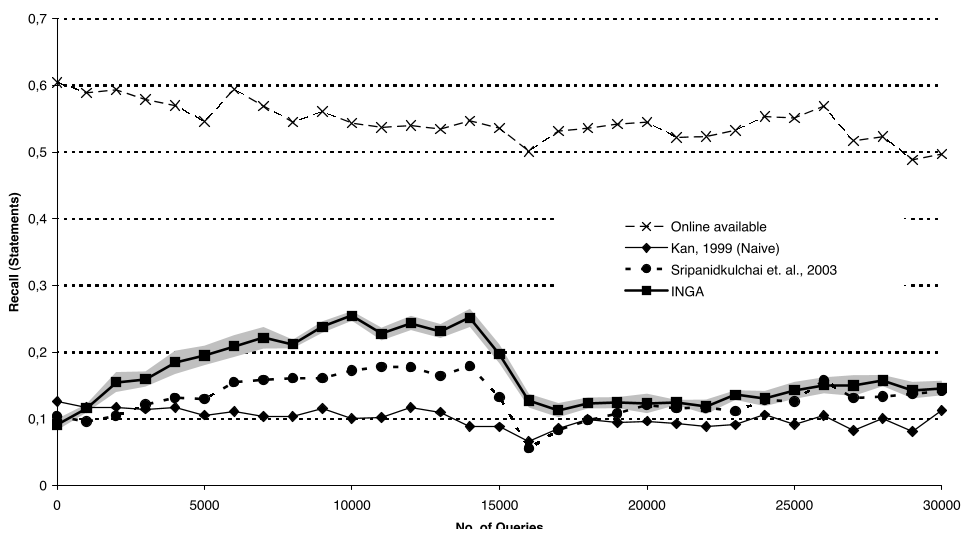 Fig 2: INGA shows significant recall superiority and faster recovery after "Interest Shifts" compared to IBL (blue) and Naive (yellow).
Critical Analysis & Conclusion
Takeaways
The brilliance of INGA lies in its passive learning. Because it indexes query traffic (the Recommender layer), the network naturally evolves into a "Semantic Social Overlay" without requiring nodes to broadcast their entire content catalogs to the world.
Limitations
- Cold Start: The system requires a "learning phase" before shortcuts become effective.
- Semantic Drift: While the paper addresses interest shifts, a rapid global change in the underlying taxonomy would require re-calculating similarity for all stored shortcuts.
Future Outlook
This work paved the way for modern decentralized search. In the age of AI, the "Shortcuts" described here can be seen as early precursors to vector embeddings and neural routing, where the "similarity" isn't calculated by a fixed taxonomy, but by higher-dimensional latent spaces.