
Unlocking Social Intelligence: Using Semantic Technology to Map Relationships in Web 3.0
Social Network Data Retrieving Using Semantic Technology
This paper introduces a "Semantic Search Tool" designed to retrieve and analyze hidden relationships within social network data, specifically focusing on Facebook. By leveraging semantic technologies like RDF and FOAF, it converts unstructured user information into a structured knowledge base for advanced relationship mining.
TL;DR
The vast amount of data generated on Facebook is often a "black box" for traditional search tools. This paper presents a Semantic Search Tool that extracts unstructured social data, converts it into RDF Triples, and uses SPARQL queries to uncover hidden relationships and shared interests. It represents a significant step toward transforming social networks into machine-understandable knowledge bases.
The "Keyword Trap" and the Semantic Gap
Most of us rely on Google-style keyword searches. However, keywords are superficial; they don't capture context or relationships. For instance, if you want to find a drummer in your friend circle who also likes jazz, a standard keyword search might fail if those two pieces of data aren't explicitly linked in a single text string.
The authors argue that the current social web (Web 2.0) is "unmanaged." The missing link is Semantic Web Technology, which assigns well-defined meanings to data, enabling computers to act like a "huge human brain" that understands the logic between concepts.
Methodology: From Profiles to Triples
To bridge the gap between unstructured social data and structured knowledge, the researchers developed an architecture that transforms the Facebook experience into a Semantic Web application.
1. The Ontology Backbone
The system relies on FOAF (Friend-of-a-Friend), an ontology designed to describe people and their social circles. By extending FOAF with SIOC (Semantically-Interlinked Online Communities), the authors created a framework that can handle the specific nuances of modern online interaction.
2. The Conversion Pipeline
The system uses the Facebook SDK to retrieve authorized user profiles. These profiles are parsed by the ARC2 library and converted into RDF (Resource Description Framework) format.
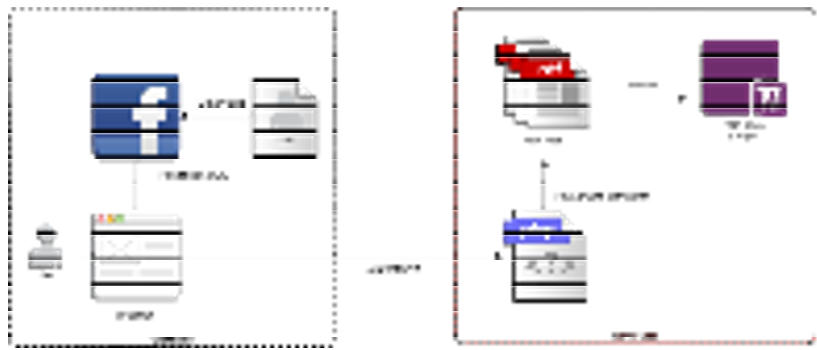 Figure 1: The system architecture showing the flow from Facebook API to the RDF Store.
3. SPARQL: The Power of Structured Inquiry
Instead of standard SQL, the system uses SPARQL. This allows for complex "triple" queries (Subject-Predicate-Object). For example, finding a person (Subject) who has an interest (Predicate) in a specific group (Object).
Experimental Insights: Discovering Commonality
The authors tested their tool with real-world scenarios, such as identifying common interests among students in a university department.
- Single-Interest Search: Successfully identified specific individuals interested in a particular departmental association.
- Multiple-Interest Matrix: The tool could calculate an "interest count," showing that while User A and User B both share two interests, User C only shares one. This quantitative look at social overlap is much harder to achieve with standard social media interfaces.
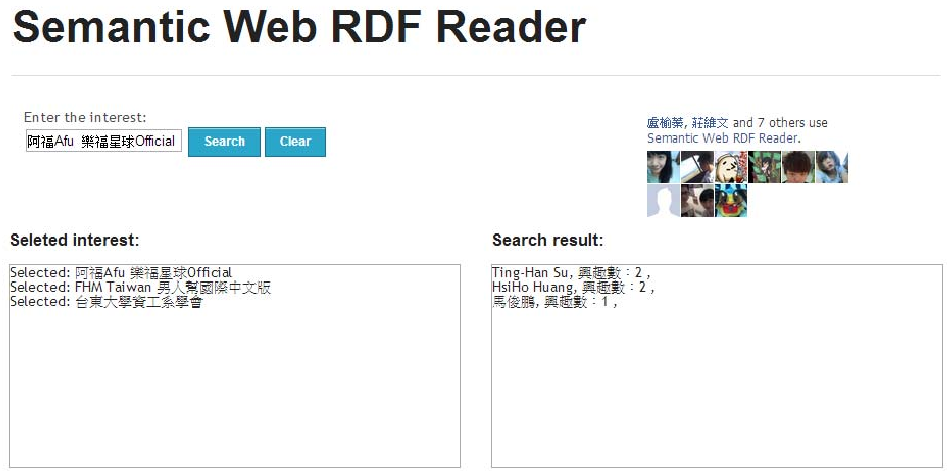 Figure 2: Results showing the number of shared interests among multiple users.
Critical Analysis & Future Outlook
While this research provides a robust framework for Web 3.0 readiness, it faces a few modern hurdles:
- Proprietary Walls: Facebook and other giants have significantly tightened their API restrictions since this paper's publication, making unauthorized semantic scraping nearly impossible.
- Real-time Challenges: The authors noted that their RDF Store is not instantly synchronized—a critical limitation for fast-moving social data.
- Beyond Facebook: The next logical step is a "Cross-Web" ontology that maps a user's identity across Twitter, LinkedIn, and decentralized platforms, creating a unified semantic profile.
Conclusion
This work demonstrates that the future of social networking is not just about "more data" but about "better data." By utilizing RDF and SPARQL, we can move beyond the surface level of likes and shares to a deeper, more logical understanding of human connection.