
Predicting the End: Semantic Unlink Prediction via Probabilistic Description Logic
Semantic Unlink Prediction in Evolving Social Networks through Probabilistic Description Logic
The paper introduces a semantic approach for "unlink prediction"—the task of forecasting when an existing relationship in a social network will end. It utilizes the Probabilistic Description Logic CRALC to incorporate domain knowledge beyond simple graph structures, achieving superior performance on researchers' collaboration networks.
TL;DR
While the AI community is obsessed with predicting new connections (Link Prediction), this paper addresses the equally vital "Unlink Prediction"—predicting when a relationship will vanish. By moving beyond graph math and employing Probabilistic Description Logic (CRALC) to encode semantic domain knowledge (like the lifecycle of a student-advisor bond), the authors achieved state-of-the-art results, boosting accuracy significantly over topological baselines.
The "Blind Spot" of Graph Metrics
Traditional Social Network Analysis (SNA) views the world through nodes and edges. Common metrics like Jaccard Coefficients or Katz Centrality assume that if two people share mutual friends or have a short path between them, their bond is strong.
However, the authors point out a critical flaw: Graph strength does not imply longevity. Consider a PhD student and their advisor. They share a massive number of common neighbors and co-authored papers. A graph algorithm would predict this link is "stronger than ever" right before the student graduates. But domain knowledge tells us that graduation often signals the end of an active daily collaboration.
Methodology: Bringing Semantics to Probability
The researchers propose a hybrid approach that bridges the gap between structured ontologies and probabilistic reasoning.
1. The Power of CRALC
They use CRALC (a probabilistic extension of the ALC Description Logic). This allows the system to define "concepts" (e.g., Researcher, Student) and "roles" (e.g., sharesPublication) with attached probabilities.
2. Longitudinal Assertions
Instead of a static snapshot, the authors divide the dataset (ABox) into time-slices. They introduce five specific semantic roles to summarize a link's history:
- Longevity Roles:
shortTermRelationship,mediumTermRelationship,longTermRelationship. - Behavioral Roles:
growingNetwork(adding many new links) andstableNetwork(consistent connections).
3. The Naive Bayes Inference
By grounding the terminology into a Bayesian Network, they create a classifier where these semantic roles act as evidence to calculate the probability of the unlink(u, v) event.
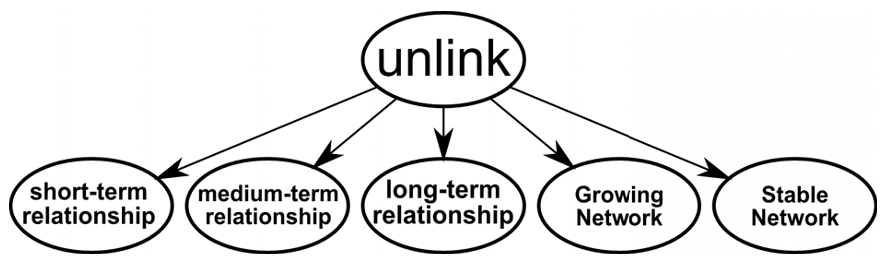 Figure: The Naive Bayes model used to classify unlinks based on semantic role evidence.
Experiments: The Lattes Platform
The authors tested their hypothesis on the Lattes Platform, a public repository of Brazilian scientific curricula. They tracked 7,918 collaborations that ended (positive unlinks) and a balanced set of those that continued (negative unlinks).
Performance Comparison
The results were stark. Graph-based methods were barely better than a coin flip (~53-56% accuracy). Even methods that accounted for "dynamics" like Growth/Decay only hit roughly 51%. The CRALC-based approach reached 77.41% accuracy.
| Predictor | Precision | Recall | Accuracy |
|---|---|---|---|
| Common Neighbors | 0.5537 | 0.5717 | 55.55% |
| Stability Based | 0.6025 | 0.8935 | 65.20% |
| CRALC Based | 0.6888 | 1.0000 | 77.41% |
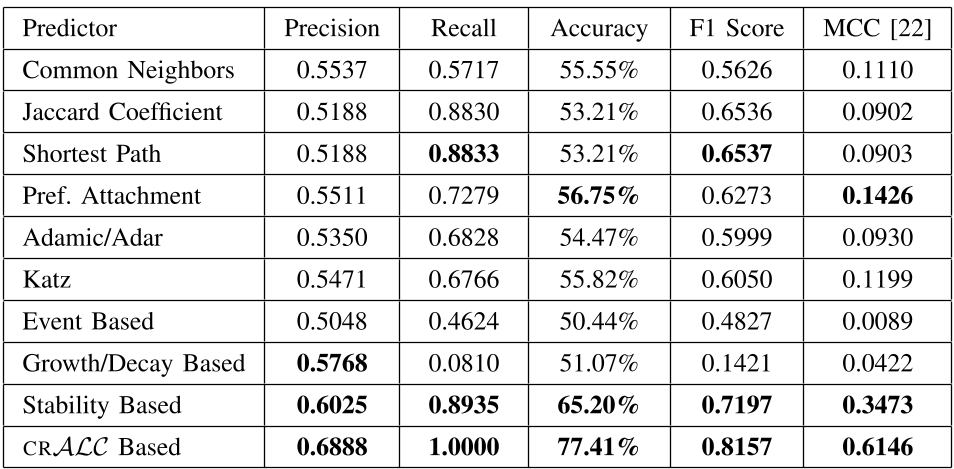 Figure: Comparison of various predictors. The CRALC-based method shows a dominant lead across all metrics.
Critical Analysis & Conclusion
This paper serves as a vital reminder: Data context is king.
- Why it works: By encoding specific professional states (like how long a relationship typically lasts), the model captures the "hidden" signals of decay that topological metrics miss.
- Limitations: The current model uses a Naive Bayes structure, which assumes conditional independence between roles. In reality, a "stable network" and a "long-term relationship" are likely highly correlated. Moving to a more complex dependency graph in CRALC might yield even higher precision.
- Future Impact: This framework can be applied to any evolving network where "ends" matter—from predicting employee attrition (HR) to identifying potential "churn" in B2B partnerships.
In conclusion, predicting the death of a link is a semantic task, not just a mathematical one. By using Probabilistic Description Logic, we can finally begin to understand why networks fall apart.