
Semantic Big Data: The New Frontier of Social Network Analysis
A survey on semantic Web and big data technologies for social network analysis
The paper provides a comprehensive survey on the convergence of Semantic Web and Big Data technologies for Social Network Analysis (SNA). It identifies how RDF-based semantic modeling and distributed processing frameworks (like Hadoop and Spark) are essential for managing the scale, heterogeneity, and complexity of modern social graphs.
TL;DR
Social Network Analysis (SNA) is undergoing a paradigm shift. As social data explodes in complexity and scale, the traditional "relational database" approach is failing. This survey explores the synergy between Semantic Web technologies (which solve data heterogeneity) and Big Data architectures (which solve computational scale). By combining RDF-based knowledge graphs with in-memory engines like Apache Spark, researchers can finally analyze massive, unstructured social interactions at scale.
Problem & Motivation: The Integration-Scale Paradox
Modern SNA faces a dual crisis:
- Heterogeneity: Social data is scattered across platforms (Twitter, Facebook, LinkedIn) in unstructured or semi-structured formats. Integrating these into a unified, semantically consistent network is nearly impossible with traditional SQL schema.
- Computational Intensity: Most graph mining algorithms (e.g., community detection, partitioning) are NP-hard. As the "Volume" and "Velocity" of social data increase, single-node systems hit a wall.
The authors argue that the only way forward is to bridge the gap between human-understandable semantics and machine-efficient distributed processing.
Methodology: The Semantic-Distributed Engine
The core methodology involves a two-pronged technological stack:
1. The Semantic Layer (The "What")
To solve the integration problem, the authors advocate for the Resource Description Framework (RDF). In this model, every social interaction is a "triple": <subject, predicate, object>. This creates a labeled directed graph that is inherently flexible.
- FOAF (Friend of a Friend): A key ontology for describing users and relationships.
- SPARQL: The query language that allows for complex pattern matching across these semantic graphs.
2. The Big Data Layer (The "How")
To handle the scale, the paper categorizes architectures into:
- Parallel Processing Frameworks: Transitioning from the disk-heavy Hadoop MapReduce to the in-memory Apache Spark, which allows for much faster iterative graph processing.
- Graph Databases (NoSQL): Systems like Neo4j and Titan that treat "edges" as first-class citizens, avoiding expensive "join" operations found in relational databases.
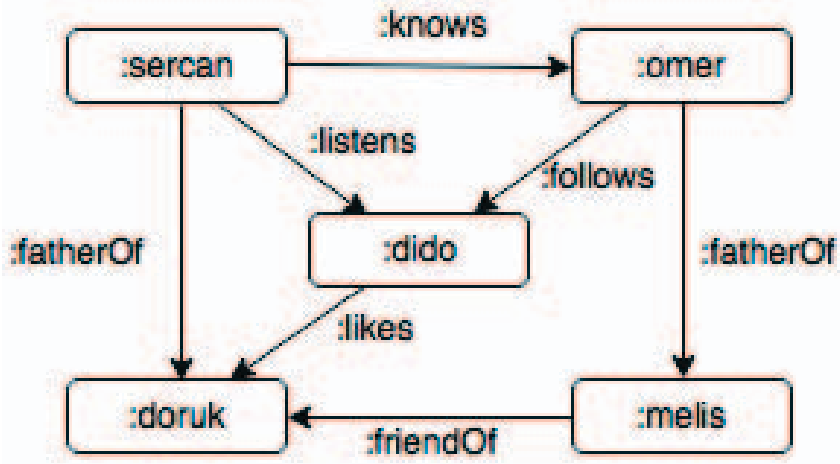 Figure 1: An RDF Graph visualization showing how entities and their relationships are semantically linked.
Experiments & Results: Spark vs. The World
The survey reviews various performance benchmarks across the industry:
- Hadoop vs. Spark: While Hadoop is suitable for batch processing, Spark is the clear winner for SNA due to its
Resilient Distributed Datasets (RDDs), performing up to 100x faster for the iterative algorithms common in graph mining. - Graph Processing Systems: Frameworks like GraphX (on Spark) and Giraph (on Hadoop) are compared. GraphX was found to be 8x faster than traditional MapReduce applications.
- Database Performance: In the NoSQL realm, Neo4j remains a top performer for complex queries, while Virtuoso is highlighted as a leading triplestore for handling large-scale RDF data.
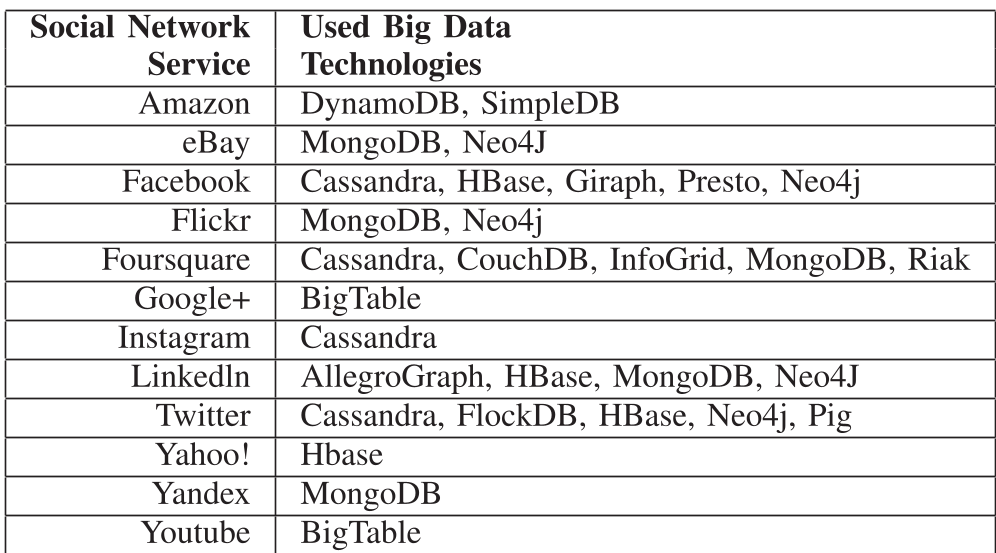 Table 1: Tech stacks of major social services showing the heavy reliance on NoSQL and distributed systems like Cassandra and HBase.
Critical Analysis & Conclusion
Takeaway
The future of SNA lies in distributed RDF stores and in-memory graph processing. The combination of semantic clarity (RDF/OWL) and distributed power (Spark/GraphX) allows us to analyze not just the structure of a network, but the meaning behind the connections.
Limitations & Future Work
Despite the progress, several "Open Research Directions" remain:
- Privacy & Trust: How do we perform SNA on large-scale data while preserving user anonymity?
- Data Scarcity: Most platforms (Facebook/Twitter) provide limited API access, forcing algorithms to work with incomplete graph data.
- Real-time Processing: Moving from batch analysis to real-time semantic stream reasoning remains a significant technical challenge.
In summary, the transition from Relational to Semantic-Graph architectures is a necessity, not a choice, for the next generation of social data scientists.