
The Semantic Web: Building Collective Intelligence Through Structured Knowledge
The Semantic Web: Collective Intelligence on the Web
The paper provides a comprehensive overview of the Semantic Web architecture, framing it as a platform for "Collective Intelligence." It details the transition from unstructured hypertext to a structured, machine-interpretable Web using W3C standards like RDF, SPARQL, and OWL to enable cross-domain data integration.
TL;DR
The Semantic Web isn't just about "smarter" websites; it's a structural evolution from a Web of Documents to a Web of Data. By leveraging a standardized "Layer Cake" of technologies (RDF, OWL, SPARQL), it enables disparate data sources—from BBC playlists to Wikipedia biographies—to be merged into a single, machine-interpretable graph. This paper outlines the architecture required to scale local knowledge into global "Collective Intelligence."
The Problem: The "Document Silo" Limitation
In the traditional Web, information is locked inside natural language documents. If you want to know "Which Swedish composers are being played on UK radio right now?", a standard search engine struggles because the answer is split across three different places:
- BBC Playlists (Broadcast data)
- MusicBrainz (Artist metadata)
- DBpedia/Wikipedia (Biographies and nationalities)
Existing systems lacked a common language to bridge these "silos" without fragile, custom-coded integrations.
Methodology: The Semantic "Layer Cake"
The authors describe a layered architecture designed to provide flexibility, robustness, and scalability. This is the blueprint for a computing "mega system."
1. The Core Infrastructure
- Identifiers (URI/IRI): Use global IDs like
http://bbc.co.uk/artist/abba#artistinstead of ambiguous strings. - The Graph (RDF): Instead of tables, data is stored as a directed graph of "Triples" (Subject-Predicate-Object). This allows anyone to add a new "edge" to any "node" without breaking the system.
2. The Logic Layers
- SPARQL: The SQL for the Web. It allows querying across multiple named graphs.
- Ontologies (RDFS/OWL): These define the "rules" of the domain. For example, an OWL axiom can state that a
mo:Musicianis a subclass offoaf:Person. A reasoner can then automatically infer that "Anni-Frid Lyngstad" is a person, even if the data source didn't explicitly say so.
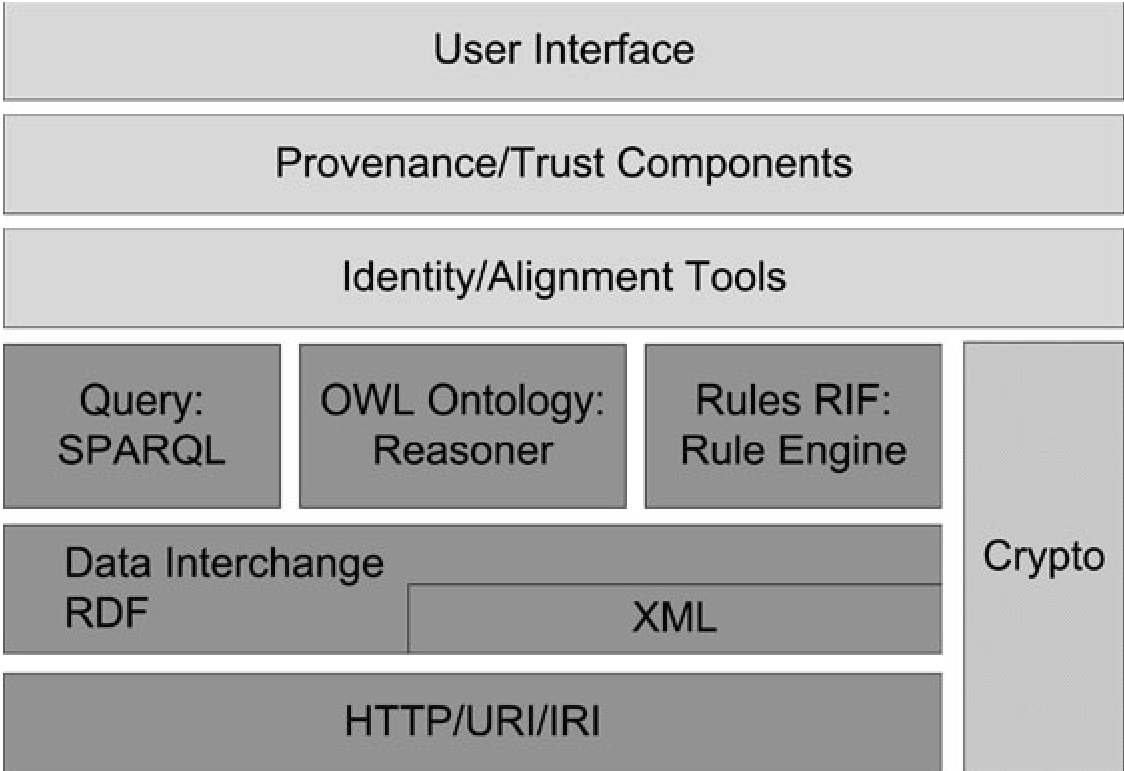 Fig 1: The W3C standard layers (dark gray) and future target capabilities like Trust and Proof (light gray).
Collective Intelligence in Practice: Linked Data
The "Intelligence" arises when independent datasets are linked via the owl:sameAs property. This tells the machine that a resource in the MusicBrainz database is the exact same entity as one in DBpedia.
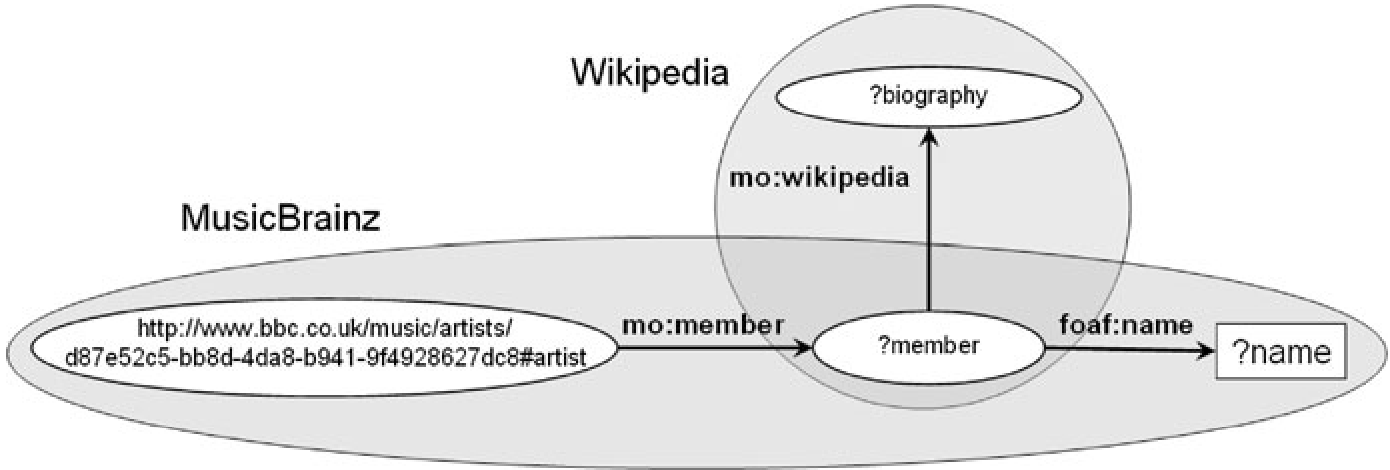 Fig 2: A practical join: Combining BBC broadcast data with European geographic data via shared URIs.
Critical Analysis: Trust, Provenance, and UI
While the bottom layers (Data/Query) are mature, the authors highlight three ongoing challenges:
- Identity Resolution: How do we automatically know "Helmut Kohl" the politician is different from "Helmut Kohl" the author?
- Trust: In a decentralized Web where anyone can publish anything, how do we weight the "truth" of a fact?
- User Interfaces: Users shouldn't have to write SPARQL queries. The paper demonstrates "Faceted Search" (e.g., SemaPlorer) as a way to let users browse complex graphs intuitively.
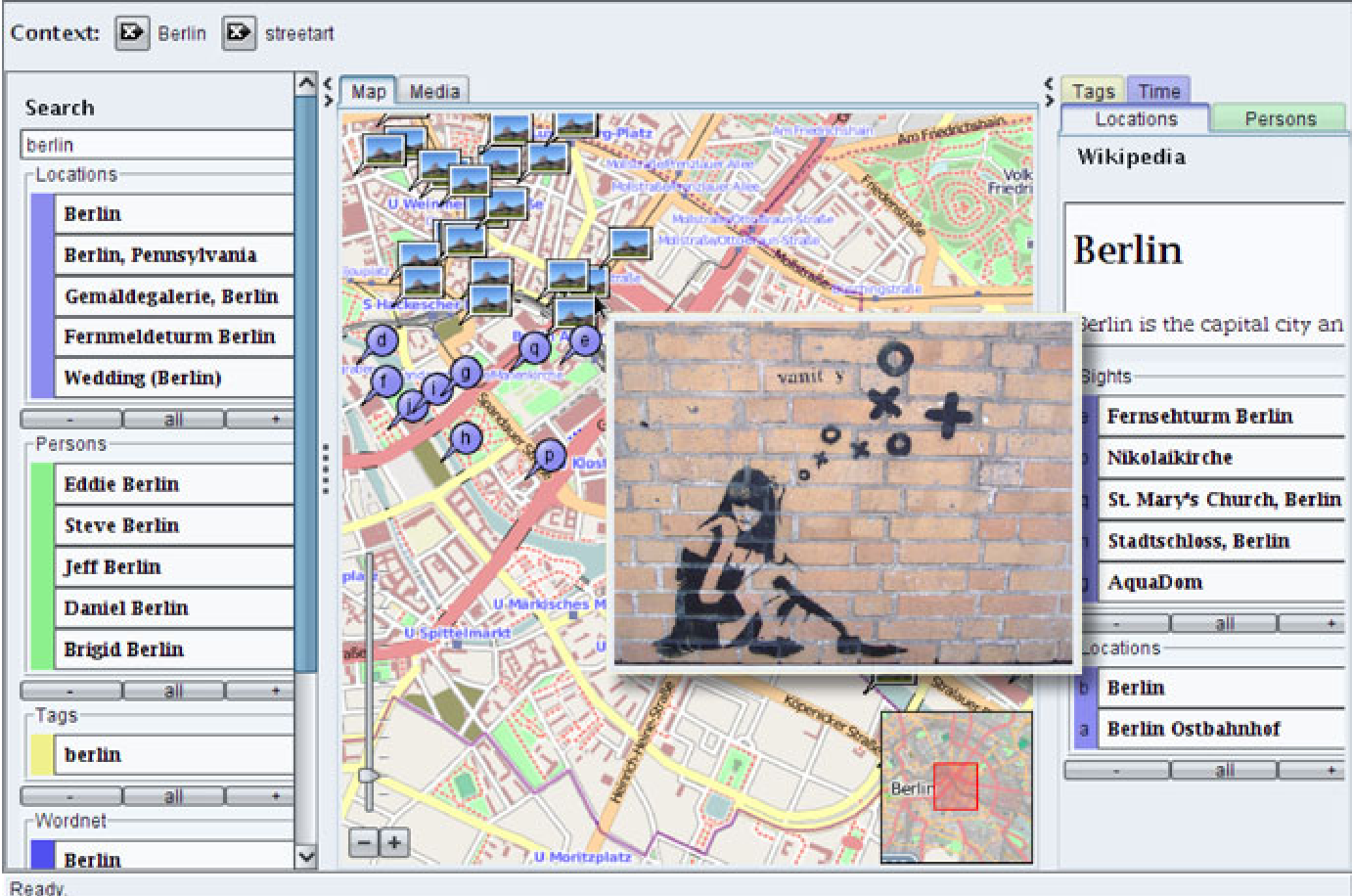 Fig 3: SemaPlorer uses facets (Location, Time, People) to make the Semantic Web accessible to human users.
Conclusion
The Semantic Web is the bridge between Artificial Intelligence and the World Wide Web. By moving from "unstructured strings" to "structured things," we enable a level of collective intelligence where the web essentially becomes a global, queryable database. As commercial giants like Yahoo and Google adopt these formats (Schema.org/GoodRelations), the vision of a seamless, data-driven web is moving from academic theory to industrial reality.