
The Pulse of the Semantic Web: Dynamics and Evolution of FOAF Social Networks
How is the Semantic Web evolving? A dynamic social network perspective
This paper presents a longitudinal study on the evolution of the Semantic Web through the lens of Friend of a Friend (FOAF) social networks. Utilizing a dataset spanning over two years, the authors analyze structural dynamics and growth patterns, eventually identifying a "speckled" evolution model where the network grows in a highly distributed and disconnected fashion.
TL;DR
This research investigates the "living" nature of the Semantic Web by analyzing how FOAF (Friend of a Friend) social networks changed over a two-year period (2005-2007). Moving beyond static snapshots, the authors demonstrate that the Semantic Web evolves in a "speckled" fashion—distributed, disconnected, but steadily maturing towards higher reciprocity and structural complexity.
Background: Beyond the Static Snapshot
In the mid-2000s, critics argued that the Semantic Web was too complex for average users to sustain. To counter this, researchers Zhou, Ding, and Finin turned to FOAF documents, the most active "salient" social network on the Semantic Web.
The core limitation of previous work was its static nature. By ignoring when relations were formed, researchers couldn't tell if the community was growing into a cohesive "Small World" or remaining a fragmented collection of isolated nodes. This paper introduces the Time Graph, allowing us to see the actual lifecycle of metadata.
Methodology: Categorizing the Social Fabric
The authors didn't just count links; they classified the shapes of social interaction. They identified:
- Singletons: Isolated individuals.
- Stars: A central hub (one person) knowing many others who don't know each other.
- Complex Components: Tightly knit groups with higher integration.
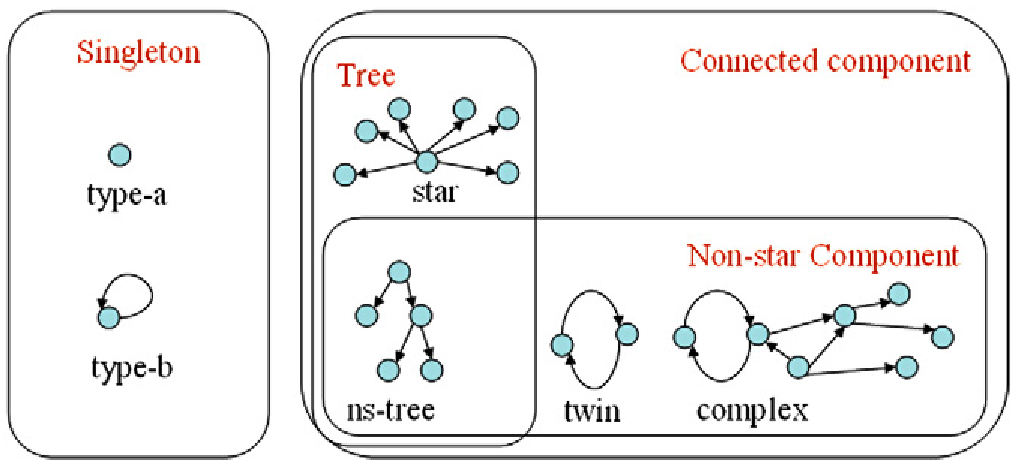
Using a dataset of over 688k FOAF documents, they tracked revisions and newly created documents, identifying that nearly 50% of changes directly impact the social network structure (growth in person instances and 'knows' relations).
Key Findings: The "Star" Problem and Speckled Growth
The data revealed a surprising structural reality: the FOAF network is overwhelmingly composed of Stars.
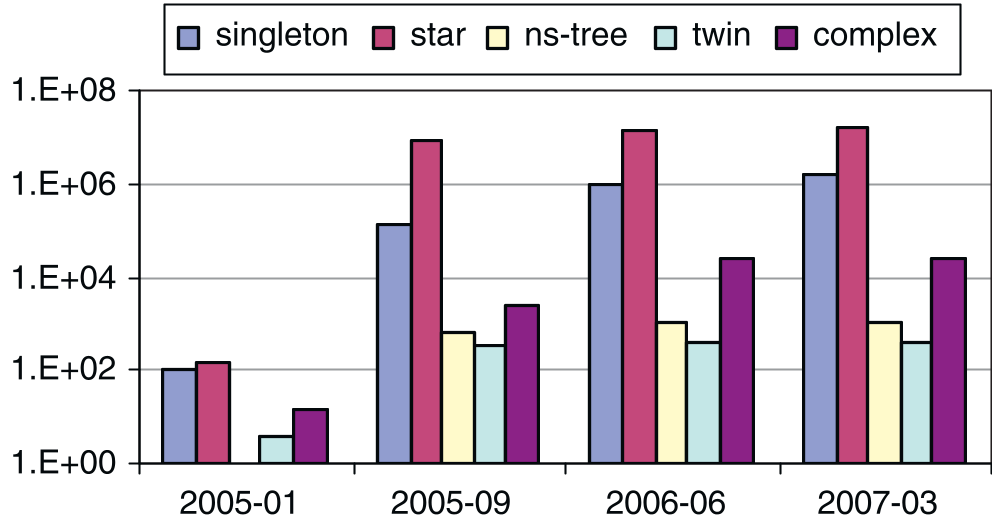
Why the Star dominance?
The authors hypothesize three main reasons for this fragmented "speckled" growth:
- Privacy Concerns: Authors use "blank nodes" rather than permanent URIs to link friends, effectively cutting off the link to the global graph.
- Technological Friction: Maintaining a permanent URI is difficult for non-technical users.
- Delayed Reciprocity: In a decentralized web, if A says they know B, there is a natural time lag before B updates their own FOAF file to acknowledge A.
The Rise of the Giant Component
Despite the fragmentation, the "Largest Component" showed healthy growth. The Clustering Coefficient increased over time, meaning localized communities are becoming more tightly knit.
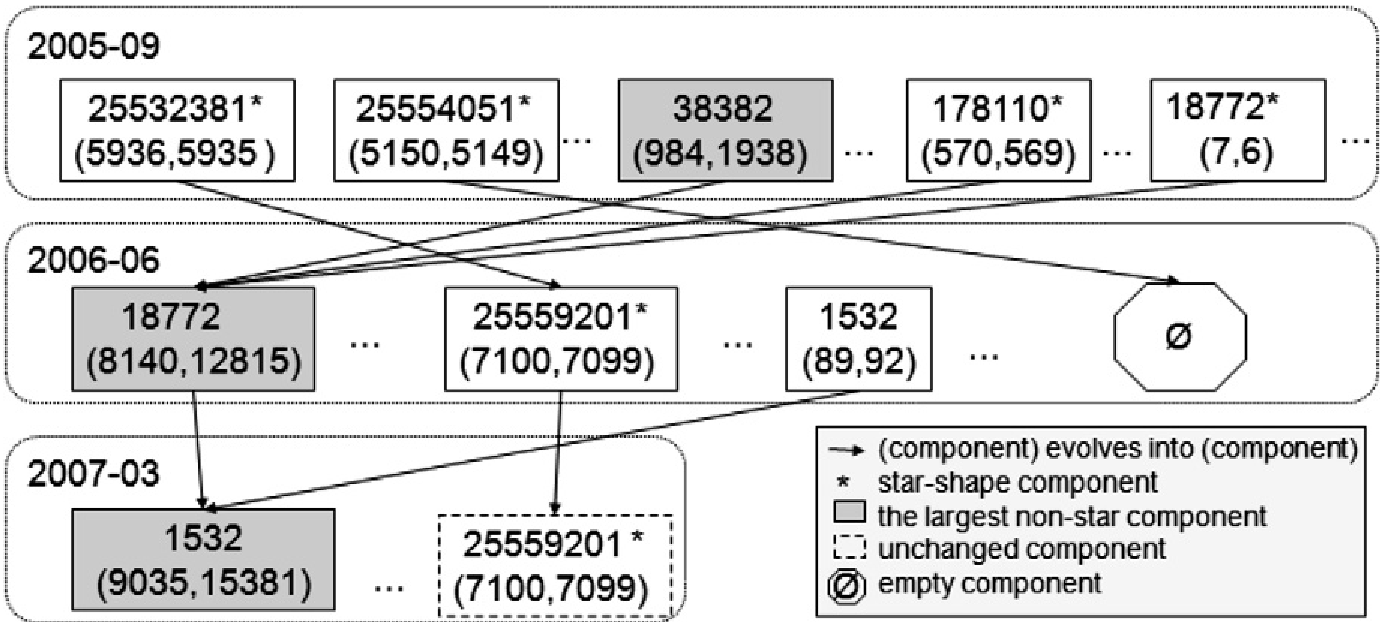
As shown in the figure above, multiple non-star components eventually merge into a single massive structure, proving that the Semantic Web community is integrating over time.
Critical Insight: Stability vs. Dynamics
The study concludes that the Semantic Web community is not a monolith but a collection of "speckles" that gradually coalesce. While the density of the network temporarily dipped as new users joined (outpacing the creation of new ties), the long-term trend points toward equilibrium and sustainability.
Limitations and Future Outlook
While the study is a milestone in longitudinal Semantic Web analysis, it primarily focused on the foaf:knows relation. Future shifts toward Linked Data and Schema.org have since expanded these social signals. However, the core takeaway—that social metadata evolves through distinct lifecycle stages—remains a fundamental principle for anyone building decentralized knowledge systems today.
Conclusion
This work provides the first empirical evidence that the Semantic Web is not just a theoretical vision but a growing, dynamic ecosystem. It highlights that the "social assets" of the web are built slowly, moving from isolated "stars" to complex, reciprocal communities.