
Beyond Keywords: A Computational Linguistics Approach to Web Service Discovery
A novel semantic approach for Web service discovery using computational linguistics techniques
The paper introduces a semantic framework for automatic Web service discovery using Computational Linguistics. It employs a natural language interface, mapping user queries to the SUMO ontology via WordNet, and utilizes a novel edge-based matchmaking algorithm to achieve fine-grained service ranking.
Executive Summary
TL;DR: This paper presents a sophisticated framework that allows users to find Web Services using natural language queries rather than rigid keywords. By integrating NLP techniques (like WSD and PoS tagging) with formal ontologies (SUMO), it calculates a highly precise "semantic distance" to rank service relevance.
Positioning: This work positions itself as a bridge between the Syntactic Web (WSDL/UDDI) and the Semantic Web (OWL-S). It moves away from "absolute" matching towards a "graded" similarity model, significantly improving discovery accuracy.
The "Keyword" Bottleneck
In the world of Web Services, finding the right "tool for the job" has historically been frustrating. Traditional registries like UDDI act like old-school phone books; if you don't use the exact name the provider listed, you find nothing. Even early "Semantic" attempts were too academic, forcing users to write queries in complex languages like OWL-S. The authors identify a dual crisis:
- Syntactic matching is blind to the fact that "Booking" and "Reservation" mean the same thing.
- Semantic tools are too complex for the average human user.
Methodology: The Semantic Pipeline
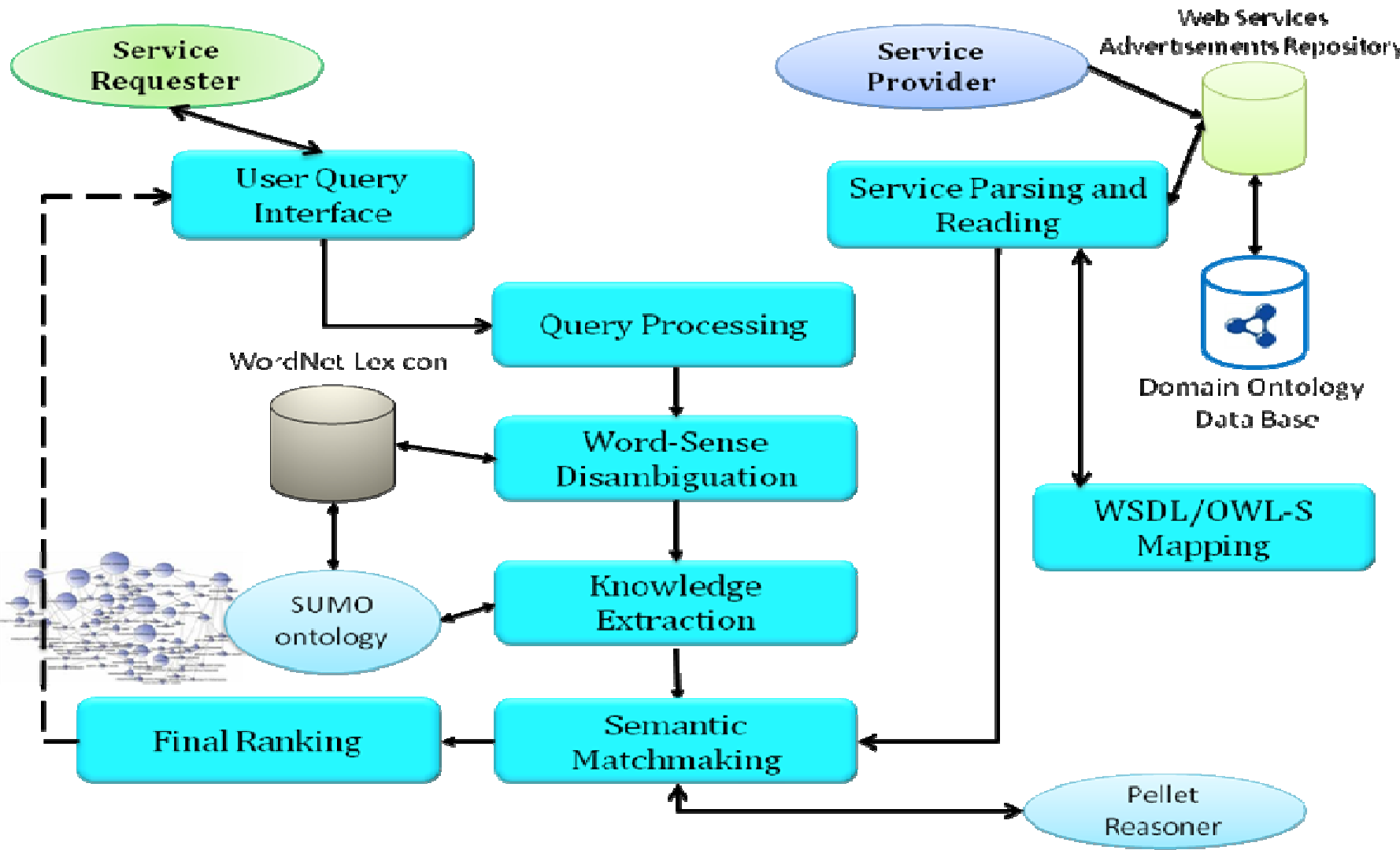
The authors' framework functions as a sophisticated translator that turns a messy English sentence into a precise mathematical coordinate in an ontology.
1. The Linguistic Front-end
Before looking for services, the system performs "Query Pre-processing." It uses:
- Part-of-Speech Tagging: Identifying if a word is a verb (action) or noun (object).
- Word Sense Disambiguation (WSD): Using the Leacock & Chodorow measure to decide if "book" means a reading material or the act of reserving a flight.
2. The Matchmaking Engine
The core innovation lies in how they measure similarity. Instead of a binary "Yes/No" match, they use an edge-based approach on the SUMO ontology.
The weight of an edge between two concepts is not constant. It is dynamically calculated based on:
- Depth (): Relationships deeper in the tree are more specific and thus weighted differently.
- Density (): If a concept has many children, the semantic distance between them is perceived as smaller.
The final formula for Semantic Distance () is the sum of weights along the shortest path:
Experimental Validation
The authors compared their "Continuous Distance" approach against the popular "Discrete Category" approach.
| Query Concepts | The Authors' Semantic Distance | Previous Work (Discrete) |
|---|---|---|
| City vs. UrbanArea | 0.174 (Very Close) | CSubclassP |
| Town vs. City | 0.348 (Similar) | CSiblingP |
| Capital vs. Destination | 2.049 (Distanced) | PSubsumesC |

The results show that while older models might group "Town/City" and "FarmLand/NationalPark" into the same category (CSiblingP), the authors' method reveals that "Town/City" are actually much closer semantically (0.348 vs 1.392).
Critical Insight & Conclusion
The Takeaway: The genius of this paper is the integration of WordNet (Lexical/Word level) with SUMO (Context/Logic level). It acknowledges that language is fluid but logic is rigid, and it provides the mathematical glue to stick them together.
Limitations: While the approach is robust for English, the reliance on a central ontology (SUMO) can be a bottleneck. If a service provider uses a niche domain-specific ontology, the mapping might lose its nuance.
Future Outlook: As we move toward AI-driven service composition, this linguistic pre-processing will be vital. The next step is clearly Deep Semantic Discovery, where Large Language Models (LLMs) might replace the manual mapping to SUMO, while still utilizing the weighted-graph logic proposed here.