
Semantically Enabled SOA: Bridging the Gap Between Clinical Big Data and Social Indicators
Towards semantically enabled development of service-oriented architectures for integration of socio-medical data
The paper proposes a semantically-enabled Service-Oriented Architecture (SOA) family framework to integrate heterogeneous "Big Data" from medical and social domains. By leveraging ontologies and software product line engineering, the authors establish a methodology for the automatic processing and configuration of sophisticated services for health predictions and recommendations.
TL;DR
Integrating medical data is no longer just a "volume" problem—it is an interoperability nightmare. This paper presents a framework that uses Service-Oriented Architecture (SOA) Families and Ontologies to transform fragmented socio-medical data into a unified, configurable ecosystem. By applying software engineering practices from the "Software Product Line" domain, the authors provide a roadmap for automated medical prediction and recommendation services.
The Problem: The "Silo" Trap of Medical Big Data
Healthcare systems are currently gold mines of data, but this data is locked in "closed" silos. Traditional Clinical Information Systems (CIS) rarely talk to social or economic databases.
- Heterogeneity: Data ranges from molecular (genomics) to behavioral (diet, smoking) and economic (insurance).
- Semantic Friction: Different systems use different terms for the same concept, making automated reasoning nearly impossible.
- Static Architectures: Current IT systems cannot rapidly adapt to new medical workflows or changing demographics.
Methodology: The Power of SOA Families
The core insight of the paper is treating medical services not as one-off applications, but as a Product Family. This is achieved through a two-phase development lifecycle:
1. Service-Domain Engineering (Phase I)
This is the "blueprint" phase. The team identifies commonalities across different hospitals and research centers. Key activities include:
- Ontology Integration: Using middle-layer ontologies (like HDOT) to provide a shared vocabulary.
- Variability Modeling: Defining what changes between implementations (e.g., local legislation, specific clinical specialties).
2. Service-Application Engineering (Phase II)
This is the "configuration" phase. Using the blueprint from Phase I, specific applications are generated based on stakeholder needs.
- Intelligent Selection: If multiple services are available (e.g., different drug procurement services), the system uses reasoning to select the most efficient one.
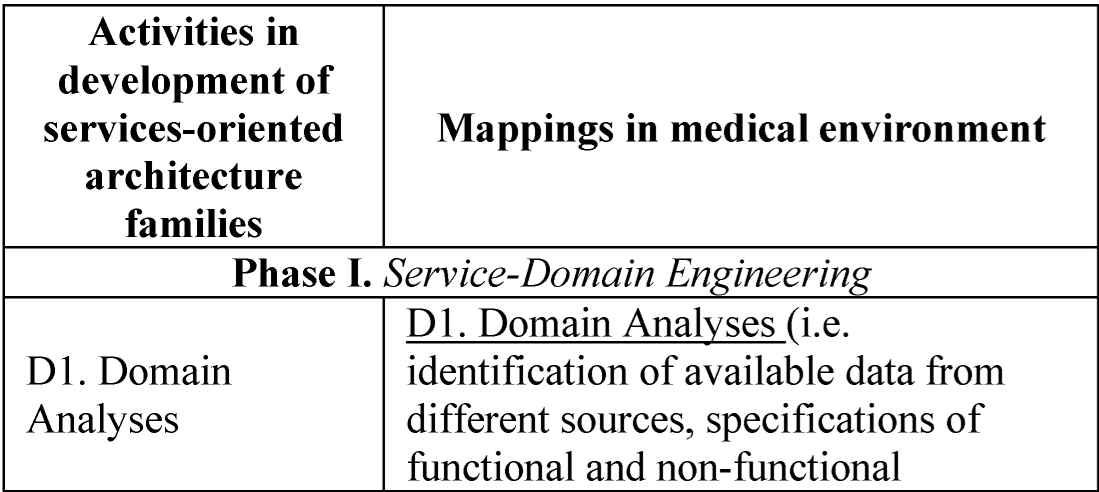 Figure 1: This table illustrates how fundamental software engineering steps like "Domain Analysis" are mapped directly to medical data source identification.
Key Technological Enablers: Semantic Ontologies
The paper emphasizes that for big data to become "smart data," it must be semantically annotated. The researchers point to several existing ontologies as the building blocks for their proposed Socio-Medical Model (SMM):
- Gene Ontologies: For species-independent descriptions of biological processes.
- Foundational Model of Anatomy (FMA): For phenotypic structures.
- Disease Ontology: For clinical perspectives on etiology.
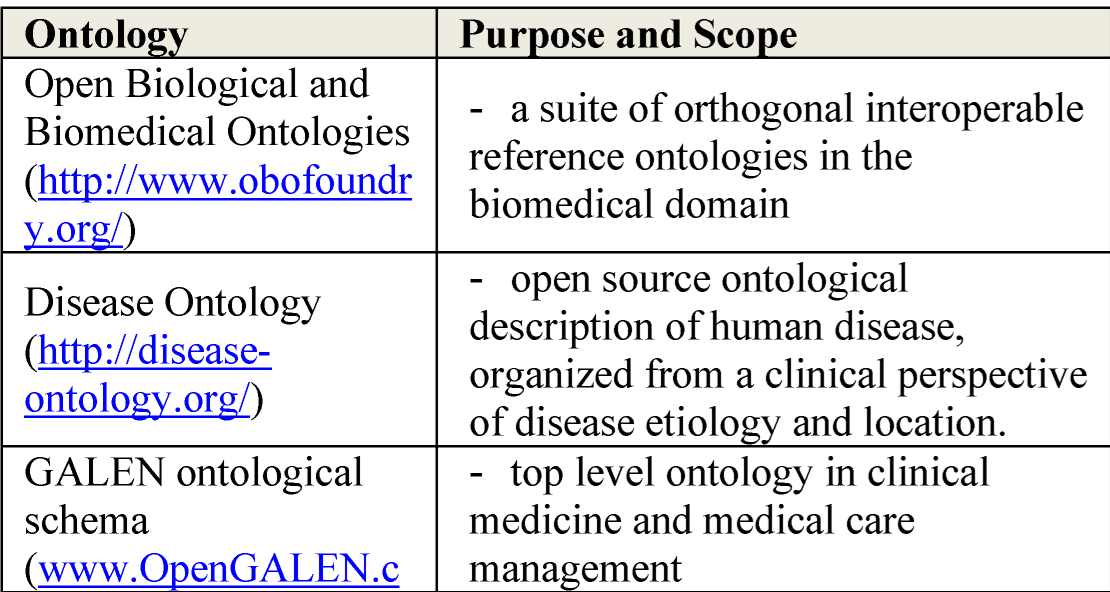 Figure 2: A summary of existing ontologies that provide the semantic backbone for the proposed SOA family.
Critical Insight & Conclusion
The true value of this work lies in its cross-disciplinary approach. By borrowing Variability Analysis and Feature Resolution from software engineering, the authors offer a way to manage the "Big Data" chaos in medicine.
Takeaway for the Industry: We must stop building "monolithic" healthcare apps. Instead, we should focus on building a library of interoperable, semantically-aware services that can be "configured" into unique clinical workflows on the fly.
Future Outlook: While the framework is robust, its success depends on the willingness of national health systems to adopt open semantic standards. The next step will be testing this architecture on real-world case studies to measure the latency and accuracy of its automated recommendations.