
Semantically Oriented Sentiment Mining: Deciphering the Pulse of Social Network Spaces
Semantically Oriented Sentiment Mining in Location-Based Social Network Spaces
The paper introduces a pattern-based sentiment mining system specifically designed for location-based social networks (LBSN) like Yelp and Foursquare. By leveraging SentiWordNet and Part-of-Speech (POS) tagging, it calculates semantic orientation scores to classify short, geo-coded reviews into positive or negative categories.
TL;DR
This research tackles the challenge of sentiment classification in the "wild" environment of Location-Based Social Networks (LBSNs) such as Yelp and Foursquare. Unlike long-form critiques, these reviews are short and context-heavy. The authors propose a system using SentiWordNet and Part-of-Speech (POS) tagging to calculate semantic orientation, achieving a peak accuracy of 61.5% by focusing on linguistic precision rather than strict data filtering.
Context & Motivation: The "Short Review" Dilemma
Most sentiment analysis research is polished against massive datasets like the IMDb movie reviews. However, the language of LBSNs is different: it’s succinct, often informal, and geographically focused.
The authors identified a critical gap: How do we determine the "vibe" of a place when the review is only a few words long? Traditional machine learning requires massive labeled training data, which isn't always available for niche social platforms. Therefore, the authors turned to a lexicon-based (semantic orientation) approach, which uses pre-defined sentiment dictionaries to "calculate" the mood of a text without a heavy training phase.
Methodology: The Engineering of Meaning
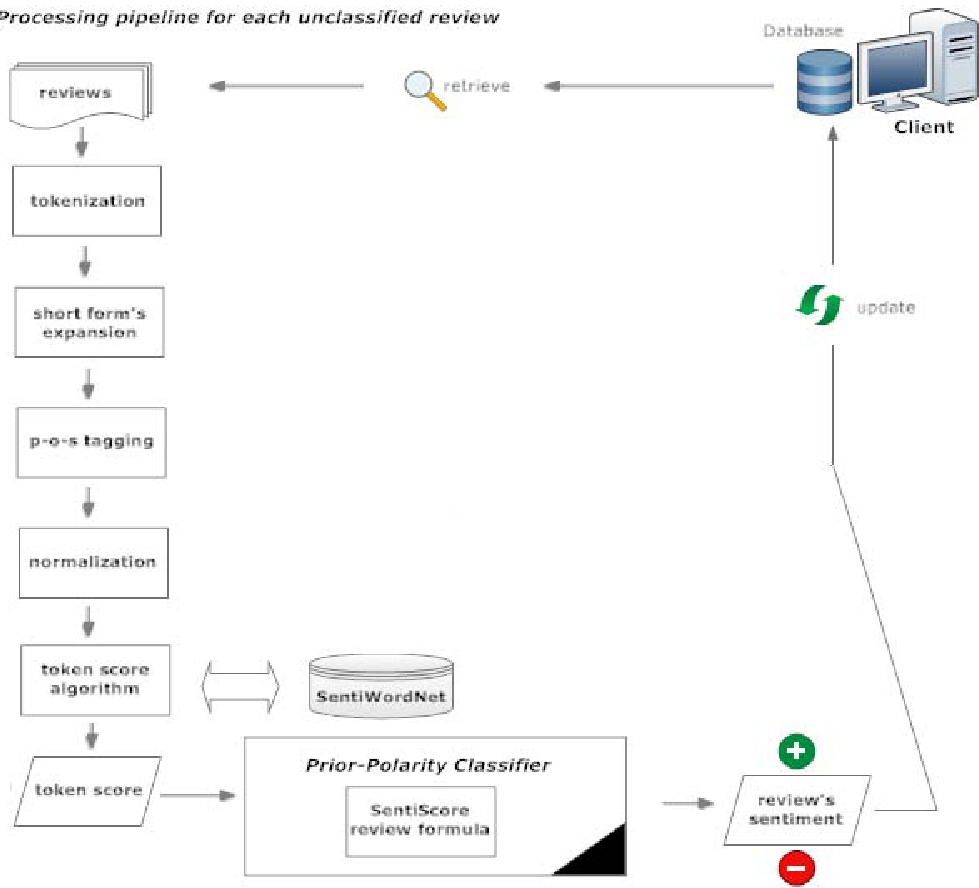
The system follows a rigorous pipeline designed to squeeze maximum information out of every token.
1. The Pre-processing Pipeline
To handle the noise of social media, the system employs:
- Normalisation: Expanding contractions (e.g., "don't" to "do not").
- Lemmatization: Reducing words to their base form (e.g., "was" to "be") to match dictionary entries.
- POS Tagging: Identifying if a word is a Noun, Verb, Adjective, or Adverb—crucial for resolving ambiguity.
2. Solving Word Sense Disambiguation (WSD)
A single word can have many meanings. The authors tested three strategies to handle this in SentiWordNet:
- Random Sense: Picking a definition at random (Baseline).
- All Senses Arithmetic Mean: Averaging scores across all possible meanings.
- POS-matching Senses (The Winner): Only averaging meanings that match the identified POS tag (e.g., scoring "cool" as an adjective, not a noun).
3. The SentiScore Formula
The core logic resides in a normalized polarity calculation: This ensures that a single long review with many moderate words doesn't unfairly outweigh a short, punchy review with high-intensity words.
Experiments and Insights
The researchers tested their models on a dataset of 600 Yelp and Foursquare reviews.
Key Findings:
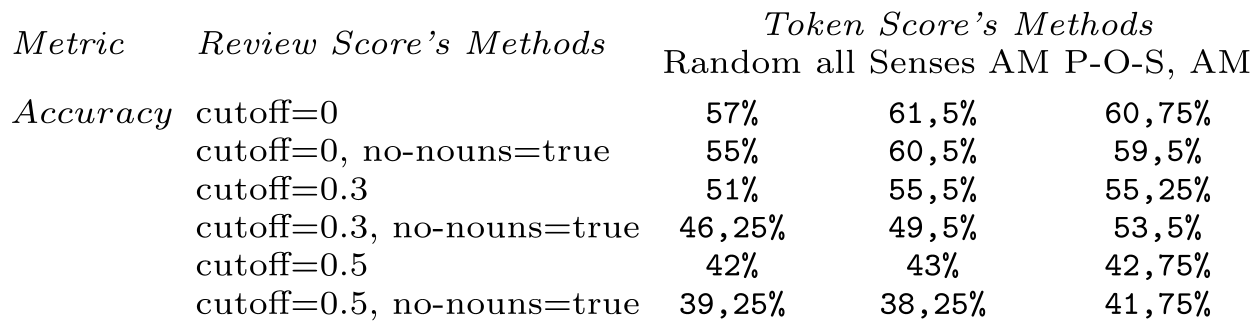
- POS Tagging Matters: The best results (Accuracy: 61.5%) came from using POS tagging to filter word senses.
- The "Cut-off" Trap: In movie reviews, it's common to ignore "objective" words. However, in short LBSN reviews, the authors found that applying a high objectivity cut-off (e.g., 0.5) slashed accuracy significantly. Why? Because short reviews have so few words that throwing any away leaves the classifier with zero information.
- Symmetry in Sentiment: The system performed better at identifying positive reviews than negative ones, likely because reviewers often include "polite" positive remarks even in negative critiques.
Critical Analysis & Conclusion
While 61.5% accuracy may seem modest compared to today’s Large Language Models (LLMs), this work highlights the fundamental linguistic challenges of unsupervised sentiment mining.
Limitations:
- Irony and Sarcasm: Lexicon-based systems are notoriously blind to sarcasm (e.g., "Great, another hour of waiting!").
- Tagging Errors: If a POS tagger misidentifies a word (tagging "cool" as a noun), the sentiment score is instantly corrupted.
- Context-Shift: Factors like "cold" might be negative for a soup review but positive for a beer review—a distinction SentiWordNet cannot easily make.
Final Takeaway
This paper serves as a blueprint for building lightweight sentiment engines where compute or labeled data is scarce. It underscores that for short-form social media, precision in linguistic tagging is more valuable than complex statistical filtering. Future systems would benefit from combining these semantic rules with neural embeddings to capture contextual nuances.