
S-Aframe: Empowering Vehicular Social Networks through Semantic Multi-Agent Synergy
A semantics-based multi-agent framework for vehicular social network development
This paper introduces S-Aframe, a multi-layer semantic-based multi-agent framework designed to streamline the development of Vehicular Social Network (VSN) applications. It leverages the synergy between mobile and resident agents to manage dynamic network topologies and diverse service requirements in VANETs.
Executive Summary
TL;DR: S-Aframe is a sophisticated software framework that simplifies the creation of Vehicular Social Network (VSN) applications. By combining mobile agents, resident agents, and semantic web technologies, it allows vehicles to autonomously discover services and share multimedia in the highly volatile environment of Vehicular Ad-hoc Networks (VANETs).
Academic Positioning: This work bridges the gap between distributed agent-based computing and Semantic Web services. It moves beyond simple V2V communication protocols into a high-level application platform that manages the complexity of dynamic node joining/leaving and heterogeneous service requirements.
Problem & Motivation: The Dynamic Chaos of VANETs
Developing applications for vehicles is notoriously difficult. Unlike static social networks, Vehicular Social Networks (VSNs) must survive:
- Topology Volatility: Vehicles move at high speeds, making connections ephemeral.
- Service Heterogeneity: Different users have vastly different needs (entertainment vs. safety).
- Network Overhead: Traditional mobile agents that carry their entire codebase are too "heavy" for short-lived wireless links.
The authors observed that existing frameworks (like MobiSN or RoadSpeak) either lacked extensibility or relied too heavily on centralized servers, which are unreliable in pure ad-hoc scenarios.
Methodology: The S-Aframe Architecture
The core innovation lies in the S-Aframe programming model, which splits the burden of execution into two distinct agent types:
- Resident Agents: These live on the device and act as "service providers," hosting localized APIs (e.g., GPS, local data).
- Mobile Agents: These are "travelers" that carry task logic and migrate between nodes, invoking the services of local Resident Agents.
Multi-Layer Stack
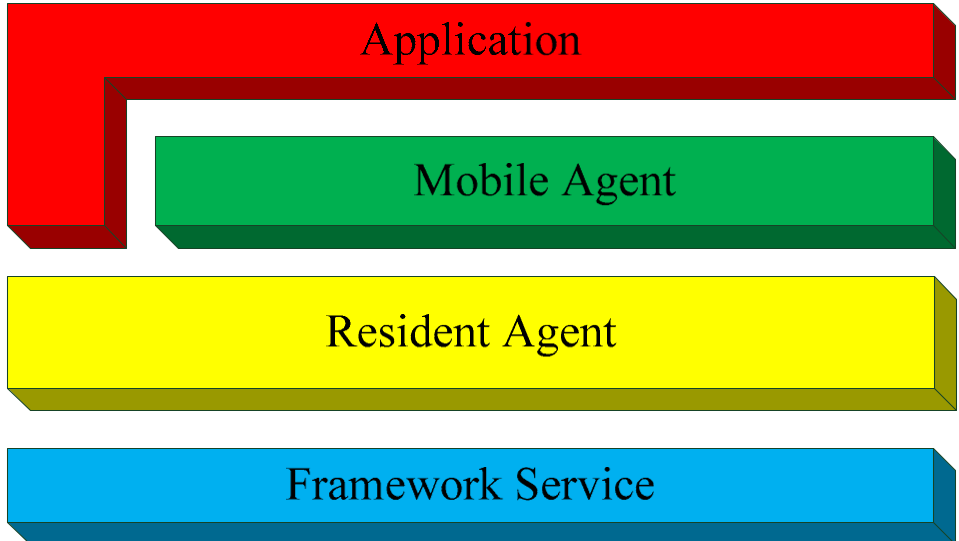
The framework consists of four rigorous layers:
- Framework Service Layer: Provides core utilities like UUID naming, migration, and network status.
- Resident Agent Layer: The bridge between framework services and specific application logic.
- Mobile Agent Layer: Executes the actual social tasks by visiting multiple nodes.
- Application Layer: The UI and owner logic that dispatches agents.
The Semantic Edge
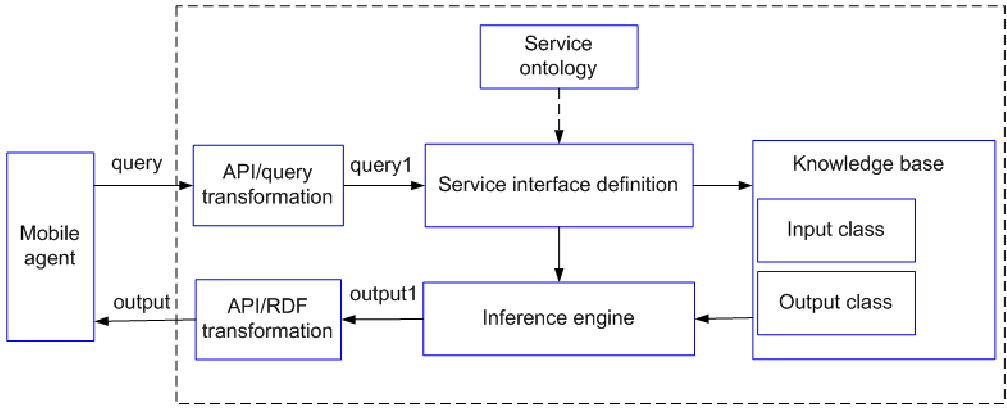
To handle "Dynamic Invocation," S-Aframe uses Semantic Web technologies. Instead of hard-coding service calls, agents use an OWL (Web Ontology Language) based service ontology to ask: "What can this node do?" This allows for intelligent matchmaking where a mobile agent can dynamically adapt its behavior based on the specific capabilities of the vehicle it currently resides in.
Experiments: Real-world Friend Discovery
The authors validated S-Aframe using a Friend Search application. The experiment involved heterogeneous hardware (Laptops + Android phones).
- Self-Adaptation: When a new node ("Judy") joined the network, the framework's deployment service automatically pushed the necessary resident agents to her device.
- Task Execution: A mobile agent autonomously traversed the network, collected GPS coordinates and IDs, and returned a consolidated "social map" to the original owner.
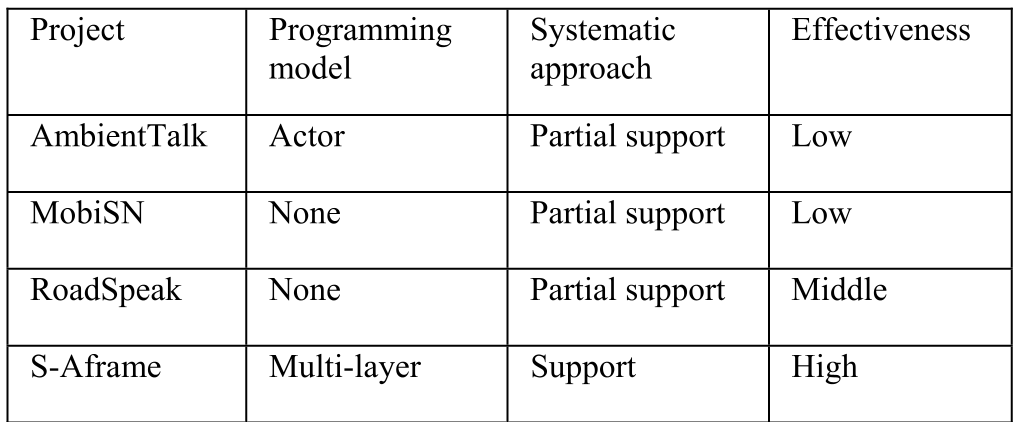
Compared to AmbientTalk (low-level script) or MobiSN (fixed functions), S-Aframe offers high effectiveness due to its Java-based extensible APIs and structured multi-layer approach.
Critical Analysis & Conclusion
Takeaway
S-Aframe effectively hides the "plumbing" of VANETs (disconnections, routing, service discovery) from the application developer. By making agents semantic-aware, it creates an environment where software can "reason" its way through a changing network.
Limitations
- Security Overhead: While the paper mentions identity checking, the actual computational cost of running semantic reasoners (like Pellet or Racer) on embedded vehicular hardware may introduce latency.
- Energy Consumption: Agent migration and continuous network scanning are energy-intensive for mobile devices.
Future Work
The authors aim to incorporate more robust multipath multimedia transmission (P2P-like streaming) to handle the heavy bandwidth requirements of modern vehicular entertainment systems. As autonomous vehicles become more data-centric, frameworks like S-Aframe will be vital in creating "Social Cars" that cooperate for better safety and efficiency.