
Leveraging Partisanship: Semi-Automatic Sentiment Labeling in Political Twitter
Semi-Automatic Training Set Construction for Supervised Sentiment Analysis in Political Contexts
The paper introduces a semi-automatic methodology for constructing large-scale training datasets for supervised sentiment analysis in political contexts. By leveraging the "partisan bias" of politicians on Twitter, it achieves efficient labeling without intensive human labor, validated using a hybrid Multinomial Naive Bayes and Logistic Regression classifier.
TL;DR
Researchers from the Universidad Politécnica de Madrid have developed a method to bypass the "manual labeling bottleneck" in sentiment analysis. By assuming that politicians are inherently biased (praising allies and attacking rivals), they automatically generated a high-quality dataset of ~20,000 tweets. They also introduced a robust mathematical fix for the "base rate problem," ensuring that performance metrics remain accurate even when the proportion of positive/negative talk shifts in the real world.
The Bottleneck: Why Manual Labeling Fails Scale
In the world of Natural Language Processing (NLP), supervised learning is king. However, its Achilles' heel is the training set. Human annotation is slow, expensive, and often inconsistent—inter-annotator agreement typically hovers around a mere 80%. In fast-moving environments like political campaigns, waiting for humans to label data is often not an option.
Furthermore, most models are "fooled" by distribution shifts. If your training set is 50/50 positive/negative, but the real world is 90% negative, your model's Precision will be wildly misleading.
Methodology: The "Partisan Logic" Heuristic
The authors' core insight is simple yet powerful: In a polarized electoral campaign, neutral talk from a participant is rare.
1. The Labeling Rule
By tracking 5,000+ political accounts during the Spanish general elections, the system applied the following logic:
- Positive Label: A politician mentions their own party.
- Negative Label: A politician mentions a rival party (without mentioning their own).
- Filtering: Retweets were removed to prevent data duplication.
2. The Model Architecture
The team utilized a high-performance baseline strategy proposed by Wang and Manning (2012):
- Feature Extraction: Bag-of-unigrams and bigrams.
- Generator component: Multinomial Naive Bayes (MNB) to produce log-count ratios.
- Discriminative component: Logistic Regression (LR) using those ratios as features, refined via sigmoid calibration.
(Figure: Overview of the SPTGE dataset construction and the hybrid MNB-LR classification pipeline)
Solving the Base Rate Bias
One of the paper's most significant contributions is its treatment of Precision in biased environments. If the ratio of negatives to positives () in your application set differs from your test set, your precision is "wrong."
The authors provide a correction formula:
This allows researchers to calculate a Corrected Precision () using the estimated real-world ratio (), preventing the deployment of models that look good in the lab but fail in the field.
Experimental Results
The authors compared their automatically labeled SPTGE dataset against the gold-standard TASS and STOMPOL datasets.
| Train Set | Test: SPTGE | Test: STOMPOL | Test: TASS |
|---|---|---|---|
| SPTGE (Auto) | 0.823 | 0.640 | 0.50 |
| TASS (Manual) | 0.653 | 0.673 | 0.908 |
| Combined | 0.820 | 0.740 | 0.903 |
Key Findings:
- Meaningful Labels: The SPTGE dataset's high self-test ROC-AUC (0.823) proves the partisan heuristic is a valid proxy for sentiment.
- Domain Sensitivity: Models trained on general data (TASS) struggle with political nuances, while the auto-labeled SPTGE generalizes well when combined with other political sets.
- Threshold Reliability: As shown below, the corrected precision-recall curve (green) accurately tracks the actual validation performance (blue), whereas the uncorrected test curve (red) is dangerously optimistic.
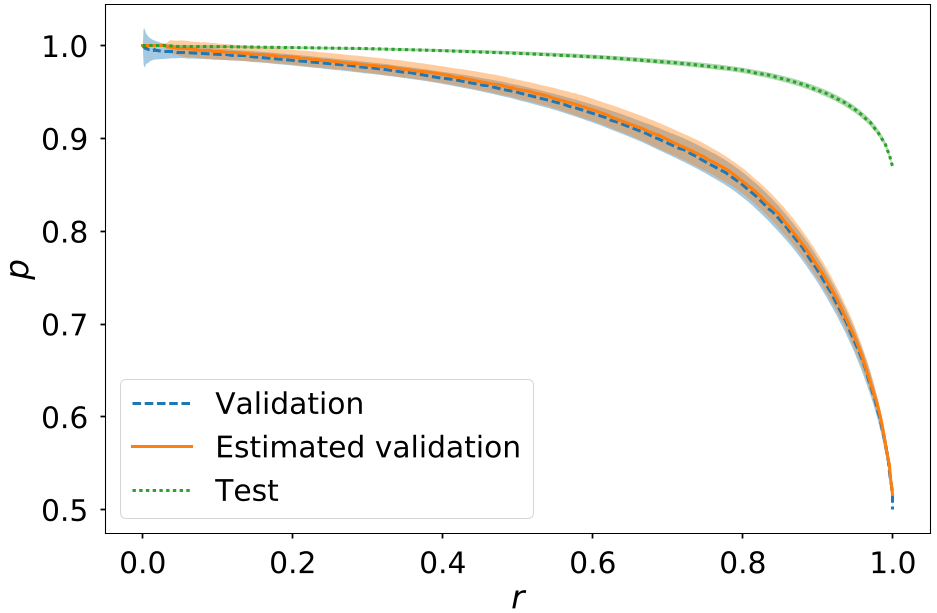 Fig 2: The estimated curve (green) accurately matches the true validation curve (blue), proving the math works.
Critical Insight & Future Outlook
While the "partisan heuristic" works brilliantly for politics, its real value lies in its generalizability. The authors suggest this could be applied to:
- Brand Wars: Samsung vs. Apple enthusiasts.
- Sports: Rivalries like Real Madrid vs. Barcelona.
Limitations: The method currently generates fewer negative samples than positive ones—a reflection of the "echo chamber" effect where users interact more with their own side than with rivals. Future work could improve the "negative" retrieval mechanism to balance the dataset further.
Bottom Line: This research bridges the gap between high-level social science observations (polarization) and practical machine learning deployment, making large-scale political sentiment analysis accessible without the heavy price tag of manual labeling.