
Beyond the Friend List: A Semi-supervised Approach to Granular Privacy Quantification
A Semi-supervised Approach to Measuring User Privacy in Online Social Networks
This paper introduces a circle-based privacy scoring metric for Online Social Networks (OSNs) and a semi-supervised framework to calculate it. By leveraging Active Learning (Uncertainty Sampling) and Naive Bayes, the system quantifies user privacy risk based on granular sharing preferences rather than binary "all-or-nothing" friend visibility.
TL;DR
Social network privacy is broken because we treat "Friends" as a monolithic group. This paper introduces a Circle-Based Privacy Score that measures risk based on which specific individuals can see your data. By using Active Learning, the system can predict your privacy preferences for hundreds of friends after you label just a few, providing a realistic "Privacy Meter" that reflects true digital exposure.
Background: The Dunbar Problem in Digital Spaces
In the early days of OSNs, "visible to friends" was a sufficient privacy shield. However, as link density increased, the average user’s friend list grew far beyond Dunbar’s Number (the cognitive limit of stable social relationships). We now share "friendships" with coworkers, acquaintances, and strangers.
The core motivation of this work is the realization that visibility is not binary. If you share a photo with 500 "friends" but only trust 50 of them, your privacy risk is significantly higher than existing metrics—which rely on coarse separation-based policies (Friends/Public)—would suggest.
Methodology: The Circle-Based Paradigm
The authors re-engineer the classic privacy score framework by Liu and Terzi. The primary innovation is the transition from a Separation-Based Response Matrix () to a Circle-Based Response Matrix ().
1. The Mathematical Intuition
Instead of a discrete integer representing "distance" (e.g., 1 for friends, 2 for FOF), the new response entry represents the density of disclosure:
This formula calculates the proportion of friends () who are explicitly or implicitly "allowed" to see item .
2. Active Learning Wizard
Labeling every item for every friend is an task—too tedious for any user. To solve this, the authors employ Uncertainty Sampling.
- The Classifier: A Naive Bayes model trained on features like age, gender, hometown, and community membership (detected via the DEMON algorithm).
- The Loop: The system identifies the friend for whom the classifier is most "uncertain" (Maximum Entropy), asks the user for a label, and retrains.
 Figure 1: The Entropy-based sampling logic used to select instances for user labeling.
Experiments: Reality vs. Default Settings
The researchers conducted a two-phase study with real Facebook users. The results revealed a startling disconnect:
- Perceived Sensitivity: When forced to think about specific circles, users rated their data (like political views or photos) as more sensitive than when using general Facebook settings.
- Safer Behavior: Privacy scores for the "Circle-based" approach were actually lower (safer) because users realized they didn't want to share everything with everyone in their list.
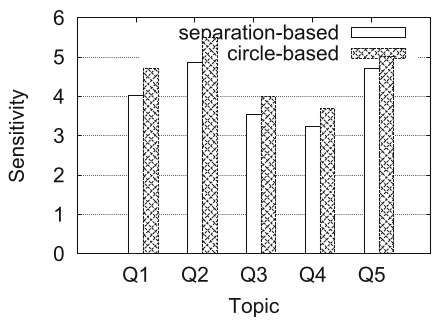 Figure 2: Accuracy and F-measure improvements as the number of labeled friends increases.
As shown in the ablation of the labeling process, the Accuracy significantly sharpens after labeling just 10-15 friends. This proves that users don't need to do much work to get a high-fidelity privacy assessment.
Critical Insight: The "Ego-Minus-Ego" Network
A standout technical detail is the use of community detection on the "ego-minus-ego" network (the network of your friends excluding yourself). By identifying overlapping clusters (work colleagues vs. family), the Naive Bayes classifier can much more accurately predict sharing permissions, as privacy preferences are highly correlated with social "silos."
Conclusion & Future Impact
This research moves the needle from theoretical privacy to usable privacy.
- Strategic Value: It provides a technical foundation for "Privacy Meters" that could be integrated into OSN interfaces to warn users before they post.
- Limitations: The model relies on profile metadata being available; as more users "lock down" their profiles, the classifier may need to rely more heavily on network topology (graph-based features) rather than attribute-based features.
Ultimately, the paper proves that while social networks have made us more exposed, Machine Learning can be the tool that helps us regain control, effectively acting as a digital filter that matches our online sharing with our real-world social boundaries.