
Unlocking Human Sentiment: How Semi-Supervised Learning Solves the Speech Emotion Bottleneck
A Survey on the Semi Supervised Learning Paradigm in the Context of Speech Emotion Recognition
This paper provides a comprehensive survey of Semi-Supervised Learning (SSL) paradigms applied to Speech Emotion Recognition (SER/ASER). It evaluates various generative models, including GANs, Autoencoders (AE), and Ladder Networks, emphasizing their ability to achieve SOTA performance while significantly reducing the dependency on expensive labeled emotional datasets.
TL;DR
Automatic Speech Emotion Recognition (ASER) is pivoting from data-hungry supervised models to Semi-Supervised Learning (SSL). This survey highlights how architectures like GANs, Autoencoders, and Ladder Networks leverage vast amounts of unlabeled audio to match or even beat supervised SOTA performance, slashing the need for expensive expert annotation.
Context & Motivation: The Annotation Tax
Emotion is inherently subjective and complex. Labeling a scream as "fear" or "anger" often requires psychological expertise, making high-quality datasets like IEMOCAP or EmoDB small and expensive.
The author's core insight is that while labeled data is scarce, raw audio is abundant. By shifting the paradigm to SSL, we can use "proxy labels" or "consistency training" to force models to learn the underlying manifold of human speech without needing a human to tag every second of audio.
Methodology: The Three Pillars of Semi-Supervised ASER
The paper identifies three dominant technical architectures currently leading the field:
1. Robust GANs (Generative Adversarial Networks)
The survey examines VSSSGAN (Virtual Smooth Semi-Supervised GAN). This model doesn't just distinguish "real" from "fake" audio; it uses Virtual Adversarial Training to smooth the decision boundaries. By calculating "adversarial directions" on unlabeled data, the model becomes robust to small perturbations in speech.
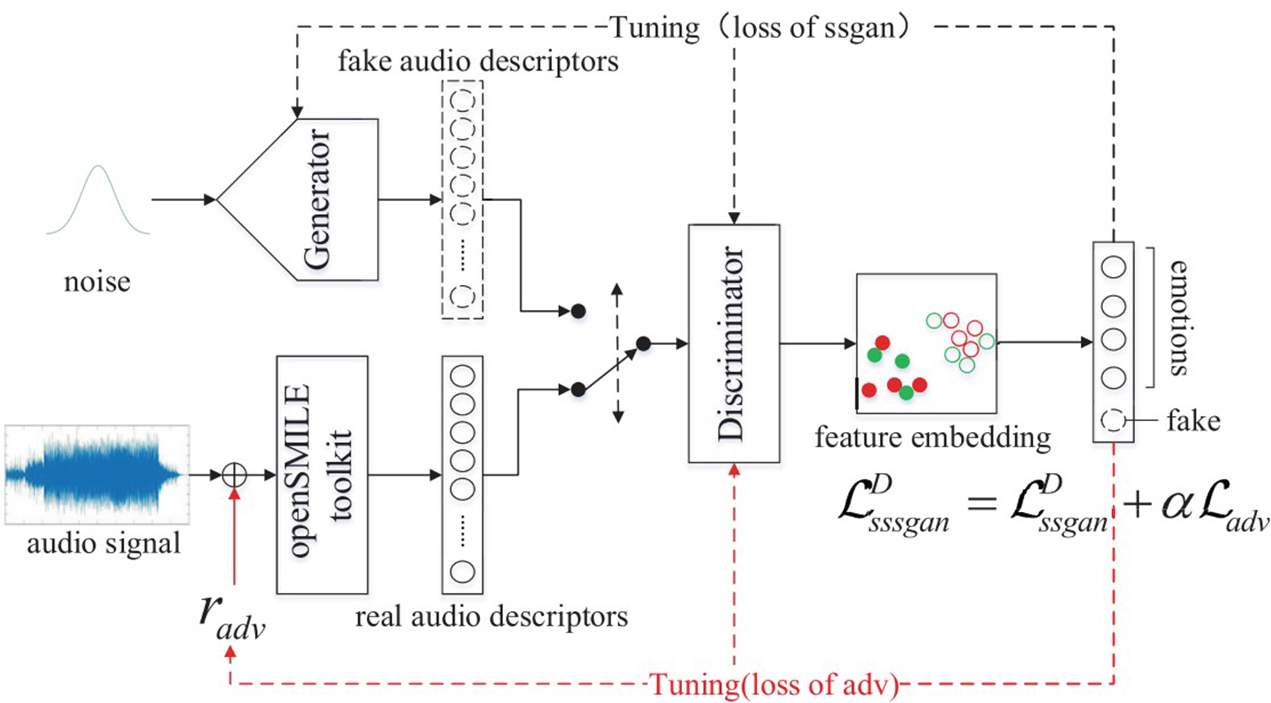 Fig 1: Proposed SSSGAN framework using Adversarial Training to smooth decision boundaries.
2. Semi-Supervised Autoencoders (SS-AE)
Autoencoders are used to extract latent features in an unsupervised manner. The survey highlights a specific innovation: Identity Skip Connections. This allows information to flow across multiple layers, preventing vanishing gradients and enabling the model to retain "raw" acoustic details while learning high-level emotional abstractions.
3. Ladder Networks
Ladder Networks are presented as perhaps the most robust SSL tool. They feature two encoders (one noisy, one clean) and a decoder. The reconstruction loss at every layer forces the model to learn features that are useful for both reconstructing the audio and classifying the emotion.
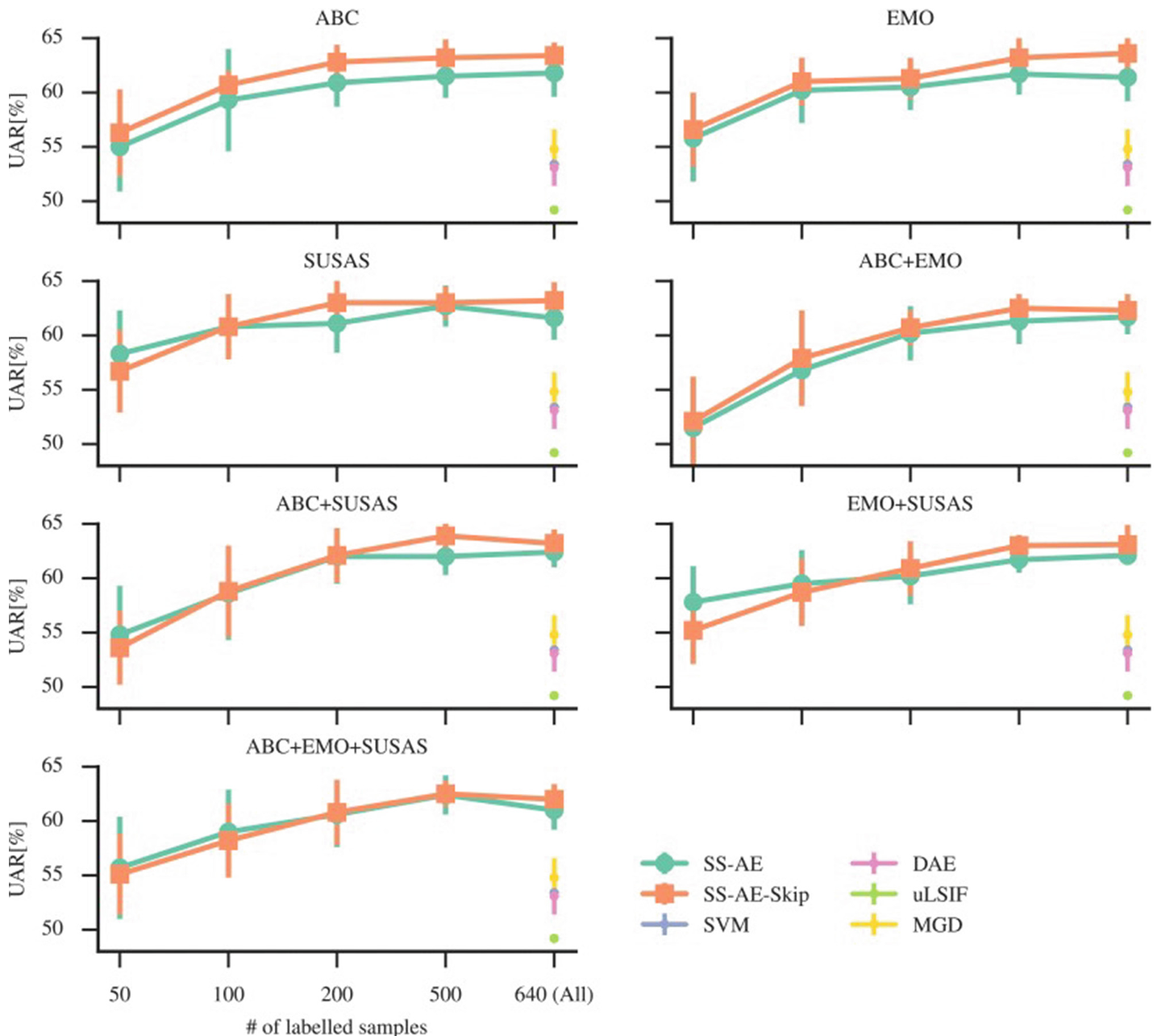 Fig 2: The standard Ladder Network architecture used for joint supervised/unsupervised learning.
Experiments: More Data Beats More Labels
The results across various datasets (AEC, IEMOCAP, MSP-Podcast) show a recurring theme: The "UL" (Unlabeled) advantage.
- In-Domain Performance: On the AEC dataset, Adding SSL skip-connections pushed accuracy higher than standard AE, nearing fully supervised results with only a fraction of the labels.
- Cross-Domain Generalization: In the most challenging tests—training on one dataset and testing on another—models utilizing unlabeled data (Lad + UL + MTL) achieved significantly higher Concordance Correlation Coefficients (CCC).
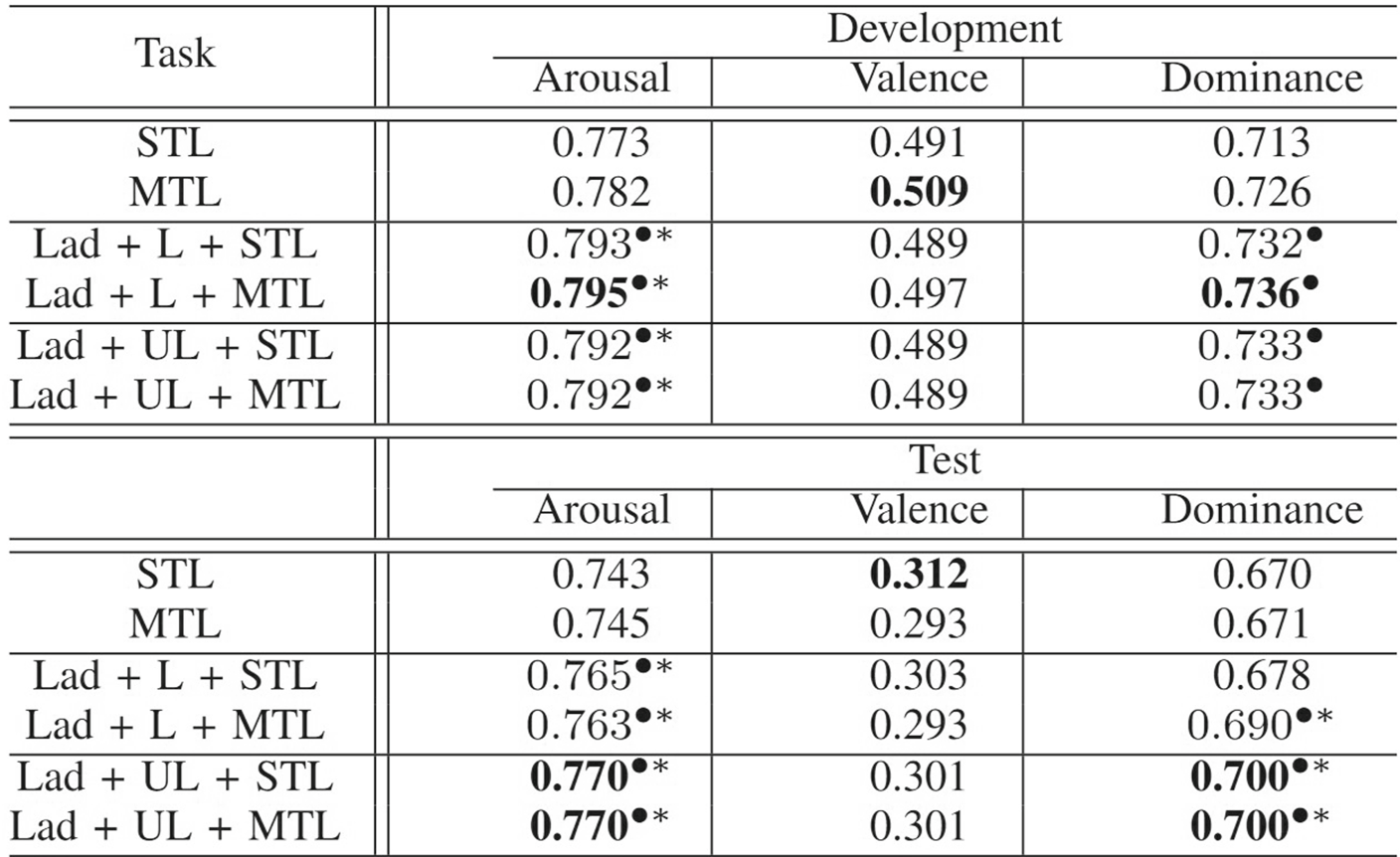 Table 1: Performance metrics showing Lad+UL (Unlabeled) models outperforming Supervised (STL/MTL) baselines in cross-corpus tests.
Critical Insight: The Modality Trade-off
The authors conclude with a sobering reality check on Multi-task vs. Single-modal learning. While video and text add context, they exponentially increase computational overhead and data collection complexity. For real-world deployment on mobile devices or "ambient" AI, single-modal audio SSL represents the "sweet spot" of efficiency and performance.
Summary & Future Outlook
This work confirms that SSL is no longer a "backup" for small data—it is a primary strategy for robustness. Future research is trending towards Natural Speech (recorded in the wild) rather than "acted" speech (recorded in studios), where SSL will be the only viable way to process the sheer volume of undocumented human emotion.