
ssToT: Bridging Social Media and Clinical Psychiatry through Semi-Supervised Learning
Semi-Supervised Approach to Monitoring Clinical Depressive Symptoms in Social Media
The paper introduces ssToT (Semi-supervised Topic modeling over Time), a novel framework designed to monitor clinical depression symptoms on Twitter. By integrating clinical PHQ-9 guidelines with a semi-supervised statistical model, the system achieves a 68% accuracy and 72% precision in detecting fine-grained depressive indicators without requiring massive labeled datasets.
TL;DR
Researchers have developed ssToT (Semi-supervised Topic modeling over Time), a proactive screening tool that transforms raw Twitter feeds into clinical insights. By mapping tweets to the nine standard symptoms of the PHQ-9 depression scale, the model detects clinical depression with 68% accuracy and 72% precision, effectively emulating a psychiatrist's diagnostic process without the need for manual surveys.
Background: The Limits of Traditional Screening
Diagnosing clinical depression is fundamentally different from detecting "sadness." Under clinical guidelines (DSM-V), depression requires the persistent presence of specific symptoms—such as sleep disorders, loss of energy, or suicidal ideation—over a sustained period.
Current digital health efforts face a "data bottleneck":
- Surveys are prone to cognitive bias and represent only a snapshot in time.
- Lexicon methods miss metaphors (e.g., "counting sheep" vs. "nightmare").
- Supervised Machine Learning requires clinicians to label thousands of tweets, which is prohibitively expensive.
Methodology: The Hybrid "Top-Down vs. Bottom-Up" Logic
The core innovation of this paper is the ssToT model. It combines the clinical rigor of medical scales (Top-Down) with the discovery power of Topic Modeling (Bottom-Up).
1. The Seeded Knowledge Base
The team worked with clinicians to build a lexicon of 1,620 terms categorized by PHQ-9 symptoms. These aren't just keywords; they are "seeds" that guide the algorithm.
2. Disambiguation and Sentiment
To avoid false positives (e.g., "economic depression" vs. "clinical depression"), the model uses sentiment-aware filtering. A word like "cut" is only treated as a symptom seed if the surrounding context carries a negative sentiment polarity.
3. Temporal Monitoring
Instead of analyzing tweets in isolation, the model groups them into time buckets (e.g., 14-day windows). This reflects the clinical requirement that symptoms must persist to be considered a depressive episode.
 Figure 1: Conceptual framework for monitoring depressive symptoms.
Experimental Performance: SOTA Results
The researchers compared ssToT against five major baselines, including Latent Dirichlet Allocation (LDA) and Biterm Topic Model (BTM).
- Higher Coherence: ssToT produced much more "interpretable" topics. While standard LDA mixed "eating disorders" with "suicidal thoughts," ssToT successfully isolated these into clinically distinct clusters.
- Competitive with Supervised Models: Remarkably, despite being semi-supervised (not seeing any labels during training), ssToT performed on par with fully supervised SVM and Naive Bayes classifiers.
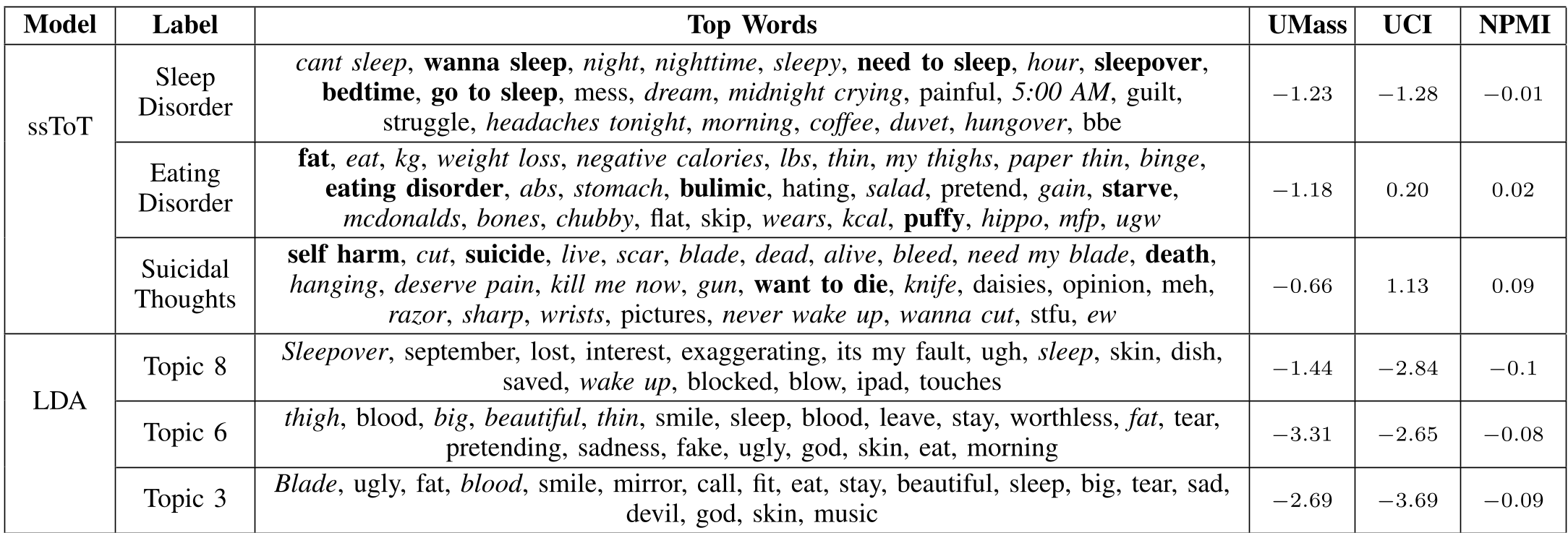 Table 1: Comparison of topic coherence. Higher scores in UMass and UCI indicate more meaningful symptoms.
The "Invisible" Symptoms
Beyond the PHQ-9, the model discovered "Community Triggers" that clinicians often miss. For instance, the model identified clusters specifically related to academic stress (exams, assignments) and relationship friction (family, "friendless"), providing a more holistic view of the user's environment.
Critical Analysis & Future Outlook
While the results are promising, the study has notable limitations:
- Selection Bias: The dataset was built from users who self-reported depression in their profiles; the model may perform differently on users who mask their symptoms.
- Sparse Data: Users who tweet rarely provide insufficient signal for temporal monitoring.
The Takeaway: This work proves that clinical knowledge can be "injected" into statistical models to create high-performance diagnostic tools. As mental health resources become increasingly scarce, unobtrusive monitoring via social media could serve as a vital "early warning system" for those sliding into clinical depression.
Future Direction
The authors suggest that the next step is integrating this textual analysis with Electronic Health Records (EHR) to move from public social media to private, clinical intervention platforms.