
Sensing Handshakes: Automating Social Connectivity via Wearable Accelerometers
16616_Sensing Handshakes for Social Network Development.
The paper introduces a wearable sensing system designed to automate social network development by detecting handshakes using wrist-worn 3-axis accelerometers. By leveraging SHIMMER sensors and cross-correlation algorithms, the system identifies physical greetings and automatically triggers digital connection requests via email and Facebook.
TL;DR
This research presents a prototype system that automates the expansion of online social networks by sensing physical handshakes. Using wrist-worn SHIMMER sensors, the system identifies the unique rhythmic patterns of a handshake through accelerometer data and cross-correlates signals between participants to trigger instant digital connection requests. It moves networking from a manual, forgettable process to a seamless, automated interaction.
Contextual Positioning
Within the trajectory of Ubiquitous Computing (UbiComp), this work represents an early and specialized application of Activity Recognition (AR) tailored for Social Computing. While most wearable research focuses on health or fitness, this paper treats a physical gesture as a "digital handshake" to bridge the gap between physical encounters and online social graphs.
The Problem: The Friction of Physical Networking
Traditional networking at conferences is plagued by "connection friction." The reliance on physical artifacts like business cards or manual note-taking leads to several failure points:
- Cognitive Load: Forgetting the context of when and why a contact was made.
- Manual Labor: The tedious subsequent task of searching for individuals on LinkedIn or Facebook.
- Inaccuracy: Data loss or illegible handwriting.
The authors' insight is simple yet profound: the handshake is already the universal protocol for social initiation. By digitizing this gesture, the "administrative" part of networking can be offloaded to the background.
Methodology: Detection through Cross-Correlation
The technical core of the system relies on Intel-developed SHIMMER sensors and the BioMOBIUS development environment.
1. Dimensionality Reduction
Although the sensors provide 3-axis data, the authors observed that the vertical "shaking" motion primarily excites the Y-axis (parallel to the forearm). By focusing on this single stream, the computational complexity is reduced, making real-time analysis feasible even on low-power wearable hardware.
2. Signal Verification and Noise Filtering
A significant challenge in gesture recognition is the "Midas Touch" problem—where every movement is interpreted as an intentional command. To avoid false positives such as scratching one's leg or cleaning a whiteboard, the system uses Cross-Correlation.
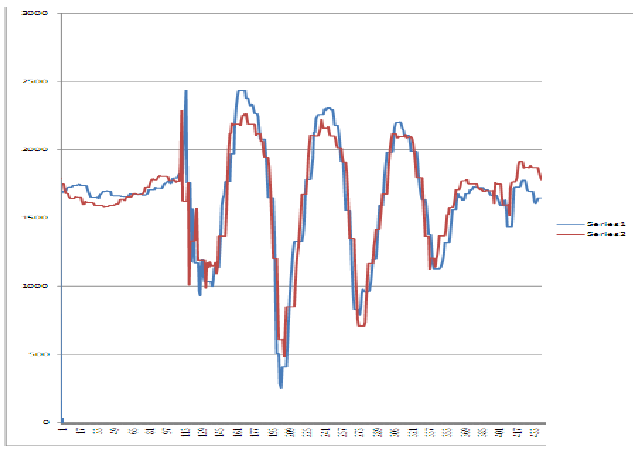 Figure 1: (a) Physical orientation of SHIMMER sensors during a handshake. (b) The characteristic rhythmic signal output from the Y-axis.
The algorithm doesn't just look for "shaking"; it looks for synchronized shaking. If person A and person B are shaking hands, their sensors will report signals with nearly identical phases and periods. If the signals do not correlate, the system ignores the motion as individual noise.
Experimental Results & Demonstration
The system was field-tested at the AICS 2009 conference.
- Workflow: Users wore sensors Data transmitted via Bluetooth Real-time analysis Automatic "Add on Facebook" email sent.
- Performance: The cross-correlation method proved effective at distinguishing intentional social greetings from idiosyncratic movements.
However, the authors noted a hardware bottleneck: when multiple pairs shake hands simultaneously, the system faced challenges in resolving exactly "who met whom" without more sophisticated proximity data (like RSSI or ultra-wideband).
Critical Insight & Future Outlook
The brilliance of this work lies in its Inductive Bias: it assumes that a social link is a synchronized event between two parties.
Limitations
- Hardware Form Factor: The 2009-era SHIMMER sensors are bulky compared to modern sleek wearables.
- Privacy: Automatic connection requests raise questions about "accidental connections" and data sovereignty.
The Future of Social Wearables
Looking ahead to 2026 and beyond, this research paves the way for "Intention-Aware" devices. Imagine a world where your smartwatch doesn't just count your steps, but understands your social orbit. The logic presented here is a direct ancestor to modern "NameDrop" features found in flagship smartphones, proving that the physical-to-digital bridge remains a vital frontier in human-computer interaction.
Takeaway
By transforming a biomechanical signal (the handshake) into a digital trigger, we can eliminate the friction of modern social networking, ensuring that a physical meeting always leaves a digital footprint.