
BNgram: Sensing the Pulse of Real-World Events through Twitter Streams
Sensing Trending Topics in Twitter
2013-06-06
Summary
Problem
Method
Results
Takeaways
Abstract
This paper presents a comparative study of six topic detection methods on Twitter streams, introducing a novel approach called BNgram. It demonstrates that leveraging n-gram co-occurrences combined with a time-dependent burstiness score (df-idf) achieves state-of-the-art results in identifying trending stories across diverse event scales.
## Executive Summary
**TL;DR**: This research tackles the "noise-to-signal" problem in social media by comparing legacy methods like LDA against newer, feature-pivot techniques. The authors find that a combination of n-gram clustering and temporal burstiness scores (BNgram) is remarkably more reliable for identifying emerging news stories than standard document-clustering or probabilistic models.
**Academic Positioning**: This work serves as a comprehensive benchmark and a methodological advancement in the Topic Detection and Tracking (TDT) field, specifically tailored for the bursty, fragmented nature of microblogging content.
## Problem & Motivation: The Chaos of the Stream
Traditional NLP tools were built for long-form, static documents. When applied to Twitter, they face three fatal hurdles:
1. **Sparsity**: A 140-character tweet lacks the co-occurrence density required for models like LDA to function effectively.
2. **Churn**: Social media topics explode and vanish in minutes; static models cannot distinguish a "persistent background topic" from a "breaking news event."
3. **Fragmentation**: The same event is often reported with slightly different wording, leading to "cluster fragmentation" in document-pivot methods.
The authors' intuition was that **n-grams** preserve بیشتری (more) context than unigrams, and that an "emerging" topic must be defined by its sudden growth compared to its historical frequency.
## Methodology: The BNgram Architecture
The core innovation is a three-pronged strategy:
### 1. The df-idf Metric
The authors modified the classic TF-IDF into a temporal version:
$$d f - i d f _ {t} = \frac {d f _ {i} + 1}{\log \left(\frac {\sum_ {j = i} ^ {t} d f _ {i - j}}{t} + 1\right) + 1}$$
This formula penalizes n-grams that were already popular in previous time slots ($t-j$), effectively "filtering out" the noise of ongoing discussions to highlight only what is *newly* trending.
### 2. Feature-Pivot Clustering
Instead of clustering tweets, BNgram clusters the keywords (features). By using n-grams, they naturally capture entities like "Mitt Romney" or "Goal by Ramires" as single units.
### 3. Named Entity Boosting
The system gives a 1.2x weight boost to n-grams containing proper nouns, recognizing that real-world events are almost always tethered to specific people, places, or organizations.
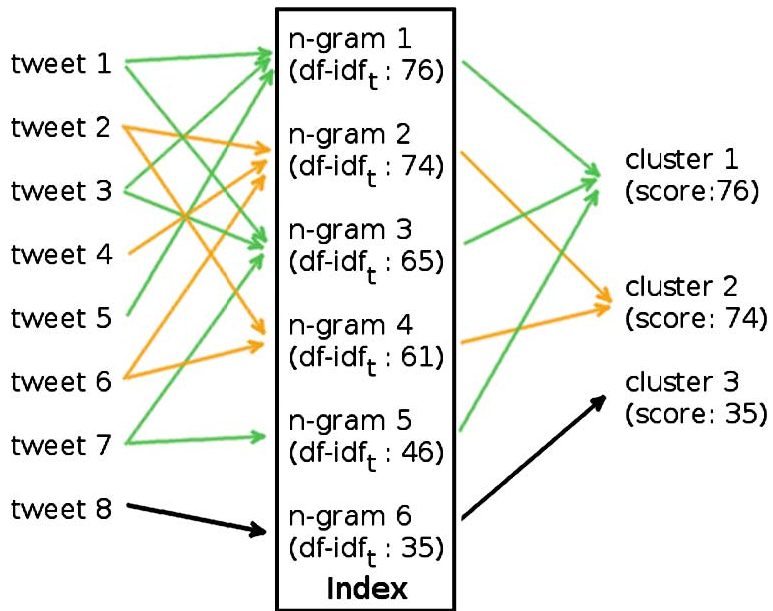
*Figure 1: Comparison of different topics and keywords across FA Cup and Elections datasets.*
## Experiments & Results: BNgram vs. The World
The researchers tested six methods: **LDA**, **Document-Pivot (Doc-p)**, **Graph-based Feature-Pivot (GFeat-p)**, **Frequent Pattern Mining (FPM)**, **Soft FPM (SFPM)**, and the proposed **BNgram**.
* **Dynamic Range**: On focused events like the "FA Cup Final," most methods performed adequately. However, on "Super Tuesday" (a noisy, multi-story event), LDA's performance collapsed to 0% recall, while BNgram maintained a 50% topic recall.
* **The Aggregation Paradox**: Interestingly, the study found that "Stemming" (reducing words to roots) consistently deteriorated results. It disrupted the specific word associations that define unique social media topics.
* **Topic vs. Time Aggregation**: Building "super-documents" by concatenating similar tweets helped Document-pivot methods but hurt others by introducing noisy word associations.
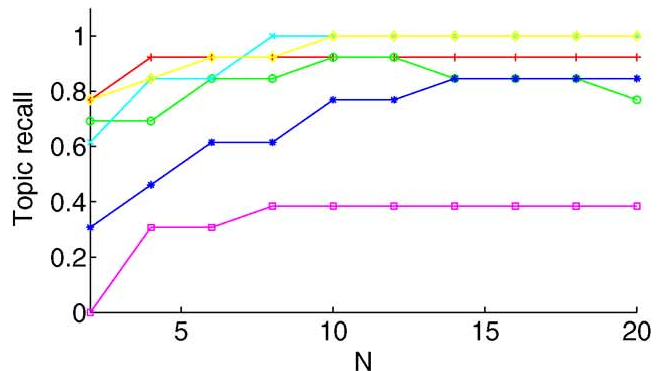
*Figure 2: Topic Recall curves showing BNgram's dominance at lower 'k' values (top results).*
## Critical Analysis & Conclusion
### Deep Insights
The success of BNgram proves that **local context (n-grams) + temporal contrast (df-idf)** is the winning formula for social sensing. It bypasses the need for the heavy computational overhead of LDA or the sensitivity to similarity thresholds found in document-pivot methods.
### Limitations
* **Scaling**: While hierarchical clustering works for top n-grams, it may struggle if the "seed filter" is too broad, leading to a computational bottleneck in the similarity matrix.
* **Depth**: The method relies on keywords; it doesn't "understand" the sentiment or the underlying narrative of the event.
### Future Outlook
This paper laid the groundwork for modern "Social Sensors." In the era of Large Language Models (LLMs), these n-gram and burstiness principles are still vital for efficiently filtering the massive "data haystack" before feeding refined snippets into expensive generative models for summarization.
**Takeaway**: If you want to find the news on Twitter, stop looking for similar documents—start looking for "exploding" phrases.