
Sensing, Understanding, and Shaping Social Behavior: The Power of Computational Trust
Sensing, Understanding, and Shaping Social Behavior
This paper explores the emerging field of computational social systems, focusing on using passive mobile sensing to sense, understand, and shape human behavior. It centers on a large-scale case study—the "Friends and Family" dataset—to quantify interpersonal trust and demonstrates its superior effectiveness over simple "closeness of ties" in driving social persuasion and behavior change.
Executive Summary
TL;DR
This seminal work by Erez Shmueli and the MIT Media Lab group shifts the focus of social computing from the "cyber world" to the "physical world." By analyzing call logs, SMS, and Bluetooth signals, the researchers successfully predicted interpersonal trust and proved that it is the "secret sauce" for behavioral change. If you want someone to exercise more or change their habits, it’s not enough to be their friend—they must trust you.
Academic Positioning
The paper acts as both a functional survey of the field and a specific case study. It sits at the intersection of Computational Social Science and Persuasive Computing, moving beyond simple activity recognition to high-level social construct modeling.
Problem & Motivation: The Gap Between Cyber and Real-World Behavior
Most social influence research happens on platforms like Twitter or Facebook. However, the authors argue that "cyber identities" are often adopted and can contrast sharply with real-world behavior.
While social psychology has long studied trust, it typically uses subjective surveys. This paper asks a bold question: Can we see trust in the data? And more importantly, does trust actually change how we respond to social pressure?
Methodology: Operationalizing the "Elephant" in the Room
Trust is notoriously hard to define—the authors cite 72 different definitions. To solve this, they "operationalized" it into three actionable real-world questions:
- Health: Would you ask this person for help in sickness?
- Finance: Would you ask this person for a $100 loan?
- Family: Would you ask this person to babysit?
Architecture of Prediction
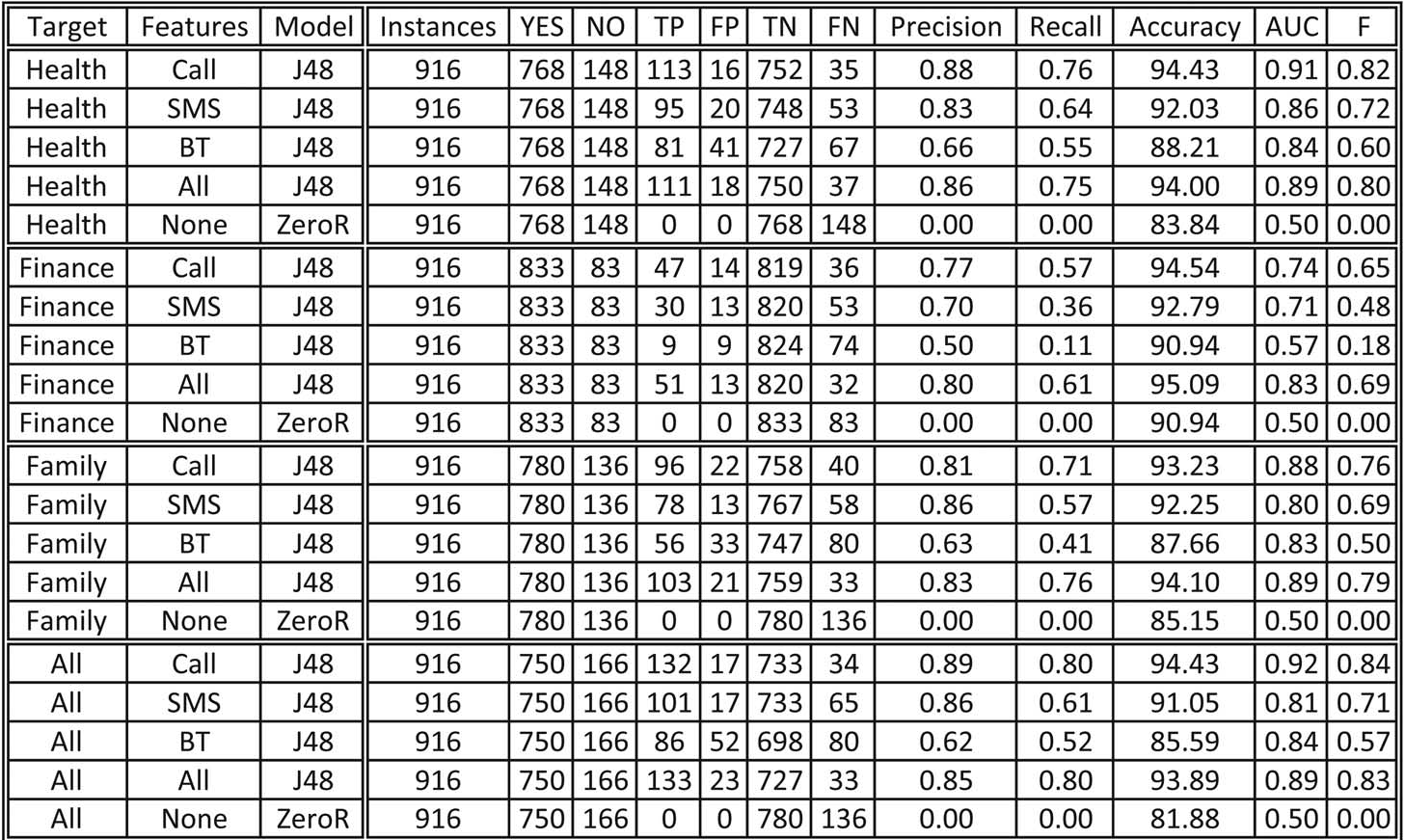
The team used the "Friends and Family" dataset (130 participants, 1 year) to extract six social-behavioral features across three modalities:
- Calls: Synchronous distant interaction.
- SMS: Asynchronous textual interaction.
- Bluetooth (BT): Physical co-location.
Experiments & Results: Trust vs. Closeness
The result was a revelation for the "social influence" community.
1. Predicting Trust
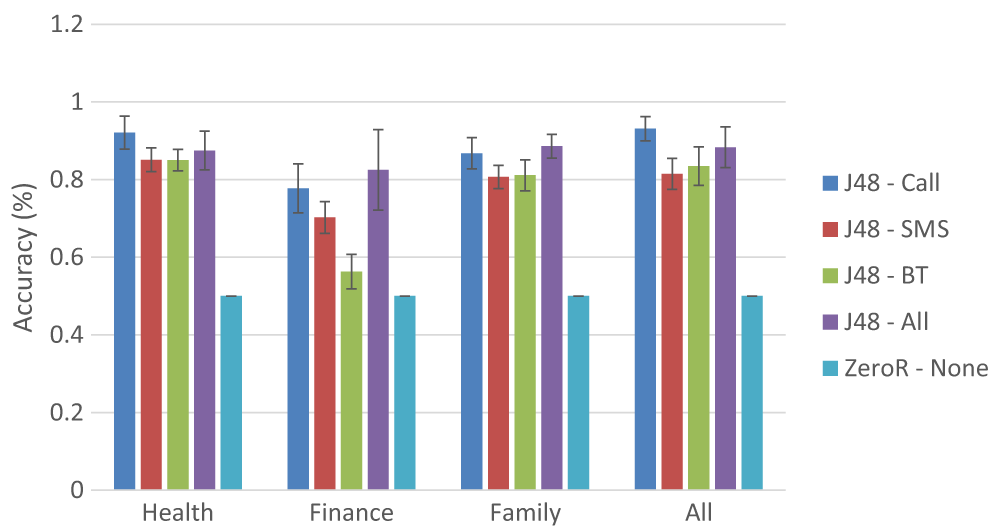
Call logs were the strongest predictors of trust, achieving AUC scores above 0.90. Interestingly, Bluetooth (proximity) was the weakest. The insight here is profound: Face-to-face interaction can happen by chance, but a phone call is an explicit choice.
2. Shaping Behavior (The FunFit Experiment)
In a physical activity intervention, the researchers compared "Closeness" (how much I like you) vs. "Trust" (as defined by the sickness/loan/babysitting metrics).
- The Trust Factor: Subjects with at least one trusted buddy saw a 4.95% increase in activity adherence.
- The Closeness Factor: Subjects with at least one close buddy saw an improvement of only 0.02%.
Critical Analysis & Conclusion
Takeaway
The core contribution of this work is the empirical proof that trust is a measurable, computational variable that mediates social influence far more effectively than simple tie strength or interaction frequency.
Limitations
The community was somewhat homogeneous (married graduate students). In a more diverse or transient population, the "signals" of trust might look different. Furthermore, the reliance on hashed metadata (to protect privacy) prevents us from understanding the content of interactions, which might refine the trust model even further.
Future Outlook
As we move toward a "mobile-first" society, these findings suggest that "Health" and "Productivity" apps should focus on identifying a user's trusted circle rather than their broadest social circle to maximize the impact of "nudges." The future of computational social systems lies in sensing these "Honest Signals" to build more effective, data-driven societies.