
Thwarting Re-identification: Sensitive Label Protection in Multi-Social Networks
Sensitive Labels Matching Privacy Protection in Multi-Social Networks
This paper introduces a privacy protection framework for multi-social networks to defend against "combination degree-neighborhood label matching attacks." It proposes the Group Graph Sensitive Label Generalization L-diversity algorithm, which achieves SOTA results in preventing sensitive information leakage while preserving graph utility.
TL;DR
As users participate in multiple social platforms (Twitter, Facebook, LinkedIn), their "digital footprint" becomes a unique fingerprint. This paper introduces a sophisticated Sensitive Label Generalization L-diversity algorithm designed to prevent attackers from linking identities across networks using degree and neighborhood labels. By intelligently merging labels and adding minimal noise, the method ensures that any sensitive attribute remains indistinguishable among at least candidates.
Background: The Danger of Cross-Network Fingerprinting
In the era of Big Data, simply removing a name from a social graph (De-identification) is insufficient. Attackers often possess "Background Knowledge"—they might know your number of friends (degree) and the professions of those friends (neighborhood labels).
The authors identify a specific threat: the Combination Degree-Neighborhood Label Matching Attack. If Alice is a "Nurse" and her unique pattern of neighbors identifies her across two different anonymized graphs, her sensitive profession is leaked.
Methodology: The Hierarchical Defense
The core of the solution lies in making sensitive labels "blurry" enough to prevent a unique match but "clear" enough to remain useful for data analysis.
1. Label Generalization Tree
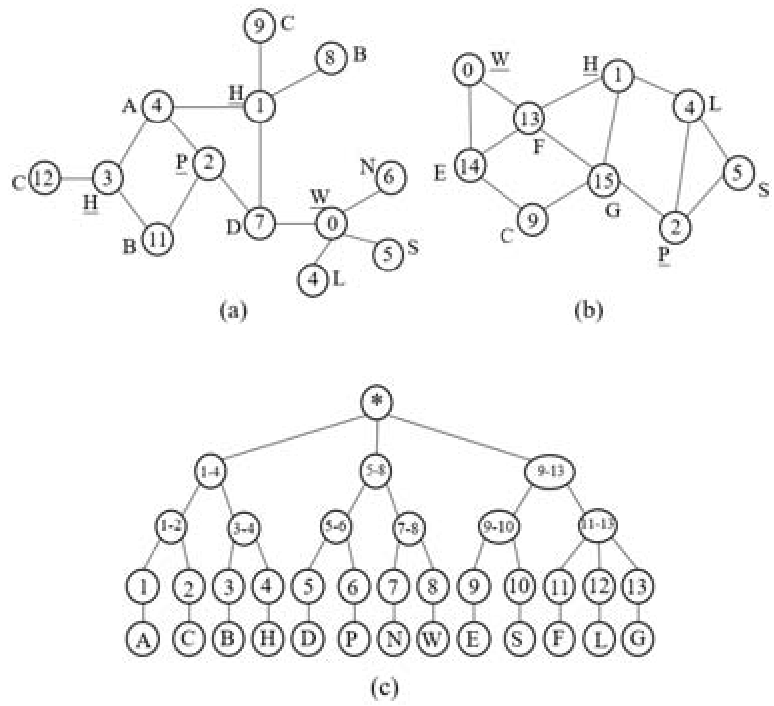
Instead of categorical suppression, the paper uses a hierarchical tree. For example, "Java Programming" generalizes to "Computer Books," which generalizes to "Books." Sensitive labels are replaced with their parent nodes in the tree.
2. Vertex Grouping and Assimilation
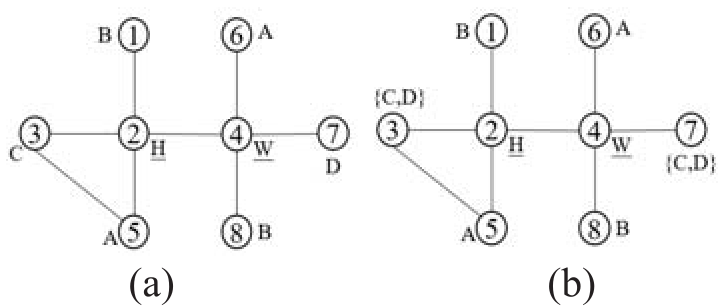
The algorithm groups vertices based on neighborhood similarity. To ensure that all vertices in a group of size look identical to an attacker, the authors use three operations:
- Label Alliance: Creating "super-labels" (unions of attributes).
- Edge Insertion: Connecting nodes to missing neighbor types.
- Noise Vertex Addition: Adding "dummy" nodes to balance the neighborhood distribution.
Experimental Insights
The researchers tested their approach on three diverse datasets, including real-world traces from Facebook and Twitter.
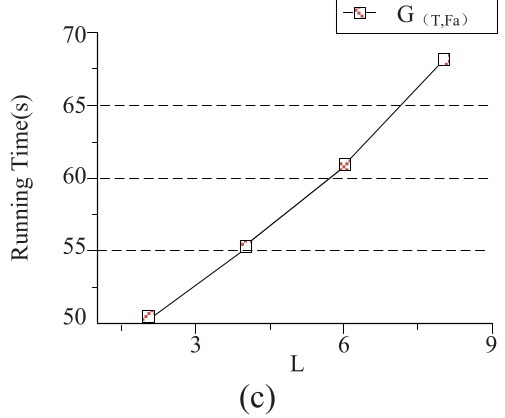
- Efficiency: Running time scales linearly with and the number of vertices, making it feasible for large-scale social graphs.
- Utility Trade-off: The Average Clustering Coefficient (ACC) and Average Path Length (APL) were used to measure data utility. While adding noise naturally reduces the APL, the overall structural integrity of the graph remains robust for reasonable values of (e.g., to ).
- Edge Changed Rate (ECR): Larger datasets require more modifications to reach L-diversity, showing that privacy "costs" more in denser, more complex networks.
Critical Analysis & Conclusion
This work provides a robust mathematical foundation for "Group Graph" privacy. Its strength lies in the Label Alliance concept, which avoids the data loss associated with traditional attribute suppression.
Limitations: The reliance on a predefined generalization tree assumes that such a hierarchy is readily available for all sensitive attributes. Furthermore, as increases, the "noise" might distort community structures which are vital for some graph mining tasks.
Future Outlook: As we move toward more integrated AI-driven social analysis, techniques like these will be essential for "Privacy-Preserving Machine Learning" on graphs, ensuring that global insights can be drawn without sacrificing individual confidentiality.